
CBN Data Localisation: The Engineering Playbook for Moving Payment Data to Nigeria Before 1 January 2027
A practical engineering playbook for the CBN payment data localisation rule: what counts, where data hides, backups and cloud, a six-step migration and a six-week plan.
Short answer: from 1 January 2027, payment transaction data generated in Nigeria has to be stored and managed in Nigeria. That includes copies in backups, disaster recovery sites, archives, logs and replicated databases, not just your main database [1][2]. Public cloud is still allowed, provided the data stays in-country and you can prove it [2]. With roughly six weeks to go, the fastest safe route is a full inventory of every copy of payment data, a target architecture agreed with your counsel, and a dual-run cutover with an evidence pack your auditors can use.
This playbook is written for the engineers, CTOs and compliance officers who have to make that happen. It is not legal advice. Read the circular and the CBN's FAQ with your counsel, then use this guide to turn their reading into a migration plan that ships on time.
What the CBN circular actually says
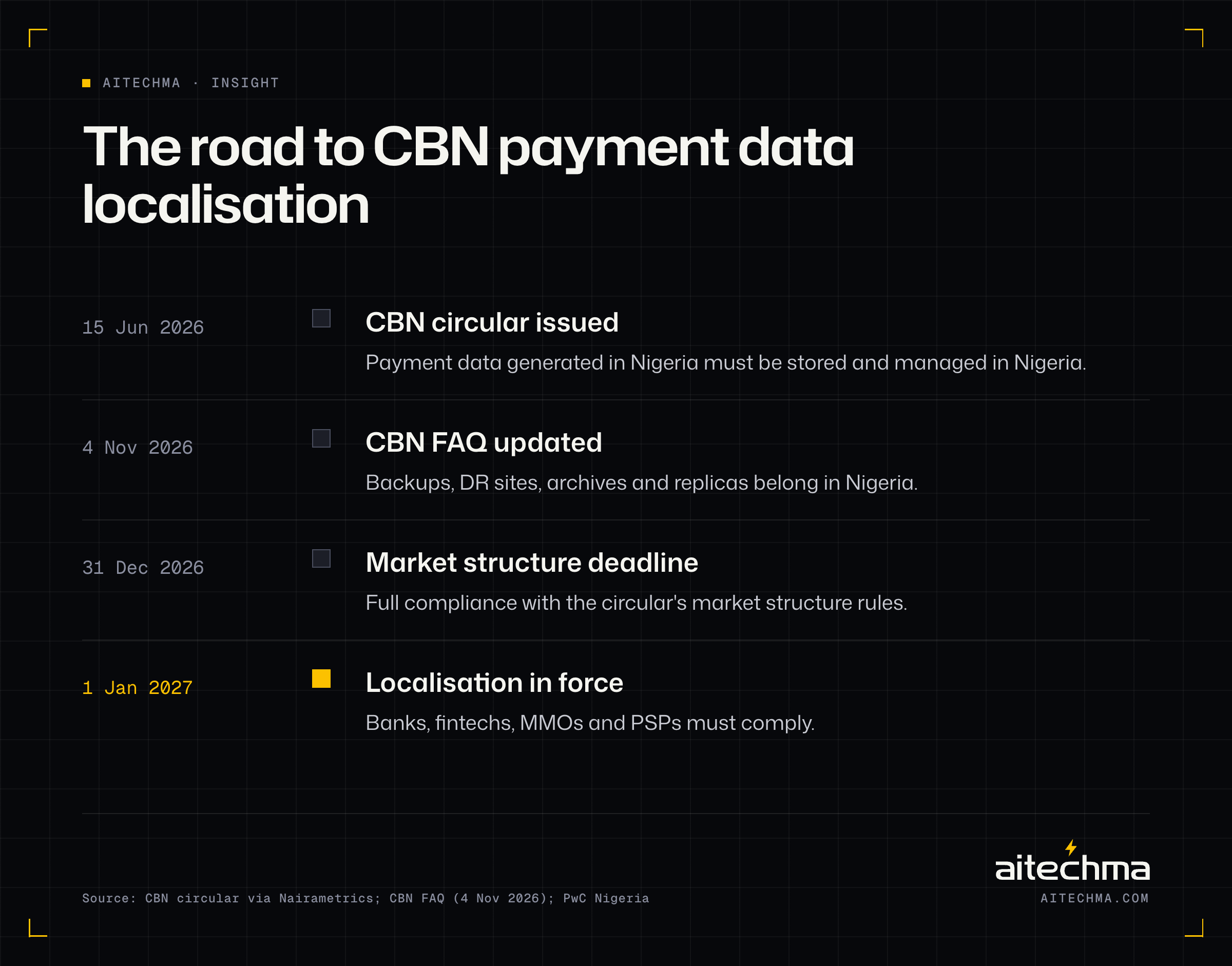
On 15 June 2026 the Central Bank of Nigeria's Payments System Supervision Department issued a circular (reference PSS/DIR/PUB/CIR/001/004) requiring banks, fintechs, mobile money operators and other payment service providers to store and manage payment transaction data generated in Nigeria within Nigeria [1][3]. The requirement takes full effect on 1 January 2027 [1].
Three details matter more than the headline:
The test is where the data is generated, not where your company is registered. A UK or US company processing Nigerian payments is in scope for that Nigerian data, just as a Lagos-registered fintech is [3].
The same circular carries other rules. It also covers ultimate beneficial ownership disclosure and market structure, with full compliance on market structure due by 31 December 2026, one day before localisation applies [4].
The CBN intends to supervise it. The bank has said it will monitor compliance closely and apply supervisory sanctions where necessary [6]. Its updated FAQ expects institutions to demonstrate compliance continuously, not only when examiners visit [2].
The CBN published an updated FAQ on 4 November 2026 [2]. If you read only one primary document after the circular, read that one. It answers the questions most engineering teams have been arguing about since June, especially on backups, disaster recovery and cloud.
Who is in scope
The circular names banks, fintechs, mobile money operators and payment service providers [1]. In practice, if your systems create, process or hold records of payments made through Nigeria's payment system, assume you are in scope until your counsel tells you otherwise. That includes:
Commercial, merchant and microfinance banks, including their digital channels.
Payment service providers, switches, processors and gateways.
Mobile money operators and payment service banks.
Fintechs running wallets, lending, savings, bill payments or card programmes, whether licensed directly or operating through a partner bank. If you are building one of these, our wallet and payments and lending teams design for localisation from the first sprint.
Foreign companies serving Nigerian users through a local licence or partnership. See our guide to entering the Nigerian market.
What counts as "payment transaction data"
Here is the uncomfortable part: the circular does not define payment transaction data, and detailed implementation guidance is limited [3]. Law firms and advisers have filled the gap with a sensible working definition: records of card payments, bank transfers, mobile money, POS transactions and online gateway payments generated through Nigeria's payment system [3][5].
The CBN's FAQ widens the practical scope. It lists backup and recovery repositories, replicated datasets, disaster recovery environments, archives, and security logs and fraud monitoring information among the datasets that matter for compliance [2]. That last item surprises many teams: if your fraud engine or SIEM ingests payment events, those copies count too.
For engineering purposes, we recommend treating a record as in scope if it contains any of the following:
Transaction identifiers, amounts, timestamps, status or narration.
Payer or payee identifiers: account numbers, wallet IDs, card tokens or masked PANs, BVN or NIN references.
Device, location or IP data captured with a payment.
Derived data that can be joined back to a specific payment, such as risk scores, chargeback records and reconciliation entries.
When in doubt, classify it as in scope and let your counsel narrow it. Narrowing scope later is cheap. Discovering an out-of-scope copy in a regulator's sample is not.
Where payment data hides
The core transaction database is the easy part. Every team we have worked with knows where it lives. The risk sits in the copies nobody designed: the places payment data ends up because a developer added a log line, a vendor SDK, or a nightly export three years ago.
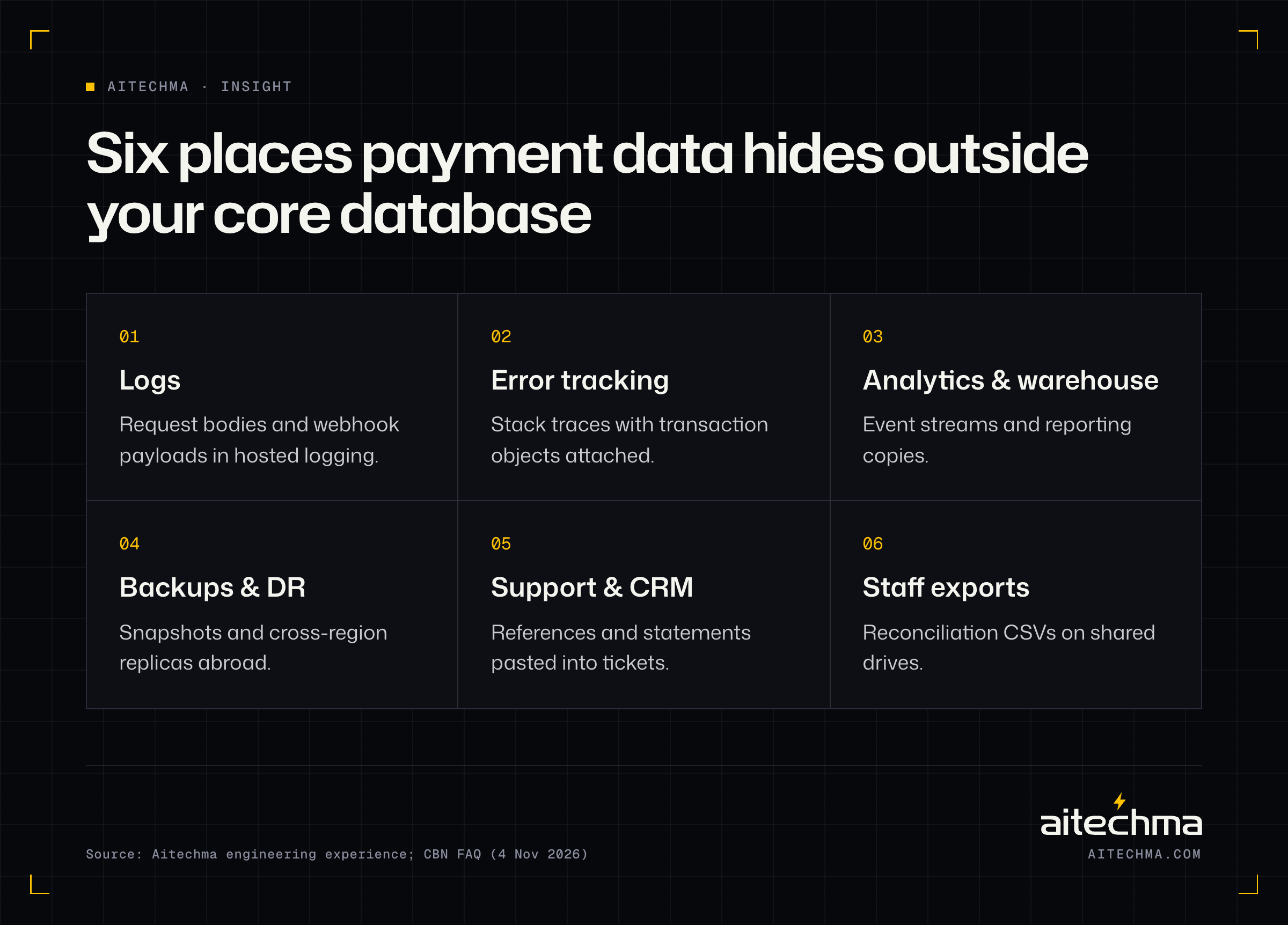
These are the six places we find offshore copies most often:
Application and access logs. Request and response bodies, webhook payloads and error messages shipped to a hosted logging service abroad.
Error tracking and APM. Exception trackers and performance tools capture stack traces with transaction payloads attached by default.
Product analytics and data warehouses. Event streams sent to analytics vendors, plus warehouse copies built for finance, growth or investor reporting.
Backups and disaster recovery. Snapshots and cross-region replicas, often configured once and forgotten, sitting in a European or US region.
Support and CRM tools. Customer support desks, chat tools and CRMs where agents paste transaction references, screenshots and statements.
Staff exports and shared drives. CSV exports for reconciliation, finance or audits, saved to personal drives and collaboration tools.
The CBN's FAQ is explicit that localisation cannot be fully achieved if regulated payment data is routinely retained outside Nigeria through backup, archival, replication or disaster recovery arrangements [2]. That makes the hidden copies a compliance problem, not just a hygiene one.
How to find them
Do not rely on architecture diagrams. They show what was designed, not what exists. Use evidence instead:
Egress review. List every outbound destination your production network talks to over two weeks: domains, IP ranges and the services behind them. Each one is a potential copy.
Vendor inventory. Pull every SaaS contract and invoice from finance, not just the ones engineering remembers. Ask each vendor where data is stored and processed, including sub-processors.
Code search. Search your repositories for SDK initialisations, webhook senders, export jobs and anything that serialises a transaction object.
Cloud inventory. List every bucket, database, snapshot and replica across all regions and accounts, including old projects nobody owns.
People. Ask finance, support, risk and growth teams which tools they use for payment data. They always know about one the engineers do not.
The output is a data-flow diagram and an inventory spreadsheet: every system, what payment data it holds, where it is physically stored, who owns it and what the plan is. That inventory becomes the backbone of your evidence pack.
Backups, disaster recovery and replicas
This is the requirement that changes architectures the most, and the one commentators describe as the hardest to meet [10][11].
The CBN's FAQ says backup environments, disaster recovery sites, archives, business continuity repositories and replicated databases should all be located within Nigeria [2]. Many Nigerian payment companies currently use a European or South African cloud region as their disaster recovery site precisely because it is outside Nigeria. Under the circular, that design no longer works for payment data.
What compliant resilience looks like in practice:
Two locations inside Nigeria. A primary and a secondary site in different facilities, ideally different operators, so one power or connectivity incident does not take both down.
Recovery objectives you have tested. Written recovery time and recovery point objectives, and a restore drill you have actually run against the Nigerian secondary.
Encrypted, in-country backups. Backups stored in Nigeria, encrypted with keys you control, with retention matched to your regulatory obligations.
No silent cross-border replication. Database, object storage and log replication rules checked so nothing quietly copies to an offshore region.
Industry analysts have warned that local data centre capacity and disaster recovery readiness are real constraints [11]. That is a reason to book capacity now, not a reason to wait.
Can you still use AWS, Azure or Google Cloud?
Yes, with conditions. The CBN's FAQ takes a technology-neutral position: public, private, hybrid, community and multi-cloud models can be used, provided they meet the localisation, cybersecurity, resilience, auditability and regulatory-access requirements in the circular [2]. Legal commentators agree that the rule is not a general ban on international cloud providers [5].
The constraint is physical location. As of late 2026, Nigeria does not have a full in-country region from Microsoft Azure or Google Cloud, and AWS's local presence is a Local Zone in Lagos rather than a full region [8]. A Local Zone extends a parent region; you need to check carefully which services run in Lagos and which control-plane functions, backups or managed features still depend on the parent region abroad.
That leaves three realistic hosting routes:
Hyperscaler services that run in Nigeria. Use the services available locally for compute and storage of payment data, and confirm in writing where every managed feature stores data.
Nigerian data centres and local cloud providers. Colocation and local cloud from operators such as Rack Centre, Open Access Data Centres, MainOne (Equinix), Africa Data Centres and Galaxy Backbone, all of which are expanding capacity [8].
Hybrid. Payment data and its copies in Nigeria, with non-payment workloads (marketing site, internal tools, anonymised analytics) staying where they are.
Nigerian institutions currently spend heavily on foreign cloud. One estimate puts the spend that the rule could shift onshore at around $850 million [9], and BusinessDay reported that the vast majority of banks and fintechs face some degree of foreign cloud exit [10]. Demand for local capacity will rise sharply in December. Contract early.
Questions to ask any hosting provider
Where exactly, by facility, will our payment data, backups and logs be stored?
Which managed services or features store data or metadata outside Nigeria?
Can we hold our own encryption keys, and where do key management services run?
What are your power, cooling and connectivity redundancies, and your uptime history?
How do you support regulator access and audits, and what evidence can you provide?
What are the exit terms if we need to move again?
Localisation and the NDPA: two regimes, not one
The circular complements the Nigeria Data Protection Act 2023 rather than replacing it [5]. Payment companies now work under both: the CBN rule says where payment data must live, and the NDPA governs how personal data is processed, protected and transferred [12].
In engineering terms, that means:
Your localisation project should produce NDPA evidence too. The same data map supports your records of processing and data protection impact assessments.
Cross-border transfers of non-payment personal data still need a lawful basis. Moving payment data home does not settle the status of customer emails in your marketing tool.
Minimisation reduces both burdens. Every field you stop collecting or start masking is one less thing to localise and protect.
The six-step migration playbook
This is the sequence we use for payment data localisation. It is designed to move fast without risking downtime or data loss.
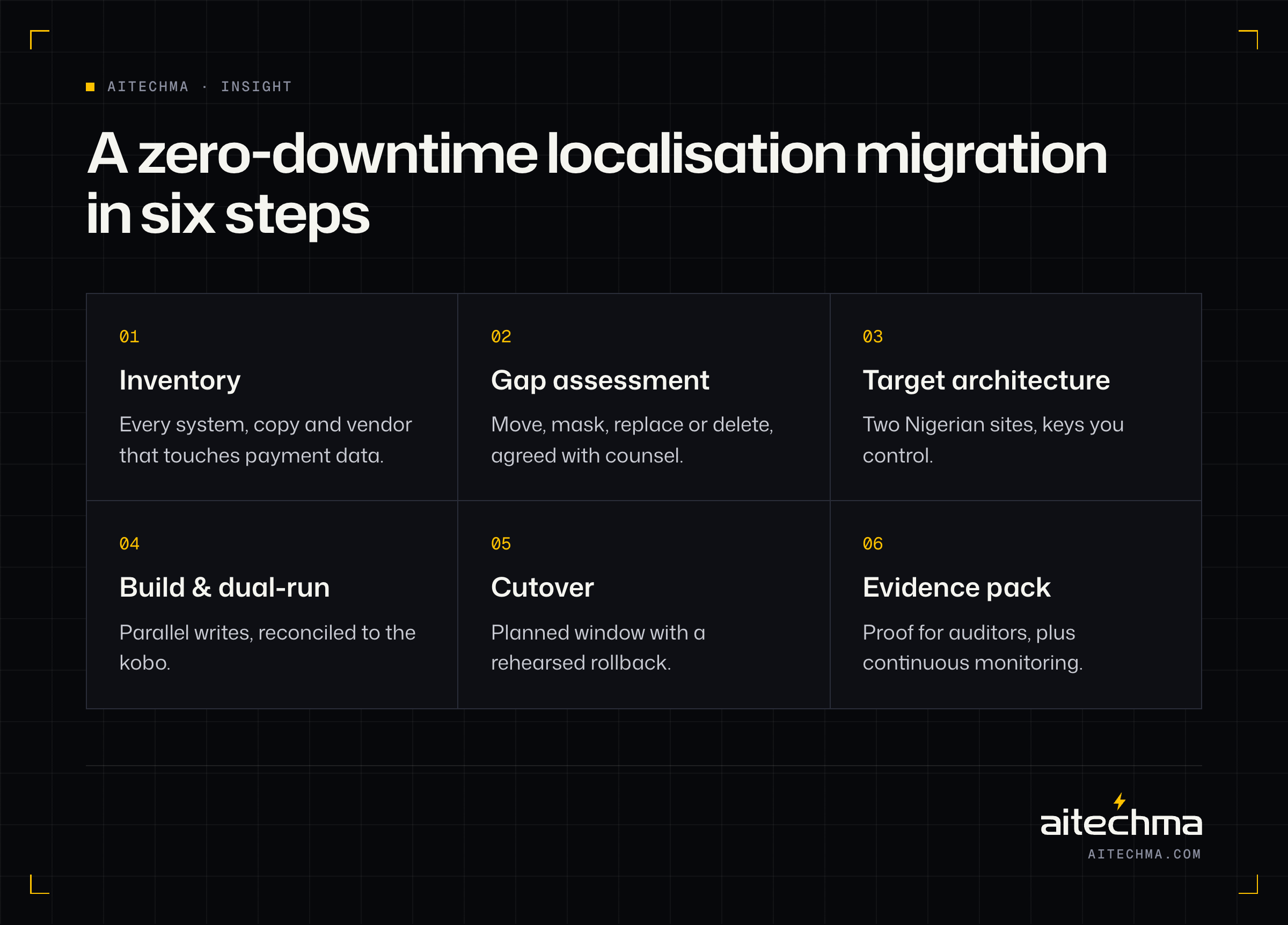
1. Inventory
Build the data-flow diagram and inventory described above. For each system record what payment data it holds, where it is stored and processed, who owns it, how it gets there and what depends on it. Expect this to surface between five and fifteen systems beyond your core database in a typical fintech.
Deliverable: a signed-off inventory and data-flow diagram.
2. Gap assessment
Review the inventory with your compliance officer and counsel against the circular and the FAQ. For each item decide one of four outcomes: move it to Nigeria, mask it so it no longer contains payment data, replace the vendor with a local or in-country option, or delete it.
Deliverable: a gap register with an owner, decision and date for every item.
3. Target architecture
Design where each workload will run after the migration, how data will be replicated within Nigeria, and how non-payment workloads connect to it. Decide your primary and secondary sites, key management, network links and the recovery objectives you will test against.
Deliverable: a target architecture document and a costed bill of materials.
4. Build and dual-run
Stand up the in-country infrastructure, then run old and new environments in parallel. Write to both, reconcile continuously and compare results until they match. For ledgers and balances, reconciliation must be exact to the kobo before you cut over. Our backend engineering team treats this as a payments problem, not an infrastructure one.
Deliverable: a parallel environment with daily reconciliation reports.
5. Cutover
Switch traffic to the Nigerian environment in a planned window, with a rollback plan you have rehearsed. Then decommission, mask or delete the offshore copies, and capture proof that you did.
Deliverable: a cutover report, rollback rehearsal record and decommissioning evidence.
6. Evidence pack
Assemble the documentation your compliance officer can hand to auditors and the CBN: the inventory, data-flow diagrams, hosting contracts with facility locations, configuration evidence, access controls, restore-drill results and the decommissioning record. Then set up monitoring that alerts when a new offshore copy appears, because the FAQ expects continuous compliance [2].
Deliverable: an evidence pack and continuous monitoring.
A realistic six-week plan to 1 January 2027
If you start in mid-November, you have about six weeks, including the Christmas and New Year holidays. That is tight but workable for most mid-sized fintechs if you start with the riskiest copies and run workstreams in parallel.
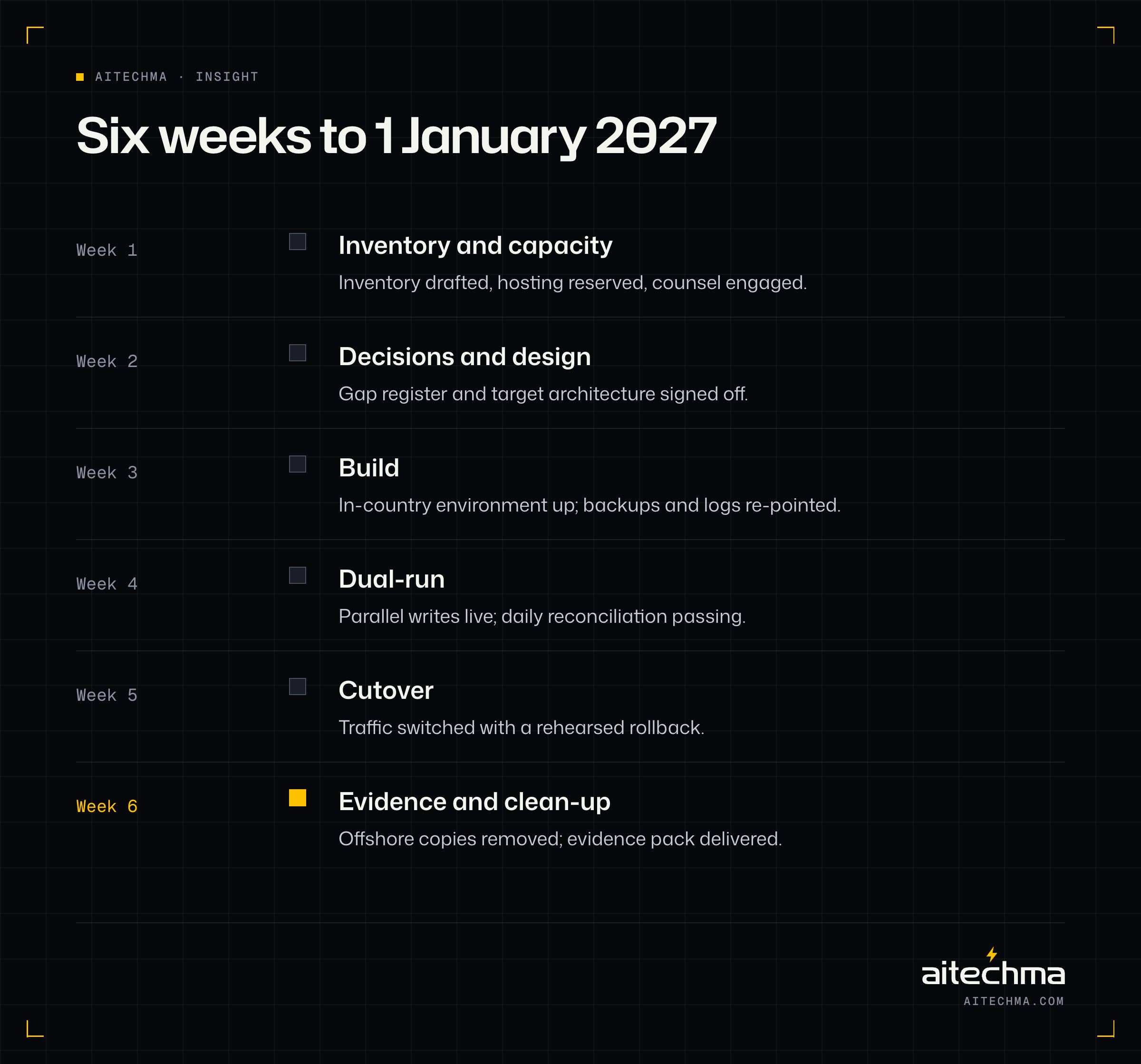
Week | Focus | What done looks like |
|---|---|---|
Week 1 | Inventory and capacity | Inventory drafted, hosting capacity reserved, counsel engaged |
Week 2 | Gap decisions and design | Gap register signed off, target architecture agreed |
Week 3 | Build | In-country environment provisioned, backups and logging re-pointed |
Week 4 | Dual-run | Parallel writes live, daily reconciliation passing |
Week 5 | Cutover | Traffic switched, rollback rehearsed, vendors replaced or masked |
Week 6 | Evidence and clean-up | Offshore copies removed, evidence pack delivered, monitoring live |
Two practical rules for the holiday period: freeze unrelated releases from week 4 so your team is not fighting two fires, and agree on-call cover with your hosting provider before 20 December.
If six weeks is not enough for your full estate, prioritise. Get the core transaction data, backups and disaster recovery into Nigeria first, mask payment data in logs and analytics immediately, and document a dated plan for the remainder. Discuss that plan with your counsel and, where appropriate, your supervisors. A credible, evidenced plan is far stronger than silence.
Three architecture patterns
There is no single right answer. These are the three patterns we see most, compared on what matters.
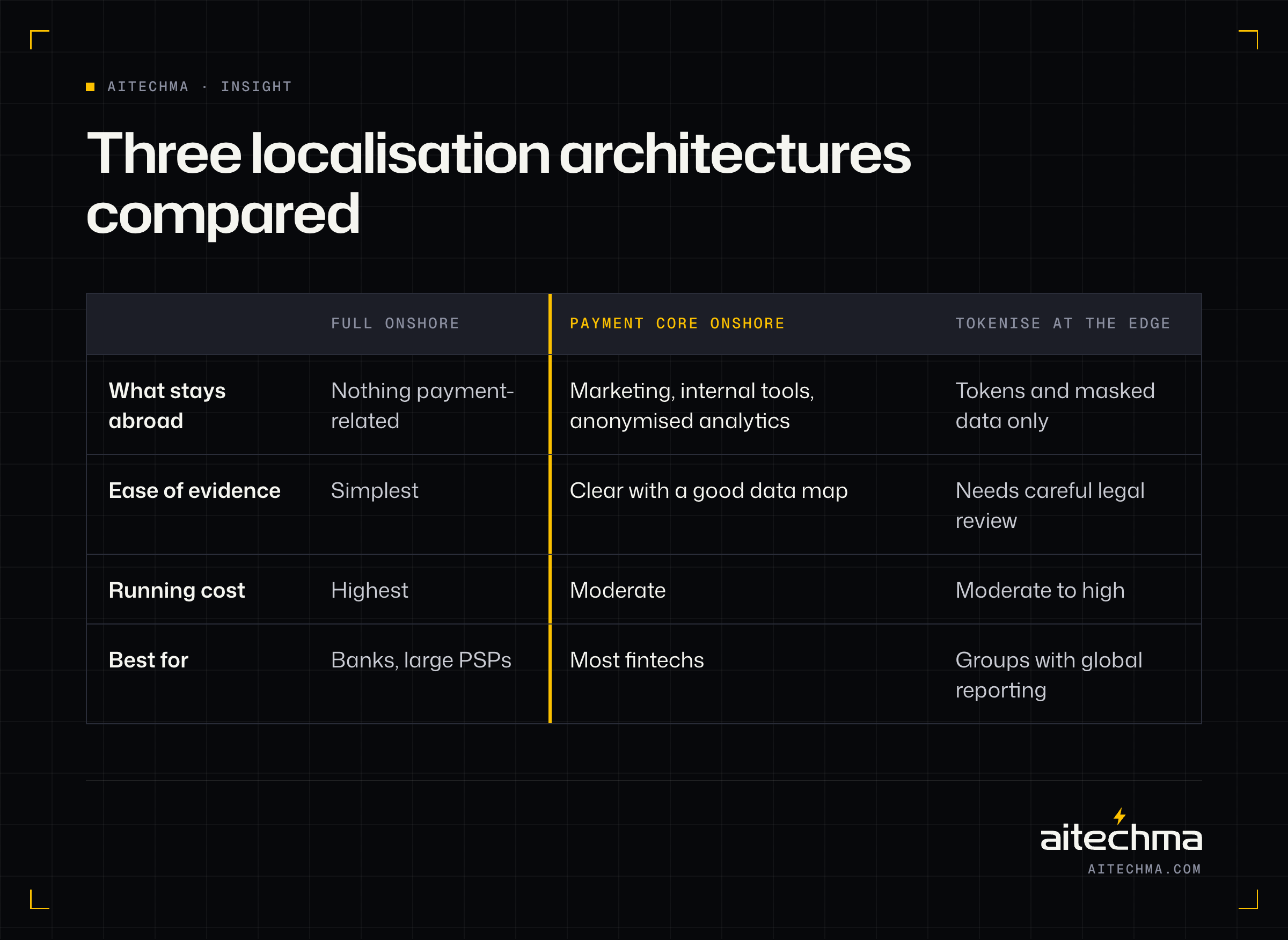
Pattern A: full onshore. Everything that touches payments runs in Nigeria: application, databases, queues, logs and backups. It is the simplest to evidence and the most expensive to operate, especially for teams used to a broad hyperscaler service catalogue.
Pattern B: payment core onshore, the rest global. The payment core (ledger, transaction processing, card and transfer integrations, their logs and backups) runs in Nigeria. Marketing, internal tools and anonymised analytics stay on global cloud. This is where most fintechs will land: compliant for payment data, with lower cost and less disruption.
Pattern C: tokenise at the edge. Payment data is stored and processed in Nigeria, and only tokens or irreversibly masked data leave the country for global analytics or group reporting. It needs careful design and legal review, because a token that can be re-identified offshore is still payment data in practice.
What it costs, and how to budget
Costs vary widely with data volume, number of systems and how much you can reuse. These are the cost lines to put in front of your finance team:
Assessment and design. A fixed-price readiness assessment covering inventory, gap register and target architecture. Ours start from $2,500 and take one to two weeks; see our data localisation service for details.
Migration engineering. Building the in-country environment, dual-run, cutover and decommissioning. Ours typically start from $12,000 and take four to eight weeks.
Hosting. Colocation or local cloud for primary and secondary sites, plus connectivity. Expect local capacity to be more expensive per unit than global hyperscalers at first, and prices to firm up as demand rises.
Vendor changes. Replacing or reconfiguring logging, analytics and support tools that cannot keep data in Nigeria.
Ongoing operations. Monitoring, restore drills, audits and the evidence pack, every year.
Use our project estimator for a quick range on any rebuild work, and get a fixed quote once the assessment is done.
Seven mistakes we see teams make
Moving the database and forgetting the copies. Logs, analytics and backups are where most offshore payment data lives.
Assuming a Local Zone is a region. Check every managed feature for dependencies on the parent region abroad.
Leaving disaster recovery abroad. The FAQ is explicit that DR, backups and replicas belong in Nigeria [2].
Treating it as an infrastructure ticket. Ledgers, reconciliation and idempotency make this a payments engineering problem.
Cutting over without a rehearsed rollback. Rehearse it, time it and write it down.
No evidence. If you cannot show it, you cannot prove it. Capture evidence as you go, not afterwards.
Waiting for perfect guidance. The definition gaps are real [3], but the direction is clear. Work with your counsel's reasonable reading and document it.
What to tell your board and auditors
Boards and auditors want three things: that you understand the obligation, that you have a credible plan, and that you can prove progress. A one-page summary should cover:
The obligation. Payment data generated in Nigeria stored and managed in Nigeria from 1 January 2027, including backups, DR, archives and logs [1][2].
The exposure. How many systems hold payment data offshore today, and which carry the most volume or risk.
The plan. The six steps, owners, dates and budget.
The evidence. What will be in the evidence pack and when it will be ready.
The residual risk. Anything that will not be complete by the deadline, the reason, and the dated plan to finish it.
A worked example: a wallet fintech's migration
To make the playbook concrete, here is how the six steps play out for a typical mid-sized Nigerian wallet business. The details are illustrative, not a specific client, but every element is something we see regularly.
The company runs a consumer wallet with bill payments, transfers and virtual accounts. Its stack sits in a European cloud region: a managed Postgres database for the ledger, a message queue for transfers, a container platform for the API, object storage for statements and KYC documents, a hosted logging service, an exception tracker, a product analytics tool, a data warehouse used by finance and a support desk used by twenty agents. Disaster recovery is a cross-region replica in a second European region.
Inventory (week 1). The egress review finds fourteen outbound destinations, four more than the architecture diagram shows. Two are forgotten: an old SMS provider that still receives transaction alerts, and a BI tool a former finance lead connected to the warehouse. Code search finds full transfer payloads in error logs and webhook bodies in access logs. Finance confirms reconciliation exports are saved to a shared drive every morning.
Gap assessment (week 2). With counsel, the team classifies each item. The ledger, queue, object storage, backups and DR replica must move. Logs and exception traces will be masked at source so payment fields never leave the application, then re-pointed to an in-country logging stack. Product analytics will receive only anonymised, aggregated events. The data warehouse moves to Nigeria. The support desk stays, but agents get an internal look-up tool so they never paste transaction details into tickets. The SMS provider and the forgotten BI tool are switched off.
Target architecture (week 2). Primary site in a Lagos data centre, secondary site with a different operator, both running the same container platform. Postgres with synchronous replication between the two Nigerian sites, nightly encrypted backups to object storage in Nigeria, and keys held in an in-country key management service the company controls. The marketing website and internal wiki stay on global cloud.
Build and dual-run (weeks 3 to 4). The new environment goes live in parallel. Transfers are written to both ledgers, and a reconciliation job compares balances, transaction counts and hashes of every entry every hour. Two mismatches appear in the first week, both caused by retries that the old system handled with a different idempotency window. They are fixed before cutover.
Cutover (week 5). A two-hour window on a Sunday morning. Traffic switches to the Nigerian environment, the old ledger becomes read-only, and the team runs the reconciliation one last time. The rollback plan, rehearsed twice the week before, is not needed.
Evidence pack (week 6). The pack contains the inventory, before-and-after data-flow diagrams, facility addresses from hosting contracts, configuration screenshots showing no cross-border replication, the restore-drill report from the secondary site, vendor confirmations and deletion certificates for the European copies. Monitoring now alerts the on-call engineer if any service starts sending payment fields to a new external destination.
The point of the example is not that every migration is this neat. It is that the order matters. Teams that start with infrastructure and leave the inventory until later usually find the forgotten copies after cutover, which is the most expensive time to find them.
Logging, monitoring and observability onshore
Observability is where most teams leak payment data without noticing, because logging tools are designed to capture everything. You have two complementary options, and most teams need both.
Mask at the source. Add a logging filter in every service that removes or masks payment fields before a log line is written: account numbers, card tokens, amounts tied to identifiers, BVN and NIN references, narrations and full request or response bodies for payment endpoints. Do the same in your exception tracker's before-send hook. Once payment data never enters logs, the location of your logging vendor matters far less for this rule, although your counsel should confirm that reading.
Run an in-country stack for what must stay. Some logs need payment context: fraud investigation, dispute handling and audit trails. Keep those in an in-country logging and search stack, with retention and access controls agreed with your compliance team. Open-source stacks run well on Nigerian infrastructure and keep costs predictable.
Whichever you choose, test it. Send synthetic transactions through every endpoint and search every external tool for their identifiers. If any appear, the masking is incomplete.
Encryption and key management
Localisation is about where data lives, but auditors will also ask who can read it. Encryption with keys you control strengthens both your localisation evidence and your NDPA position.
Encrypt at rest and in transit everywhere. Databases, object storage, backups, queues and the links between your Nigerian sites.
Hold keys in Nigeria, under your control. If a key management service runs abroad, an offshore party can effectively unlock your data. Prefer in-country key management or hardware security modules you operate.
Separate duties. The people who administer infrastructure should not automatically hold the keys to decrypt payment data.
Rotate and record. Document key rotation schedules and keep evidence that rotations happened.
Plan for backups. Encrypted backups are only useful if the keys to restore them are also available in Nigeria during an incident. Test that in your restore drill.
Vendor decisions at a glance
Most of the work in a localisation project is deciding what to do with each third-party tool. This table shows the decisions we see most often. Your counsel should confirm each one for your licence.
Tool type | Typical issue | Usual decision |
|---|---|---|
Hosted logging | Full payloads in logs stored abroad | Mask at source, move payment logs onshore |
Exception tracking | Stack traces carry transaction objects | Scrub in before-send hook, or self-host in Nigeria |
Product analytics | Events include amounts and identifiers | Send anonymised, aggregated events only |
Data warehouse | Full copies of transactions for reporting | Move to Nigeria, share aggregates with group |
Support desk and CRM | Agents paste references and statements | Internal look-up tool, redact attachments |
Email and SMS providers | Alerts include amounts and balances | Minimise content, review provider locations |
Backups and DR | Cross-region replicas abroad | Move to a second Nigerian site |
Testing and reconciliation: how to know the migration worked
For payment systems, "the servers are up" is not the definition of success. The definition is that every naira is in the same place after the migration as before it. Build these checks into the dual-run phase:
Balance reconciliation. Every account and wallet balance in the new ledger matches the old one, to the kobo, at agreed checkpoints.
Entry-level comparison. Counts and hashes of every ledger entry per day match between environments, so you catch missing or duplicated entries, not just net differences.
Idempotency tests. Replay webhook deliveries and client retries against the new environment and confirm no transaction is applied twice.
Provider reconciliation. Settlement files from your bank, switch and payment gateways reconcile against the new environment exactly as they did against the old one.
Restore drill. Restore a full backup into the secondary Nigerian site and run the reconciliation suite against the restored data.
Performance under load. Run peak-day traffic, such as month-end salary transfers or festive-season bill payments, against the new environment before cutover.
Keep the outputs of every test. They are some of the strongest items in your evidence pack because they show not just where the data is, but that it is complete and correct.
Questions to settle with your counsel
Engineering teams can move data, but some questions need a legal answer before you commit to an architecture. Bring these to your counsel early, with your inventory in hand:
Scope of "payment transaction data" for our business. Which of our datasets does our counsel treat as in scope, given that the circular does not define the term [3]?
Historical data. What should we do with payment data lawfully held offshore before 1 January 2027: repatriate, delete or retain with justification? Commentators note the circular does not address this directly [3].
Group and partner arrangements. If we are part of a foreign group, or a partner bank or processor holds data for us, who is responsible and what evidence do we need from them? Responsibility stays with the regulated institution for data held by vendors [3].
Masked and tokenised data. At what point does masked or tokenised data stop being payment transaction data for our purposes?
Engagement with supervisors. If parts of our estate will not be complete by the deadline, how and when should we communicate our plan?
NDPA alignment. Which of our localisation artefacts can double as NDPA records, and where do we still need separate transfer safeguards [12]?
Write the answers down and attach them to your gap register. Decisions made with documented legal advice are much easier to defend later.
Glossary: the terms that cause confusion
Localisation projects bring engineers, compliance officers, lawyers and finance teams into the same room, and they often use the same words to mean different things. Agree these definitions at the start.
Data localisation. A rule that certain data must be stored and managed inside a country's borders. Here, payment transaction data generated in Nigeria must be stored and managed in Nigeria from 1 January 2027 [1].
Data residency. Where data physically sits, meaning the facility, city and country of the disks holding it. Localisation is a residency requirement with legal force behind it.
Processing location. Where data is computed on, which can differ from where it is stored. Ask vendors about both, because a service can store data in Lagos and process it elsewhere.
Replica. A continuously updated copy of a database, usually for availability or read performance. A replica abroad is an offshore copy, even if the primary is in Nigeria.
Backup. A point-in-time copy kept so you can restore after loss or corruption. The CBN's FAQ expects backups of payment data to be in Nigeria [2].
Disaster recovery (DR) site. A secondary environment you can switch to if the primary fails. Under the FAQ, DR for payment data belongs in Nigeria too [2].
RTO and RPO. Recovery time objective (how long you can be down) and recovery point objective (how much data you can afford to lose). Write both down and test against them.
Local Zone. An extension of a hyperscaler region that places some services closer to users. It is not a full region, so some features may still depend on infrastructure abroad [8].
Masking. Replacing sensitive values with placeholders, such as showing only the last four digits of an account number. Masking at source stops payment data reaching logs and analytics.
Tokenisation. Replacing a sensitive value with a token that can only be mapped back through a secure vault. If the vault is in Nigeria and offshore systems hold only tokens, offshore exposure falls sharply, subject to legal review.
Evidence pack. The set of documents and records that proves where your payment data lives and how you know: inventories, diagrams, contracts, configurations, test results and deletion records.
Continuous compliance. Being able to show compliance at any time, not just at an inspection. The FAQ expects this, which is why monitoring for new offshore copies matters [2].
How Aitechma can help
Aitechma is an engineering team in Ikeja, Lagos. We have built and supported payment products used by hundreds of thousands of Nigerians, including v1 of Zabira and AjoMoney, so we know where payment data hides. We run fixed-price readiness assessments, zero-downtime migrations to Nigerian hosting and evidence packs your compliance team can use, working alongside your counsel rather than instead of them.
If the deadline is worrying you, book a readiness assessment or ask us for an independent technical review of your current plan.
Frequently asked questions
The CBN circular dated 15 June 2026 requires payment transaction data generated in Nigeria to be stored and managed in Nigeria from 1 January 2027. The same circular sets 31 December 2026 for market structure compliance.
Yes. The CBN's FAQ, updated 4 November 2026, says backup environments, disaster recovery sites, archives, business continuity repositories and replicated databases should be located within Nigeria.
The FAQ is technology-neutral: public, private, hybrid and multi-cloud models can be used if they meet the localisation, security, resilience, auditability and regulatory-access requirements. In practice that means using services that store and process payment data inside Nigeria.
The circular does not define it precisely. Advisers treat it as records of card payments, transfers, mobile money, POS and gateway transactions generated through Nigeria's payment system, and the FAQ also lists logs, fraud monitoring data, backups and replicas. Confirm the scope for your business with your counsel.
A readiness assessment usually takes one to two weeks and a migration four to eight weeks, depending on data volume and the number of systems. With focused effort, a mid-sized fintech can complete the essential steps in about six weeks.
No. The circular complements the NDPA, so payment companies work under both. Your localisation data map and evidence can support NDPA records too.
Sources
- Nairametrics. CBN mandates banks, fintechs to store payment data in Nigeria (15 Jun 2026)
- Central Bank of Nigeria. Frequently asked questions: data localisation (updated 4 November 2026) (4 Nov 2026)
- Legal500 Intelligence (Pavestones). CBN's data localisation directive: compliance considerations for payment system participants (2026)
- PwC Nigeria. CBN data localisation and market structure rules (2026)
- Mondaq. CBN's data localisation directive: compliance considerations for payment system participants (2026)
- Techeconomy. CBN orders banks, fintechs to store payment data in Nigeria by January 2027 (2026)
- KPMG Nigeria. CBN's data localisation directive (Aug 2026)
- The Guardian Nigeria. M'East crisis exposes costly weakness in Nigeria's cloud economy (2026)
- WeeTracker. Nigeria gives banks and fintechs deadline to bring payment data home and make USD 850M cloud spending local (7 Aug 2026)
- BusinessDay. Over 90% of Nigerian banks, fintechs face foreign cloud exit as CBN forces data home by 2027 (2026)
- Techpoint Africa. CBN data localisation push raises concerns (2026)
- Mondaq. Beyond licensing: the new face of fintech compliance under the NDPA, GAID and CBN guidelines
Need help with cbn data localisation?
Talk to the Aitechma team in Ikeja about your product, timeline and the fastest path to a working release.
See cbn data localisation