
How to Hire Software Engineers and a Tech Lead in Nigeria: The 2027 Guide for Startups and Global Teams
A practical guide to hiring software engineers and a tech lead in Nigeria: roles, rates, sourcing, vetting, interviews, contracts, remote work and keeping great engineers.

Short answer: Nigeria has one of the world's fastest-growing developer communities, with more than 870,000 developers on GitHub by 2023 [1], and experienced engineers are commonly quoted at around $25 to $45 per hour [2]. But headcount is not the hard part. The hard part is finding engineers with real production experience, vetting them properly, and keeping them. Companies that hire well in Nigeria define the role precisely, test practical skills rather than trivia, pay fairly against an international market, give engineers a strong technical lead and treat retention as seriously as recruitment.
This guide covers the whole process, for Nigerian startups and for international companies building teams here: which roles to hire first, how much to budget, where to find candidates, how to run interviews, how to hire a tech lead, the employment options, remote collaboration and how to keep the people you hire.
The Nigerian engineering talent market
Nigeria's developer community has grown fast. GitHub data showed the number of Nigerian developers on the platform rising from about 599,000 in late 2022 to more than 872,000 by late 2023, placing Nigeria among the fastest-growing developer communities in the world [1]. Broader studies of Africa describe a developer pool that is still small relative to population but growing faster than any other continent's [3].
Three features of this market shape every hiring decision:
Experience is uneven. A large share of developers are early in their careers. Senior engineers with experience of production systems at scale are much scarcer, and in high demand from local companies and international employers alike.
Global competition is real. Strong Nigerian engineers can work remotely for companies anywhere. You are competing with salaries, benefits and career paths set internationally, not just locally.
Specialist skills are scarcer still. Reports have highlighted a shortage of AI and machine learning skills in Nigeria even as investment grows [4]. The same is true, to varying degrees, of experienced DevOps, security and data engineers.
None of this makes hiring in Nigeria hard in principle. It makes careful hiring essential.
Which roles to hire first
The right first hires depend on your stage and what you are building.
If you are an early-stage startup
A senior full-stack engineer or tech lead first. Someone who can design the architecture, build the core and make sound technical decisions. Your first technical hire sets standards for everyone after them.
Then one or two mid-level engineers to build alongside the lead, chosen to complement the lead's strengths: front-end, back-end or mobile.
Design capability early, as a hire, contractor or partner, because poor user experience is expensive to fix later.
QA and DevOps later, often covered initially by the lead and good automation.
If you are a growing company
A tech lead or engineering manager for each team of roughly four to eight engineers.
Specialists where the product demands them: mobile, data, security, DevOps or AI.
QA engineers once release frequency and complexity make manual testing a bottleneck.
A product manager once the founder can no longer make every product decision.
If you are an international company building a Nigerian team
Start with a strong local lead who can recruit, mentor and represent the team, rather than a group of individual contributors managed from abroad.
Hire in a pod: a lead, two or three engineers and QA, working on a coherent area of the product rather than scattered tasks.
Plan time-zone overlap around West Africa Time (UTC+1), which aligns well with UK and European working days.
How much does it cost?
Compensation in Nigeria varies widely by seniority, skills, employer type and whether the engineer is paid locally or by an international company.
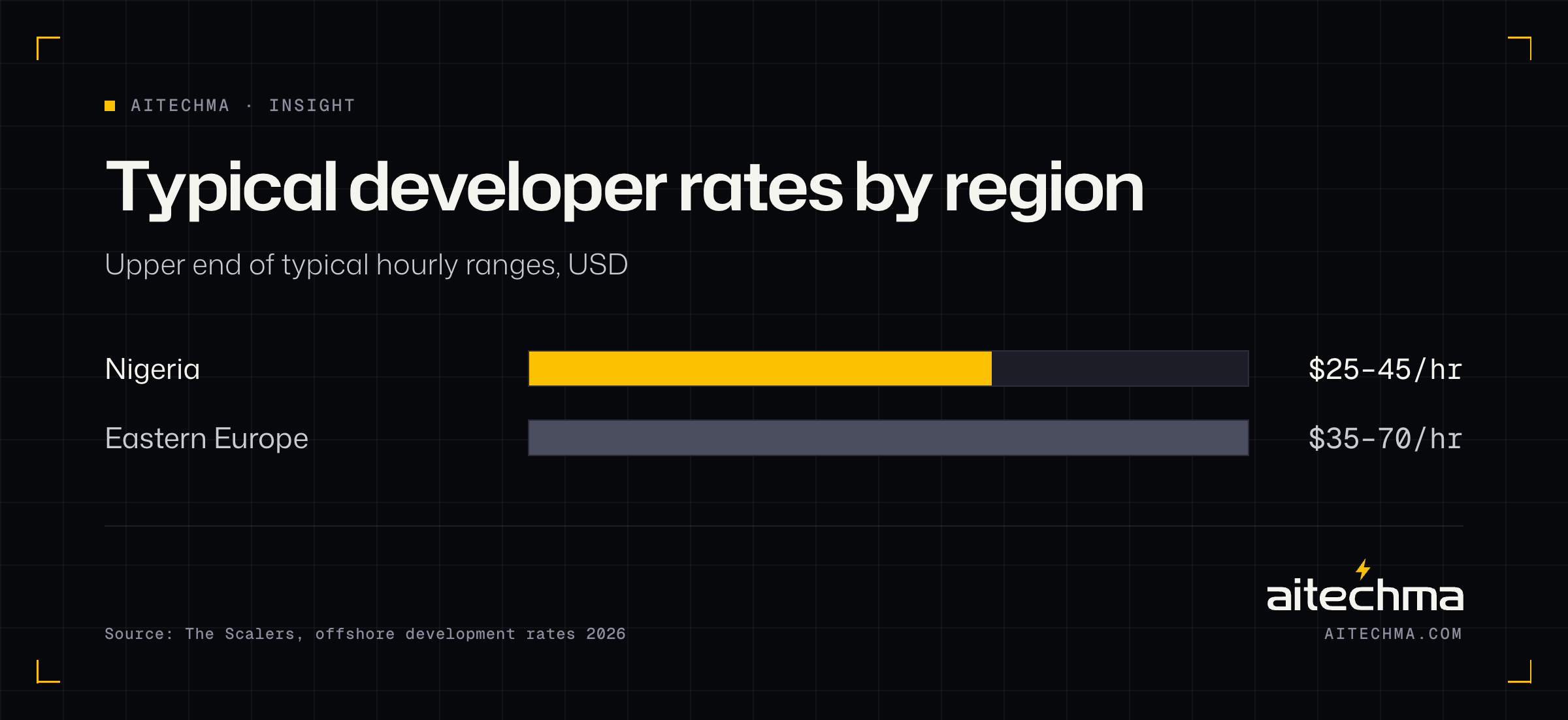
Market benchmarks for offshore development put typical Nigerian developer rates at around $25 to $45 per hour, compared with $35 to $70 in Eastern Europe [2]. Rates at the top of the Nigerian range, and above it, apply to senior engineers with strong production experience, scarce specialisms or leadership responsibility.
When budgeting, consider the full cost, not just salary:
Salary or contractor fees, benchmarked against both local and international offers.
Benefits: health insurance, pension contributions and other statutory requirements for employees.
Equipment and connectivity: laptops, backup power and reliable internet. Power and connectivity allowances are common and sensible.
Recruitment costs: your team's time, assessments and any agency or partner fees.
Onboarding time: most engineers need weeks to become fully productive in a new codebase.
Management time: good leads spend real time mentoring and reviewing.
Retention: raises, learning budgets and career progression, without which you will pay recruitment costs again.
Pay fairly. Underpaying strong engineers in a market where they can work remotely for international companies almost guarantees early departures, which cost far more than the salary difference.
Where to find candidates
Good candidates rarely respond to generic job posts alone. Use several channels:
Referrals from your own engineers and network, often the highest-quality source.
Developer communities: local meetups, tech hubs, open-source communities and online groups.
Professional networks such as LinkedIn, with personal outreach rather than mass messages.
Job boards focused on African tech talent, plus general boards for broader reach.
University and bootcamp partnerships for junior roles, paired with strong mentoring.
Partners and talent firms that pre-vet engineers and handle employment, useful when you need to move quickly or lack local presence.
Writing a job description that attracts the right people
Lead with the problem the team is solving, not a list of buzzwords.
Be specific about the stack and seniority, and honest about what is required versus nice to have.
Publish the salary range. It saves everyone time and builds trust.
Describe how the team works: remote or on-site, hours, how decisions are made, how code is reviewed.
Describe growth: mentorship, learning budget, path to senior roles.
Explain the process: stages, timeline and who they will meet.
A clear, honest description attracts engineers who fit and discourages those who do not, which saves time on both sides.
Vetting: test what the job actually needs
The biggest hiring mistakes come from assessing the wrong things. Trivia questions and puzzles test preparation, not the ability to build and maintain production software.
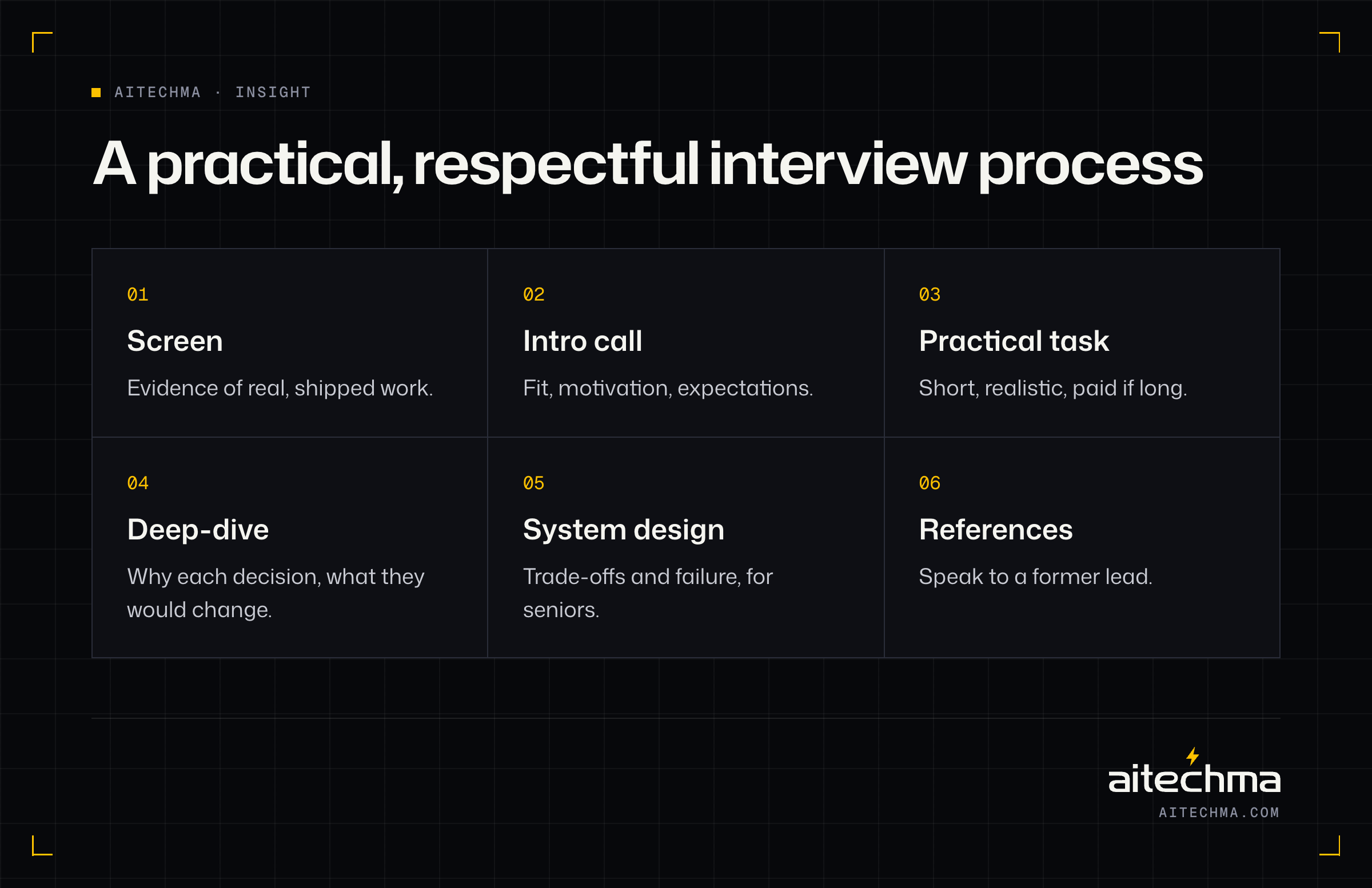
A practical, respectful process
CV and portfolio screen. Look for evidence of real work: shipped products, open-source contributions, responsibilities that match the role. Be generous with non-traditional backgrounds; many excellent Nigerian engineers are self-taught.
Short intro call (20–30 minutes). Mutual fit, motivation, communication, expectations on salary and working arrangements.
Practical exercise. A small, realistic task related to the job, time-boxed to a few hours, or a live pairing session. Pay candidates for take-home tasks longer than a couple of hours.
Technical deep-dive (60–90 minutes). Walk through the exercise and a project they are proud of. Ask why they made each decision, what they would change, how they tested it and how it behaved in production.
System design (for senior roles). Design a simplified version of a real system together, such as a payments flow, a notification service or a reporting pipeline. Look for clear thinking about trade-offs, failure and data.
Team and values conversation. How they handle feedback, disagreement, deadlines and mistakes.
References. Speak to people who have worked with them, ideally a former lead.
What to look for
Reasoning over recall. Can they explain why, not just what?
Production awareness. Do they think about errors, monitoring, security and data integrity?
Communication. Can they explain technical ideas clearly to non-engineers? This matters even more for remote work.
Ownership. Do they talk about outcomes and users, or only about tasks?
Learning. How do they keep up, and what have they learned recently?
Red flags
Inability to explain code in their own portfolio.
Blaming every past problem on others.
No interest in testing, code review or how software behaves after deployment.
Exaggerated titles without matching responsibility.
Hiring a tech lead
Your tech lead shapes the quality, speed and culture of your engineering team more than any other hire. It deserves extra care.
What a good tech lead does
Owns technical direction: architecture, standards and key technology choices.
Delivers: still writes code, especially early, and unblocks the team.
Reviews: ensures code quality through reviews, testing and sensible processes.
Mentors: grows mid-level and junior engineers, and helps hire.
Communicates: translates between business goals and technical reality, including saying no or "not yet" with clear reasons.
Manages risk: security, reliability, technical debt and dependencies.
How to assess a tech lead
Add these to your process for lead roles:
Architecture walkthrough: ask them to describe a system they led, the decisions they made, what went wrong and what they would do differently.
Prioritisation scenario: give them a set of competing demands (a security issue, a sales promise, technical debt and a feature deadline) and ask how they would handle them.
Code review exercise: ask them to review a pull request with deliberate problems. Watch both what they catch and how they phrase feedback.
Hiring and mentoring: how have they grown engineers? How do they assess candidates?
Stakeholder conversation: a founder or product manager role-plays a difficult conversation about scope or deadlines.
When you cannot find (or afford) a tech lead yet
Senior leads are scarce and expensive. Two practical alternatives:
A fractional CTO who sets architecture and standards, reviews work and helps you hire, part-time. See our fractional CTO service.
A partner-led pod where an experienced partner provides the lead and engineers together, and you transition to your own lead later.
Employment options: employee, contractor or partner
How you engage engineers affects cost, control, compliance and speed.
Full-time employees give you the most control and long-term commitment. You handle payroll, taxes, pensions, benefits and employment law. Best for core, long-term roles.
Independent contractors are flexible and quick to engage. Classification matters: treating contractors as employees in practice can create legal and tax issues. Best for well-defined work and specialist needs.
Employer-of-record services let international companies employ people in Nigeria without setting up a local entity, handling payroll and compliance for a fee.
Dedicated engineers through a partner give you vetted engineers who work full-time on your product, with the partner handling employment, equipment, replacements and often senior oversight. Best when you need to move quickly, lack local presence or want a lead and team together. Our dedicated engineers service works this way.
Project-based outsourcing hands a defined project to a team that delivers it. Best when you want an outcome rather than people. See our software development services.
Whatever you choose, ensure contracts cover IP assignment, confidentiality, data protection under the Nigeria Data Protection Act, notice periods and what happens to code and access when someone leaves.
Questions strong candidates will ask you
Hiring is a two-way decision. The best engineers interview you as carefully as you interview them, and how you answer their questions often decides whether they accept. Be ready for these:
What will I work on in my first three months? Have a concrete answer, not "various projects".
Who will I learn from? Describe the lead, the senior engineers and how mentoring works.
How do you ship? Release frequency, code review, testing and how incidents are handled.
How are decisions made? Who decides priorities, and how much say do engineers have in technical choices?
How is pay reviewed? How often, against what benchmarks, and how inflation and exchange rates are considered.
What does progression look like? Show the growth framework if you have one.
What equipment and support do you provide? Laptop, power backup, internet and learning budget.
Why did the last person in this role leave? Answer honestly; candidates often find out anyway.
What is hard about working here? Candor here builds more trust than any perk.
If you struggle to answer any of these, that is useful information. It usually points to something worth fixing before you hire, not just something to rehearse.
Onboarding: the first 90 days
Good onboarding turns a promising hire into a productive one. Poor onboarding wastes months and often ends in an early resignation.
Before day one: equipment, accounts and access ready; a buddy assigned; a short reading list on the product, architecture and practices.
Week one: meet the team and key stakeholders, set up the development environment, ship a small change to production. An early, real contribution builds confidence.
Month one: own a small feature end to end, take part in code reviews, join customer or support conversations to understand users.
Months two and three: take on larger work, agree goals for the next six months, and give and receive structured feedback.
Ask every new engineer what was confusing about onboarding and fix it for the next person.
A short onboarding document helps enormously: how to set up the development environment, how code moves from a branch to production, who owns which parts of the system, where documentation lives and who to ask about what. Keep it in the repository so it stays current, and ask each new hire to improve one thing in it during their first month. Over a few hires, onboarding becomes faster and smoother without anyone having to rewrite it from scratch.
Working with remote and distributed engineers
Many Nigerian engineering teams are remote or hybrid, and many international companies work with engineers in Lagos, Abuja and beyond. Distance works well with deliberate practices:
Overlapping hours. Agree a daily window for meetings and quick questions. UTC+1 overlaps fully with the UK and much of Europe and partially with the US East Coast.
Written by default. Decisions, designs and requirements written in shared documents, so people in different places and schedules stay aligned.
Reliable infrastructure. Power backup and reliable internet are not perks in Nigeria; they are working tools. Budget for them.
Regular face time. Video for discussions, and in-person meetups at key moments where possible.
Clear expectations. Response times, working hours, availability for incidents and how to signal when someone is blocked.
Inclusion. Remote engineers should be in the same rituals, reviews and decisions as everyone else, not treated as an external team.
Retention: keeping great engineers
In a market where strong engineers have options worldwide, retention is where hiring pays off or fails. What keeps engineers:
Fair, reviewed pay. Benchmark regularly against local and international offers, and adjust for inflation and exchange-rate movements.
Interesting work. Meaningful problems, ownership of features and visible impact on users.
Strong technical leadership. Engineers stay where they learn from good leads and peers.
Growth paths. Clear routes to senior, lead and specialist roles, with the criteria written down.
Learning support. Courses, certifications, conference time and time to explore new tools.
Respect for time. Reasonable hours, sensible on-call, and no constant emergencies caused by poor planning.
Recognition. Credit for good work, in front of the team and leadership.
Hold regular one-to-ones, ask what would make people leave, and act on what you hear before resignation letters arrive. Small, timely fixes, such as better equipment, a change of project or a clearer promotion path, retain people far more cheaply than counter-offers made after someone has already decided to go.
Diversity and early-career talent
Building a diverse team widens your talent pool and strengthens your product. Practical steps:
Remove unnecessary requirements such as specific degrees, which exclude many capable self-taught engineers.
Use structured interviews with consistent questions and scoring, which reduces bias.
Invest in junior engineers through internships and graduate programmes, paired with real mentoring. Juniors grown in your team often become your most loyal seniors.
Partner with communities that support women in tech and under-represented groups.
Separate your internship and graduate hiring from your client-facing channels, with a dedicated careers page and process. It gives candidates a clear route and keeps sales conversations focused on customers.
Hiring for international companies: extra considerations
If you are based outside Nigeria, a few points deserve attention:
Legal structure. Decide between hiring contractors, using an employer of record, partnering with a local company or setting up an entity. Take local legal and tax advice.
Payments. Agree the currency, payment schedule and how exchange-rate movements are handled. Engineers paid in naira feel inflation and devaluation directly.
Data and security. Device management, access controls and data protection obligations, including where data may be stored and processed.
Culture and communication. Invest in understanding how your Nigerian colleagues prefer to communicate and give feedback, and share your own norms explicitly.
Local leadership. A respected local lead helps with hiring, mentoring and representing the team's needs.
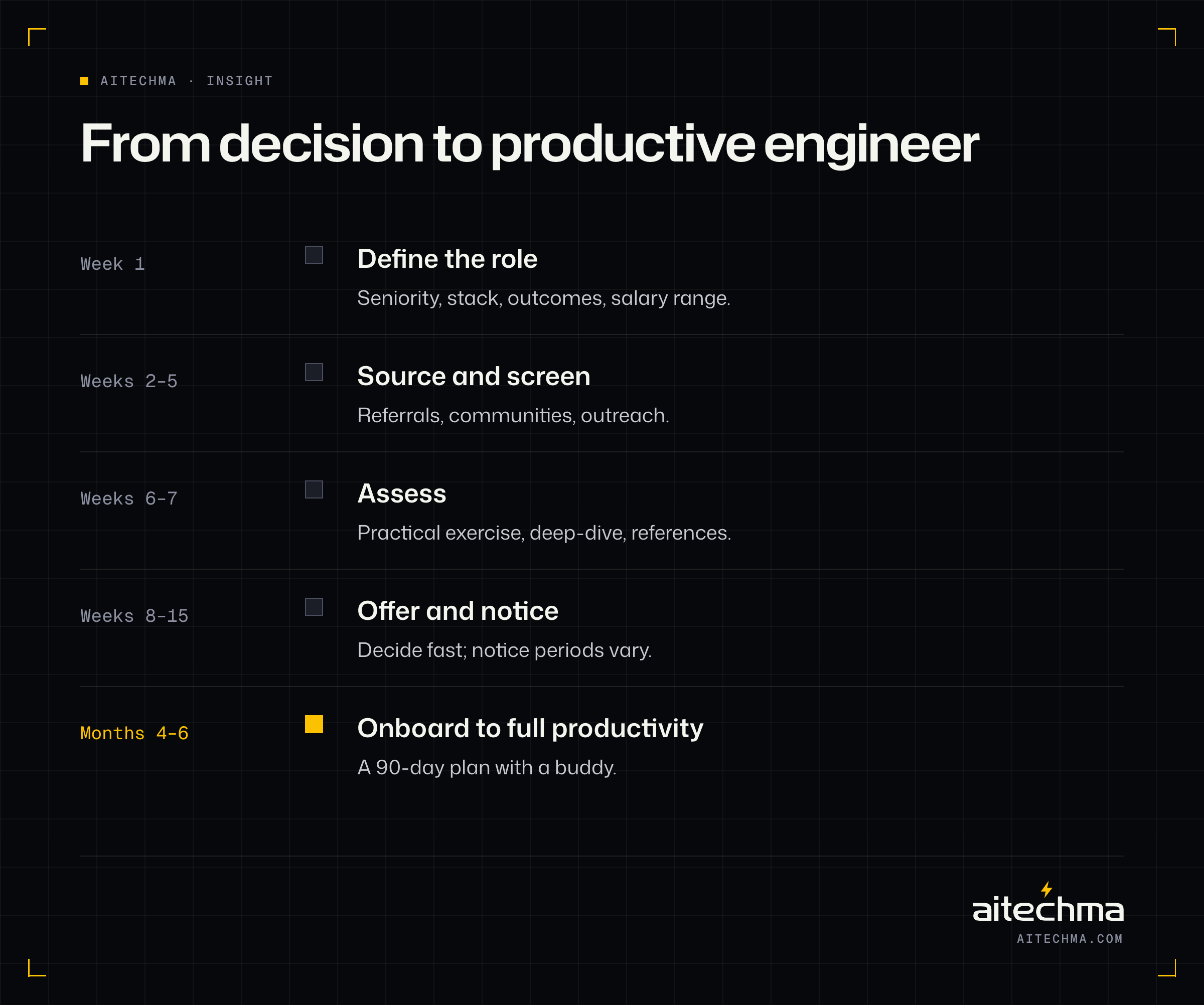
How long hiring takes
Plan your roadmap around realistic hiring timelines. For a direct hire, a typical sequence is:
Stage | Typical time |
|---|---|
Define role, salary range and job description | 1 week |
Sourcing and first conversations | 2–4 weeks |
Assessments and interviews | 1–2 weeks |
Offer and acceptance | 3–7 days |
Notice period at current employer | 2–8 weeks |
Onboarding to full productivity | 1–3 months |
From deciding to hire to having a productive engineer can therefore take three to five months, longer for senior and specialist roles. Engaging engineers through a partner can shorten the front of this timeline considerably because candidates are already vetted, but onboarding into your codebase still takes time.
Two ways to move faster without lowering standards: keep the process to a small number of stages scheduled close together, and give candidates a decision within days of their final interview.
Using take-home tasks fairly
Take-home exercises can reveal how candidates really work, but they can also exclude good people who cannot spare hours of unpaid time. Use them fairly:
Keep them short: a realistic task that takes two to three hours, not a weekend.
Make them relevant: something close to the work they would actually do.
Be clear about expectations: what you will assess, what to prioritise and what to skip.
Pay for longer tasks. If the exercise genuinely needs more time, pay for it.
Always discuss it. The conversation about why they made each choice is more valuable than the code itself.
Offer an alternative, such as a live pairing session, for candidates who prefer it.
AI tools in engineering teams and hiring
AI coding assistants are now part of most engineers' daily work, and that changes both hiring and team practices.
In hiring, decide your policy and tell candidates. Many companies now allow AI tools in exercises, because that reflects real work, and focus the discussion on whether the candidate understands, tests and can defend the code they submit. An engineer who cannot explain AI-generated code in their own submission is a clear signal.
In teams, AI tools speed up routine work, but they also produce code that looks right and is not. Research has found AI models choosing insecure approaches in a large share of coding tasks [5]. Keep code review, automated tests and security checks mandatory regardless of how code was written, and value engineers who use AI tools critically.
In skills, the engineers who gain most from AI are those with strong fundamentals: they know what to ask for, spot mistakes quickly and understand the systems they are changing. That makes fundamentals more important in hiring, not less.
Measuring engineering team health
Once your team is in place, track a few signals to see whether hiring is paying off:
Delivery: how often the team ships working changes, and how long work takes from start to production.
Quality: production incidents, bugs found by users and time to recover from failures.
Retention: voluntary departures over the past year, and how long new hires stay.
Engagement: what engineers say in one-to-ones and anonymous surveys about workload, learning and leadership.
Hiring quality: how many new hires are performing well after six months.
Look at trends rather than single numbers, and discuss them openly with the team. Engineers usually know what is slowing them down and are glad to be asked. A quarterly conversation about these signals, followed by one or two concrete improvements, does more for a team than any annual engagement survey.
A worked example: building a pod in Lagos
This composite example shows how the pieces fit together for an international company. The details are illustrative.
A UK-based B2B software company needed to grow engineering capacity for a new reporting product. Hiring in London was slow and expensive, and the roadmap was slipping. The company decided to build a pod in Lagos.
Start with the lead. Instead of hiring four engineers at once, the company first hired a senior engineer with experience leading a small team and designing data-heavy systems. The process took longer than the founders wanted, but the lead's first contribution was decisive: he rewrote the job descriptions for the remaining roles to match what the product actually needed, and joined every subsequent interview.
Hire to complement. The lead was strongest on back-end and data. The next two hires were a front-end engineer with strong design sense and a mid-level back-end engineer with testing experience. A part-time QA engineer joined a month later.
Make the pod real, not a vendor. The Lagos engineers joined the company's daily stand-up, which was scheduled in the overlap between UK and Lagos hours. They owned the reporting product end to end rather than receiving tickets from London. The UK product manager visited Lagos for the first week, and the lead spent two weeks in London in the first quarter.
Invest in infrastructure. The company provided laptops, a power and connectivity allowance and a co-working membership for anyone who preferred not to work from home.
Results. Within two quarters, the pod had shipped the first version of the reporting product and taken over its support. Two of the three engineers had been promoted within a year, and none had left. The founders' main lesson: hiring the lead first, and letting the lead shape the team, mattered more than any other decision.
An interview scorecard
Structured scoring makes interviews fairer and decisions faster. Agree the criteria before interviews start, score each one independently, then discuss.
Criterion | What good looks like | Weight |
|---|---|---|
Problem solving | Breaks problems down, considers trade-offs, explains reasoning | High |
Code quality | Readable, tested, sensibly structured code | High |
Production thinking | Considers errors, security, monitoring and data integrity | High |
Communication | Explains clearly to engineers and non-engineers | Medium–high |
Ownership | Talks about outcomes and users, not only tasks | Medium |
Collaboration | Responds well to feedback, gives it constructively | Medium |
Learning | Shows curiosity and recent growth | Medium |
Use a simple scale, such as one to four, with written evidence for each score. "Strong communication" without evidence is an impression; "explained the caching trade-off clearly to the product manager" is evidence.
Sample interview questions by role
These questions focus on experience and reasoning rather than memorised answers.
Back-end engineers
Walk me through an API you designed. How did you handle authentication, errors and versioning?
How would you make sure a payment is never processed twice if the client retries?
Tell me about a performance problem you diagnosed in production. How did you find the cause?
How do you decide what to test, and at which level?
Front-end engineers
How do you keep a web app fast on a mid-range phone on a slow connection?
Describe how you structure state in a large front-end application.
How do you make interfaces accessible?
Tell me about a time a design was hard to implement. How did you work with the designer?
Mobile engineers
How do you handle offline use and syncing when the connection returns?
What do you check before releasing to the app stores?
How have you reduced app size or memory use?
How do you test on the range of devices your users carry?
DevOps and infrastructure engineers
Describe a deployment pipeline you built. What would you improve?
How do you approach backups and disaster recovery, and how do you know they work?
Tell me about an incident you handled. What did you change afterwards?
How do you keep cloud costs under control?
Tech leads
Describe the architecture of a system you led. What would you do differently now?
How do you balance new features against technical debt?
How do you give difficult feedback to an engineer?
How do you explain a technical risk to a non-technical founder?
Growth frameworks: making progression visible
Engineers leave when they cannot see a future. A simple, written growth framework shows what progression looks like and makes promotion decisions fairer.
A useful framework describes each level (for example junior, mid-level, senior, lead and principal) across a few dimensions:
Technical skill: the complexity of problems they handle independently.
Scope: a task, a feature, a system or several systems.
Ownership: how much direction they need and how they handle problems.
Collaboration and influence: how they help others, review work and shape decisions.
Communication: how well they explain, document and represent the team.
Review progress against the framework at least twice a year, with concrete examples. Pair each review with a development plan: the skills to build, the projects that will build them and the support provided.
Access, security and engineering hygiene
New engineers need access quickly, and departing engineers need it removed quickly. Set this up properly from the start:
Company-owned accounts. Code repositories, cloud consoles and tools should be owned by the company, with individual accounts for each engineer.
Least privilege. Give people the access their role needs, and review it regularly.
Strong authentication. Multi-factor authentication on every important account.
Device standards. Encrypted laptops, screen locks and up-to-date software, especially for engineers handling customer data.
Secrets management. Passwords and keys in a vault, never in code or chat messages.
Audit trails. Logs of who changed what in production.
These practices protect your company and make engineers' work easier, because they are not waiting for access or worrying about security mistakes.
Offboarding well
People will leave, even from great teams. How you handle departures affects security, continuity and your reputation as an employer.
Plan the handover. Document the departing engineer's areas of ownership, open work and knowledge only they hold, and pair them with whoever takes over.
Remove access promptly on the last day: repositories, cloud accounts, tools, communication channels and devices.
Recover equipment and data according to your policies.
Hold an exit conversation. Ask honestly what could have kept them and what the team should improve. Departing engineers often give the most useful feedback.
Part on good terms. Engineers who leave well often refer candidates, return later or become customers and partners.
Common hiring mistakes
Hiring juniors without a senior to guide them, then wondering why quality suffers.
Testing puzzles instead of practical skills.
Moving too slowly. Strong candidates often accept other offers within days.
Underpaying in a market where engineers can work for international companies.
Skipping references.
No onboarding plan, leaving new hires to figure things out alone.
Treating remote engineers as an external vendor rather than part of the team.
Ignoring retention until people start resigning.
A hiring checklist
Define the role, seniority, stack and outcomes for the first six months.
Set a salary range benchmarked against local and international offers.
Write an honest job description with the range and process.
Use several sourcing channels, especially referrals and communities.
Run a practical, respectful assessment process with clear scoring.
Include system design and leadership exercises for senior roles.
Check references.
Prepare contracts covering IP, confidentiality and data protection.
Prepare equipment, access and a 90-day onboarding plan.
Schedule regular one-to-ones and a review of pay and growth.
Glossary
Tech lead: a senior engineer responsible for technical direction, quality and mentoring in a team, who usually still writes code.
Engineering manager: a leader focused on people, delivery and process, often managing several engineers or teams.
Pod: a small cross-functional team, typically a lead, engineers and QA, owning an area of a product.
Employer of record: a company that legally employs staff on behalf of another company in a given country.
Staff augmentation: adding external engineers to your own team, working under your direction.
System design interview: an interview where candidates design a software system, discussing trade-offs.
Onboarding: the process of helping a new hire become productive and part of the team.
Retention: keeping valued employees over time.
How Aitechma can help
Aitechma is a software engineering company in Ikeja, Lagos. We help companies in Nigeria and abroad build engineering capacity: vetted dedicated engineers who join your team, product pods with a lead, fractional CTOs who set direction and help you hire, and full product builds when you would rather outsource the outcome. Our engineers come from the team that has built fintech, SaaS and edtech products used by hundreds of thousands of people.
Hire dedicated engineers, find local talent for your Nigerian team or talk to us about a fractional CTO.
Frequently asked questions
Market benchmarks put experienced Nigerian developers at around $25 to $45 per hour, with senior and specialist engineers above that. Budget for benefits, equipment, power and connectivity, recruitment, onboarding and regular pay reviews too.
A senior full-stack engineer or tech lead who can design the architecture, build the core and set standards, followed by one or two mid-level engineers who complement the lead's strengths.
Use a short, practical exercise related to the job, a technical deep-dive into their work, system design for senior roles, a values conversation and references. Assess reasoning, production awareness and communication rather than trivia.
Employees suit core, long-term roles; contractors suit defined or specialist work; partners providing dedicated engineers suit companies that need to move quickly or lack local presence. Contracts should always cover IP, confidentiality and data protection.
From deciding to hire to a productive engineer typically takes three to five months for a direct hire, including sourcing, interviews, notice periods and onboarding. Working with a partner can shorten the front of that timeline.
Sources
- TechCabal. Nigeria, Egypt among world's 10 fastest-growing countries for software developers in 2023 (Mar 2024)
- The Scalers. Offshore software development rates by country (2026)
- BCG. Develop the developers: a strategic priority for Africa (2025)
- ITWeb. Nigeria struggles with AI talent despite surge in investment (2025)
- Veracode. AI-generated code poses major security risks in nearly half of all development tasks (Jul 2025)
Need help with dedicated engineers?
Talk to the Aitechma team in Ikeja about your product, timeline and the fastest path to a working release.
See dedicated engineers