
Product Management for Startups Without a Full-Time PM: A Practical Guide for Founders and Small Teams
How founders and small teams can run product management without a full-time PM: discovery, prioritisation, roadmaps, specs, metrics, launch and when to hire help.
Short answer: product management is the job of deciding what to build, in what order, and how to tell whether it worked. Every software company does it, whether or not anyone has the title. In an early-stage startup, the founder usually does it, often in fragments between sales calls and investor meetings. You do not need a full-time product manager to do it well, but you do need a few habits: talk to customers every week, keep one ranked list of priorities, write clear specs, measure outcomes, and protect your team from a roadmap that changes with every conversation.
This guide is for founders, CTOs and small teams in Nigeria and beyond who need product discipline without a large product department. It covers discovery, prioritisation, roadmaps, specifications, working with engineers, metrics, launches and when to bring in help.
What product management actually is
Product management sits between three questions:
Is this worth solving? Does a real customer have this problem, and will they pay to have it solved?
What should we build? Of all the possible solutions, which is the smallest that solves it well?
Did it work? After we shipped it, did the numbers we cared about move?
A product manager does not build the product, design every screen or sell it. They make sure the people who do those things are working on the right problems, in the right order, with a shared understanding of what success means.
In a large company that is a full-time role, sometimes many. In a startup of five to twenty people, it is usually split between the founder, a technical lead and a designer, with nobody quite owning it. That gap is where most wasted engineering time comes from.
Signs your product management is not working
You may not have a product manager, but you have product management, good or bad. These are the signs it is not working:
The roadmap changes every week. Each customer call, investor comment or competitor launch adds a new priority, and nothing gets finished.
Engineers wait for decisions. Work stalls because requirements are unclear, or engineers make product decisions themselves because nobody else does.
Features ship and nobody uses them. The team built what someone asked for, not what users needed.
Nobody can say what worked. There is no agreed measure of success for features, so the team cannot learn from them.
Sales promises features that do not exist. And engineering finds out from customers.
The founder is the bottleneck. Every decision waits for one overloaded person.
If three or more of these are true, your company would benefit from more product discipline, whether that comes from new habits, a fractional product manager or a hire.
Discovery: talking to customers properly
Discovery is the work of understanding customers' problems before deciding what to build. It is the most valuable product habit and the one most often skipped.
Talk to customers every week
Make customer conversations a routine, not an event. Even two or three conversations a week, across the founder, product and engineering team, compound into deep understanding over a quarter.
Ask about the past, not the future
People are poor at predicting what they would use and good at describing what they did. Instead of "Would you use a feature that…?", ask:
"Tell me about the last time you had to [do the task]."
"What did you do? What tools did you use?"
"What was frustrating about it?"
"What did that cost you, in time or money?"
"What have you tried to fix it?"
If someone has not tried to solve a problem, it may not hurt enough to pay for.
Look for patterns, not anecdotes
One customer's request is an anecdote. The same problem described by eight customers in different words is a pattern. Keep simple notes from every conversation and review them together every couple of weeks.
Watch, do not just ask
Where you can, watch people use your product or do the task you want to improve. Screen recordings, support transcripts and site visits reveal problems customers never mention because they have got used to them.
Discovery in the Nigerian context
A few practical notes for products in Nigeria:
Meet users where they are. WhatsApp voice notes and short calls often work better than formal interviews or surveys.
Respect time and data. Offer airtime or data for longer interviews; it is appreciated and improves response rates.
Go to the field. For products used by traders, riders, agents or field staff, an afternoon in a market or depot teaches more than a week of remote calls.
Separate buyers from users. In B2B products, the person who pays (an owner or manager) and the people who use it daily (staff) have different problems. Talk to both.
Prioritisation: one ranked list
The single most powerful product tool is a single, ranked list of what the team will work on next. Not two lists, not a list per stakeholder, not a list where everything is "high priority". One list, in order.
Simple ways to rank
You do not need complex frameworks. Two simple methods work for most startups:
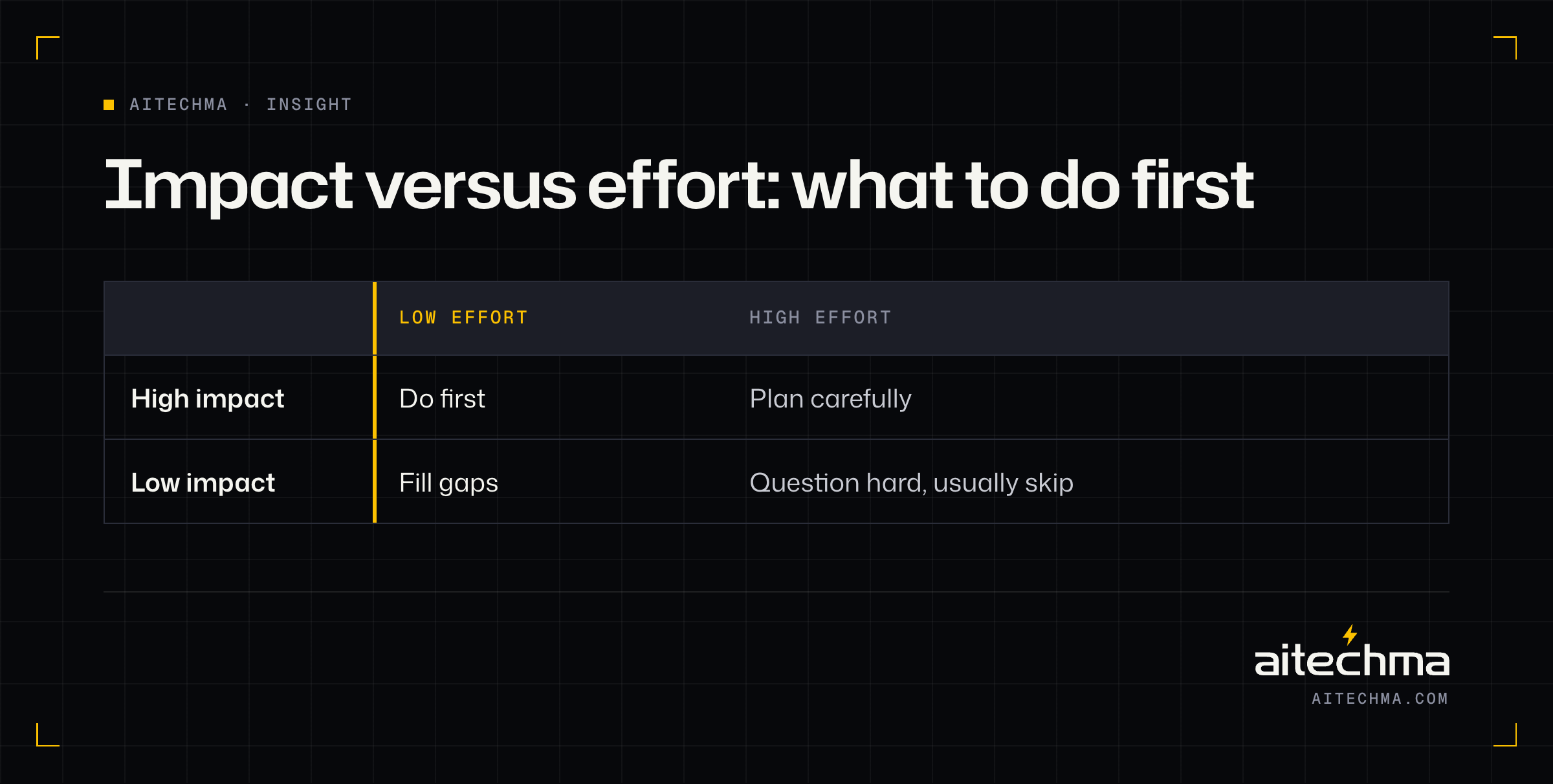
Impact versus effort. For each candidate, estimate the impact on your main goal (high, medium, low) and the effort to build it (high, medium, low). Do high-impact, low-effort work first; question high-effort, low-impact work hard.
RICE. Reach (how many users it affects), Impact (how much it helps each one), Confidence (how sure you are) and Effort (how much work). Multiply the first three and divide by effort. It is not precise, but it forces useful conversations about assumptions.
Tie priorities to one goal
Priorities only make sense against a goal. For most startups, there should be one main goal per quarter: activate more new users, convert trials to paid, reduce churn, or enter a new segment. Every item on the list should explain how it serves that goal. Items that do not serve it wait.
Keep a "not now" list
Saying no is easier when it means "not now" rather than "never". Keep a visible list of good ideas that are not current priorities, with the reason. Revisit it at each planning cycle. Stakeholders can see their ideas were heard, and the team stays focused.
Roadmaps that survive contact with reality
A roadmap communicates direction and priorities. It is not a promise of dates for every feature.
Use "now, next, later". Instead of a Gantt chart with dates for everything, show what the team is working on now, what comes next, and what is being considered later. Dates belong to the "now" column, where confidence is high.
Write outcomes, not just features. "Reduce failed KYC attempts by half" is more useful than "Improve KYC screen", because it leaves room for the team to find the best solution.
Review it regularly. Revisit the roadmap at least monthly with leadership, and quarterly in depth. Change it when evidence changes, not when the loudest voice changes.
Share it widely. Sales, support and leadership should all know what is coming and what is not. This prevents surprise promises to customers.
Writing specs engineers can build from
Unclear requirements are expensive. A good specification does not need to be long. It needs to remove ambiguity.
A simple one-page spec covers:
The problem: what users struggle with, with evidence from discovery.
The goal: the metric this should move, and by how much.
Users and scenarios: who uses it and in what situations.
User stories with acceptance criteria: "As a [user], I can [action] so that [benefit]", followed by the conditions that must be true for it to be done.
Out of scope: what this work deliberately does not include.
Open questions: decisions still to be made, with owners and dates.
Designs or sketches, linked rather than described.
Write the spec with engineers and designers, not for them. A thirty-minute conversation about edge cases before building saves days of rework after.
Example acceptance criteria
For a feature that lets wallet users schedule recurring transfers:
A user can create a recurring transfer with an amount, recipient, frequency and start date.
The user sees the next three scheduled dates before confirming.
If the wallet balance is insufficient on a scheduled date, the transfer is not attempted, the user is notified, and the schedule continues.
The user can pause or cancel a schedule at any time.
Every scheduled transfer appears in transaction history with a "scheduled" label.
Criteria like these make testing straightforward and prevent arguments about whether a feature is "done".
Working well with engineers and designers
Product management is a team sport. A few habits make the collaboration far smoother:
Bring problems, not solutions. Share the user problem and goal, then design the solution together. Engineers often see simpler options.
Protect focus. Avoid changing priorities mid-cycle unless something is genuinely urgent.
Be available. Questions answered in minutes instead of days keep work flowing.
Accept trade-offs openly. When time is short, decide together what to cut, rather than asking for everything faster.
Attend demos. Review working software regularly and give feedback quickly.
Celebrate outcomes, not output. Praise the feature that moved retention, not just the number of features shipped.
Metrics that matter
What you measure shapes what your team builds. Choose a small set of meaningful metrics rather than a dashboard of everything.
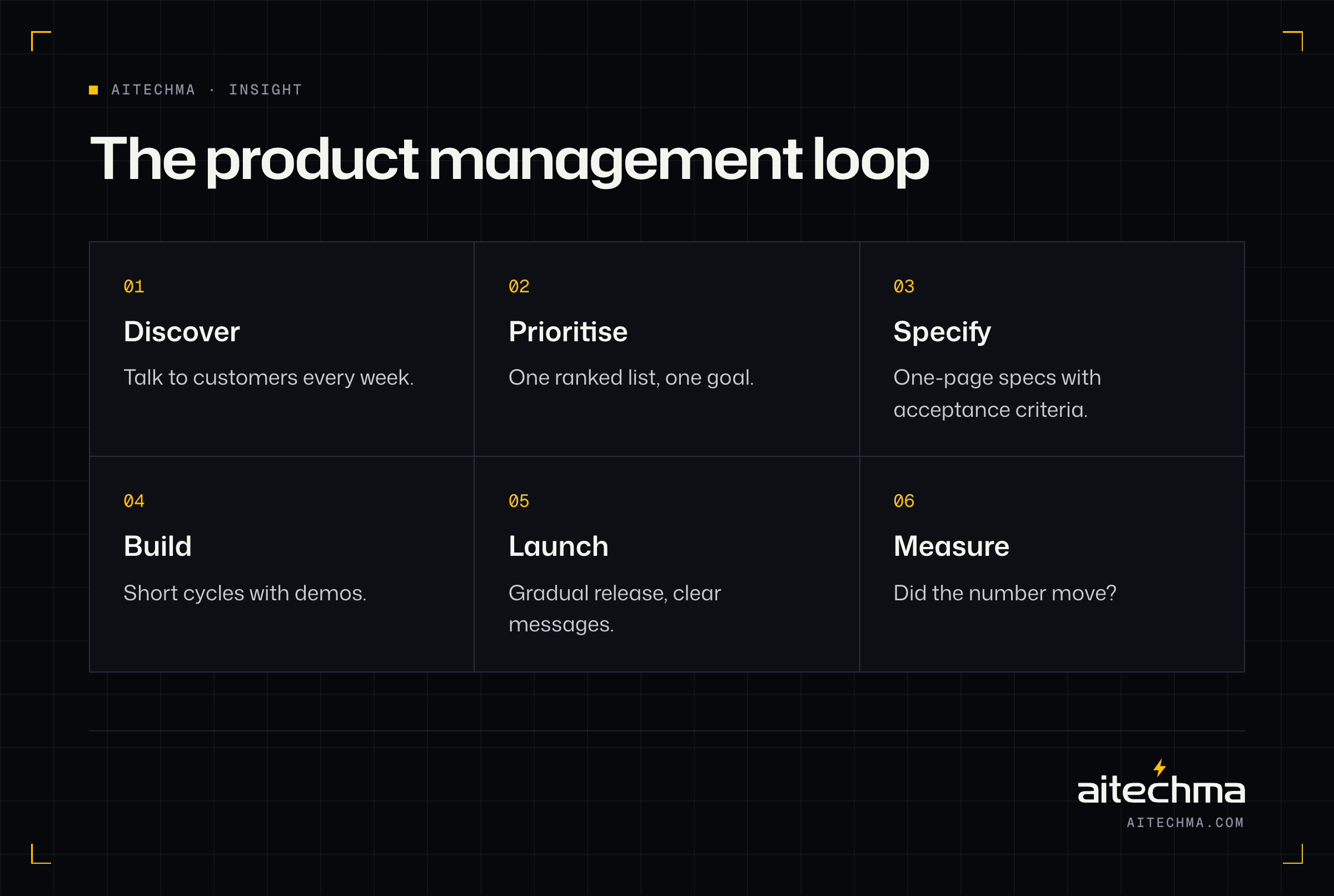
Activation. The share of new users who reach the first moment of real value, such as completing a first transfer, placing a first order or finishing a first lesson. This is usually the most important early metric.
Retention. How many users come back after a day, a week and a month. If retention is weak, acquiring more users fills a leaky bucket.
Conversion. For paid products, the share of trials or free users who become paying customers.
Engagement depth. How many of the core actions active users perform. Breadth of feature use matters less than repeated use of the core.
Revenue and unit economics. Revenue per customer, cost to acquire a customer, and how long it takes to recover that cost.
Quality signals. Support contacts per active user, crash rates, failed transactions and complaint themes.
Pick one "north star" metric that best reflects the value customers get, and a handful of supporting metrics. Review them weekly.
Launching features well
A feature is not finished when it is deployed. It is finished when users know about it, can use it and the team knows whether it worked.
Decide the success measure before launch. What number should move, and when will you check?
Release gradually. Launch to a small group first, watch the data and support channels, then expand.
Tell users clearly. In-app messages, release notes, WhatsApp broadcasts to opted-in users, or emails, focused on the benefit.
Prepare support and sales. Brief them before launch, with answers to likely questions.
Review after two to four weeks. Did the metric move? What did users say? Should you iterate, expand or remove the feature?
Removing features that do not work is a sign of product maturity, not failure.
Go-to-market is part of product
Building the product is half the job; getting it to customers is the other half. Product decisions should be made with go-to-market in mind: who exactly is the customer, how will they hear about you, why will they choose you, and what will make them pay.
In Nigeria, traction can take longer than founders expect without a deliberate go-to-market plan [1]. Founders who define a narrow first customer group, test channels systematically and price clearly tend to reach revenue faster. Product management connects the two: features should make the product easier to sell, onboard and keep, not just more complete.
Funding has improved: Nigerian startups raised about $635 million in the first nine months of 2026, more than any other African country [2]. But investors are backing traction, which means product teams need to show activation, retention and revenue, not just features shipped.
Product management for B2B and SME products
Many Nigerian startups sell software to businesses. Product management for B2B has its own patterns:
Buyers and users differ. The owner signs the contract; staff use the product daily. Design for both: value the owner can see in reports, and ease of use that staff appreciate.
Onboarding is a project. Importing data, setting up users and training staff decide whether a business account succeeds. Treat onboarding as part of the product.
Cost is a barrier. Most Nigerian MSMEs say technology matters but cost holds them back [3]. Pricing, payment options and clear return on investment matter as much as features.
Sales feedback is valuable but biased. Lost deals tell you what prospects say they need. Weigh that against what active customers actually use.
Custom requests are a trap. One large customer can pull your roadmap away from everyone else. Build for the segment, not the single account, unless that account is your strategy.
Renewals are the real test. In B2B, the moment of truth is not the first sale but the renewal. Track how many accounts are actively used by their staff each week, because accounts that go quiet rarely renew, and reach out before the renewal date rather than after.
A worked example: fixing activation in a savings app
This composite example shows how the habits in this guide work together. The details are illustrative.
A young Lagos savings app had healthy downloads from social media campaigns, but revenue was flat. The founder's instinct was to build more features: group savings, a referral programme and investment products. The team had started on all three.
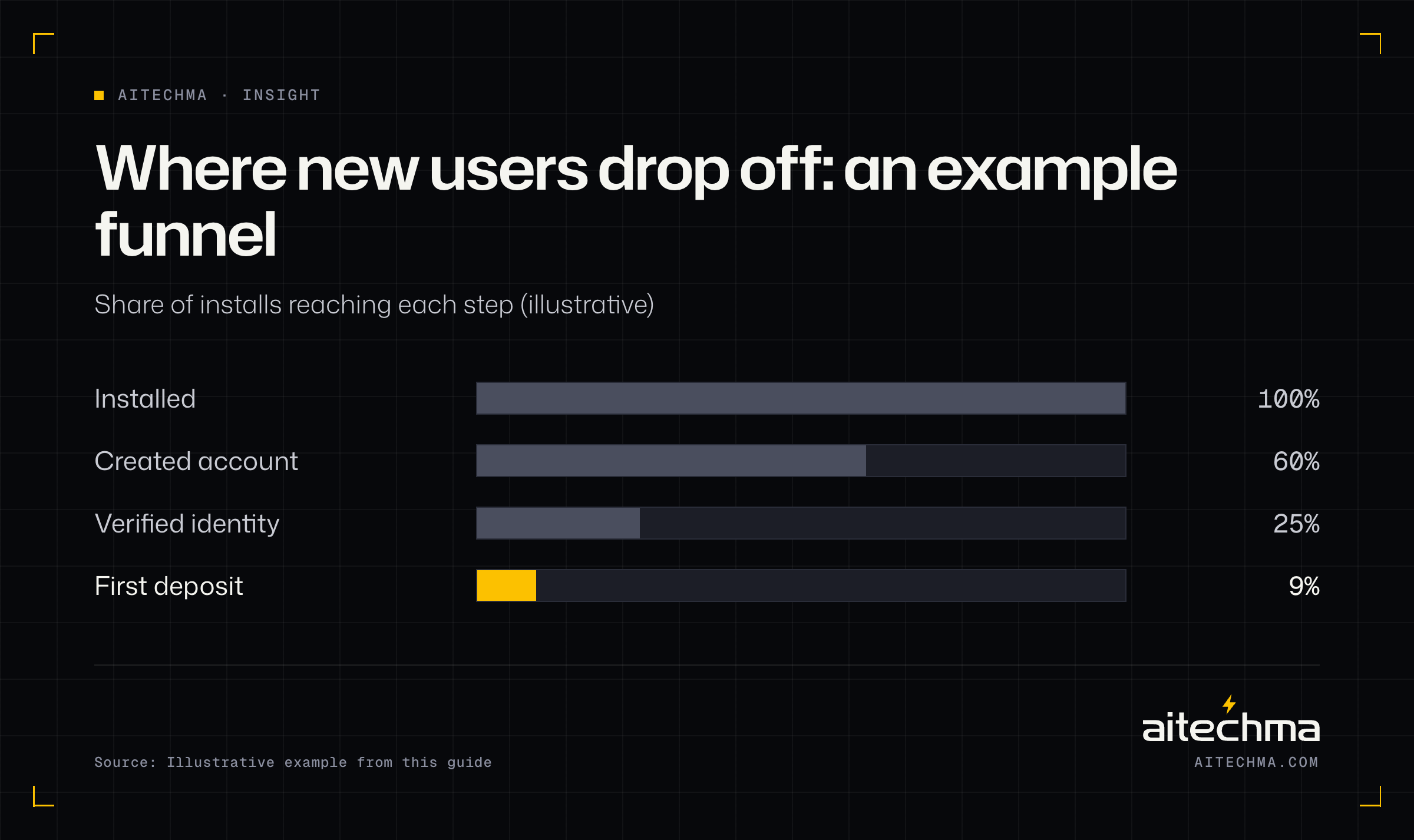
Measure first. Setting up a simple funnel showed the real problem. Of every 100 people who installed the app, about 60 created an account, 25 completed identity verification, and only 9 made a first deposit. Retention among those 9 was good. The product did not need more features; it needed more people to reach the first deposit.
Discover why. The team spent a week talking to users who had dropped out at verification and deposit. Three themes came up again and again: the verification step asked for documents users did not have to hand, failed verifications sent users back to the start, and the deposit screen did not explain clearly how quickly money could be withdrawn, which made people nervous.
Prioritise against one goal. The founder set a single goal for the quarter: double the share of installs that make a first deposit. The new features moved to the "not now" list. Three items went to the top: let users start with a lower tier of verification and upgrade later, save progress during verification, and add clear withdrawal terms with an example right on the deposit screen.
Specify clearly. Each change got a one-page spec with acceptance criteria, written with the engineers. The verification change needed input from compliance on what limits applied to the lower tier.
Launch and measure. The changes were released to a portion of new users first. Over the following weeks, the share reaching a first deposit rose substantially, and support messages about verification fell. Only then did the team pick up group savings again, now with data showing it was the most requested feature among active savers.
The lesson: the most valuable product work is often removing friction from the core journey, not adding features around it.
Pricing is a product decision
Pricing is often treated as a finance or sales question, but it shapes who buys, how they use the product and what you build next.
Price around value, not cost. What is the problem worth to the customer in time or money saved? That sets the ceiling.
Make the first purchase easy. For Nigerian consumers and SMEs, smaller, more frequent payments (weekly or monthly) often convert better than large annual ones.
Offer the payment methods customers use. Cards, transfers and USSD in naira; dollar billing for international customers.
Design tiers around clear limits. Number of users, transactions, locations or features, so customers understand why to upgrade.
Test before committing. Run pricing conversations in discovery, try different offers with new customer cohorts and watch conversion and retention.
Revisit regularly. Inflation and exchange rates move. Plan pricing reviews rather than making emergency changes.
Technical debt is a product issue
Technical debt (shortcuts that make future changes slower and riskier) feels like an engineering concern, but its cost shows up in product: slower delivery, more bugs, outages and features that become impossible to build.
Make it visible. Ask engineers to list the debt that slows them down most, with an estimate of its impact.
Budget for it. Many teams reserve a steady share of each cycle for reducing debt, rather than waiting for a crisis.
Tie it to outcomes. "Rewriting the payments module will cut failed transfers and let us add new providers in days instead of weeks" is an argument a founder can weigh.
Avoid big-bang rewrites. Improve in stages wherever possible, keeping the product working throughout.
A product manager who ignores technical debt eventually finds the roadmap blocked by it.
Running a quarterly planning session
A short quarterly planning session keeps the company aligned without heavy process. A half-day is usually enough for a startup.
Review the last quarter. What did we set out to achieve, what happened, and what did we learn?
Look at the evidence. Metrics, customer research themes, support trends, sales feedback and market changes.
Agree one main goal. The outcome that matters most for the next quarter, with a target.
Generate options. Everyone proposes work that could serve the goal.
Rank them. Use impact versus effort or RICE, and be honest about confidence.
Check capacity. Match the top of the list to the team's real capacity, including time for bugs, support and technical debt.
Write it down and share it. The goal, the ranked list, the "not now" list and how progress will be measured.
A weekly product review agenda
A weekly thirty-minute review keeps product work on track. A simple agenda:
Metrics (10 minutes). The north star and supporting metrics: what moved, what did not, and why.
Progress (10 minutes). What shipped, what is blocked and what decisions are needed.
Learning (5 minutes). One or two insights from customer conversations, support or data.
Decisions (5 minutes). Make the decisions that are blocking work, or assign an owner and a date.
Keep notes short and shared. The value is in the rhythm: problems surface within a week, not at the end of a quarter.
Handling requests from sales and large customers
Sales teams and large customers generate a steady stream of feature requests. Handled badly, they take over the roadmap. Handled well, they are a valuable source of insight.
Capture every request in one place, with who asked, why and what they are trying to achieve.
Look for the problem behind the request. "We need an export to Excel" may mean "our finance team needs a monthly report", which may have a better solution.
Count demand. Requests from many customers outrank a single loud one.
Be honest with customers. Explain what is planned, what is not, and why. Customers respect clarity more than vague promises.
Agree a rule with sales. No feature is promised to a customer without product agreement and a realistic date.
Treat strategic accounts deliberately. If building for one large customer is a strategic choice, make it explicitly, with its cost to other priorities visible.
When to hire product help
You can go a long way with founder-led product management and good habits. Bring in help when:
The founder spends more time on product decisions than on sales, fundraising or leadership, and the business suffers.
You have more than one engineering team or squad.
You are entering a new segment or market and need structured discovery.
Your roadmap keeps slipping and nobody can say why.
You are preparing for a fundraise and need clear metrics and a credible roadmap.
Fractional, full-time or both?
A fractional product manager works with you part-time, typically a few days a week, on a monthly retainer. It suits startups that need structure, discovery and prioritisation but not a full-time role yet. They can also set up processes that a future full-time hire will inherit.
A full-time product manager makes sense when the product is your core business, you have several engineers, and decisions need someone in the room every day.
Both is common during transition: a fractional senior product leader sets up the practice and helps you hire and onboard a full-time product manager.
Hiring your first product manager
When you hire, look for evidence rather than titles:
Discovery skill. Ask them to describe a time customer research changed what they built.
Prioritisation. Give them a messy list of requests and ask them to rank it and explain why.
Communication. Ask for a spec or product document they wrote.
Data literacy. Ask how they measured whether a feature worked.
Technical understanding. They do not need to code, but they should understand trade-offs and earn engineers' respect.
Fit for your stage. Startup product managers need to do discovery, specs, analytics and launches themselves, not manage a team of analysts.
Our guide to hiring engineers covers how we vet technical roles; many of the same principles apply.
A 30-day plan to improve product management
If your product process feels chaotic, this plan creates structure without bureaucracy.
Week 1: listen. Interview five customers and five team members. Gather support tickets, sales notes and analytics. Write down the top problems you hear.
Week 2: decide. Agree one main goal for the quarter. Build a single ranked list of work against it. Create the "not now" list.
Week 3: clarify. Write one-page specs for the top three items. Set up dashboards for your main metrics.
Week 4: rhythm. Establish a weekly product review (metrics, progress, decisions), a fortnightly planning session and a monthly roadmap update shared with the whole company.
After a month, the team should know what matters, why, and how success will be measured.
Product management in regulated products
Fintech, health and education products carry rules that shape what you can build and how fast. Product management in these sectors adds a few habits:
Bring compliance into discovery. Before designing a feature, check what your licence, partner bank or regulator allows. A brilliant feature you are not permitted to offer is wasted work.
Write compliance into acceptance criteria. Disclosures, consent records, limits and audit trails belong in the spec, not as an afterthought.
Plan for review time. Some changes need sign-off from compliance, legal or a partner institution. Build that time into the roadmap.
Track regulatory deadlines on the roadmap. Rules with dates, such as data localisation or registration deadlines, become non-negotiable priorities. Our CBN data localisation work is an example of how much engineering a single rule can require.
Keep evidence. Decisions, approvals and test results are often needed later for audits.
Product managers who work closely with compliance ship faster in regulated sectors, because they avoid rework and surprises late in delivery.
Combining what users say with what they do
Good product decisions use two kinds of evidence together.
Qualitative evidence comes from interviews, support conversations, sales calls and observation. It explains why users behave as they do, and uncovers problems you did not know to look for.
Quantitative evidence comes from analytics, transaction data, surveys and experiments. It tells you how many users are affected and whether a change worked.
Each alone misleads. Analytics may show that most users drop off at a particular screen, but only conversations reveal that the screen asks for a document they do not have. Interviews may suggest a feature is badly needed, but only usage data shows whether people actually use it once built. The strongest product teams move between the two constantly: a pattern in the data prompts conversations, and themes from conversations are checked against the data.
The tools you actually need
Product management does not require expensive software. A small startup can run well with:
A shared document space for specs, research notes and decisions.
A simple task board for the ranked backlog and current work.
Product analytics that track key events such as sign-up, activation steps, core actions and payments.
Error monitoring so quality problems show up as data, not only as complaints.
A place to store customer feedback, even a well-organised spreadsheet, tagged by theme.
A shared calendar of customer conversations, so the whole team can join.
Add tools only when a real problem demands them. A team that talks to customers and reviews metrics weekly with simple tools will outperform a team with a sophisticated tool stack and no habits.
A simple customer interview template
Use this structure for a thirty-minute conversation:
Context (5 minutes). Their role, business and how the topic fits into their day.
Recent story (15 minutes). "Tell me about the last time you…", followed by what they did, which tools they used, what was hard and what it cost them.
Current solutions (5 minutes). What they have tried, paid for or built to solve it.
Wrap-up (5 minutes). Anything else you should have asked, and permission to follow up.
Afterwards, write down the three most important things you learned and any direct quotes, then tag the notes by theme. Over a few weeks, those tags become the evidence behind your priorities.
Common mistakes
Building what the loudest customer asks for instead of what most customers need.
Treating the roadmap as a promise and losing credibility when dates slip.
Skipping discovery because "we already know what users want".
Measuring output (features shipped) instead of outcomes (metrics moved).
Writing specs alone and handing them to engineers.
Never removing features, so the product becomes cluttered and hard to maintain.
Ignoring onboarding, which decides activation more than any feature.
Hiring a senior product manager too early, before there is enough product to manage, or too late, after the founder has become the bottleneck.
Eight product principles for early-stage teams
When there is no product manager, shared principles help everyone make consistent decisions. These eight work well for most startups; adapt them to your own.
Solve a painful problem for a specific customer. Vague audiences produce vague products. Name the customer and the pain.
Fewer, better features. Every feature adds maintenance, support and complexity. Add one only when it clearly serves the current goal.
The core journey comes first. Sign-up, activation and the main action must be excellent before anything else gets attention.
Evidence beats opinion. When people disagree, look for data or talk to customers rather than escalating to the most senior person.
Ship small, learn fast. Small releases are easier to test, measure and reverse than big ones.
Measure outcomes, not output. Celebrate metrics that moved, not features that shipped.
Quality is part of the product. Reliability, speed and security are features users notice, especially when money is involved.
Say no kindly and clearly. A clear "not now, because…" respects customers and colleagues more than a vague "maybe".
Write your principles down, share them with the whole team and refer to them when decisions get difficult. Over time, they let people across the company make good product decisions without waiting for the founder.
Glossary
Discovery: research to understand customer problems before building.
Backlog: the ranked list of work for the team.
Roadmap: a view of priorities over time, ideally in "now, next, later" form.
User story: a short description of what a user needs to do and why.
Acceptance criteria: the conditions that define when a feature is done.
Activation: the moment a new user first gets real value.
Retention: how many users keep coming back.
North star metric: the single measure that best reflects customer value.
RICE: a prioritisation method using reach, impact, confidence and effort.
Fractional product manager: an experienced product manager working with you part-time.
Where to start this week
If this guide feels like a lot, start with three small actions this week:
Book three customer conversations. Use the interview template above and write down what you learn.
Make one ranked list. Combine every backlog, wishlist and stakeholder request into a single ordered list, and move everything below the top ten to "not now".
Pick one metric. Choose the number that best shows customers getting value, and look at it every Monday with your team.
These three habits alone will make your next month of engineering work more focused than the last. Add the rest of this guide one practice at a time: specs next, then the weekly review, then quarterly planning. Within a quarter, most teams find that fewer decisions wait on the founder, engineers spend less time on rework, and the roadmap finally reflects what customers need rather than who asked most recently.
How Aitechma can help
Aitechma is a software engineering company in Ikeja, Lagos. Our fractional product managers help founders and teams run discovery, set priorities, write clear specs and measure what matters, working alongside your engineers or ours. We have helped shape products used by hundreds of thousands of people, from fintech to edtech.
See our product management service, scope your MVP or talk to us about a fractional CTO.
Frequently asked questions
Not always full-time. Founders can run product management with good habits: weekly customer conversations, one ranked list, clear specs and a few key metrics. Bring in help when the founder becomes a bottleneck or the roadmap keeps slipping.
An experienced product manager working with you part-time, typically a few days a week, who runs discovery, sets priorities, writes specs, sets up metrics and builds the processes a future full-time hire will inherit.
Agree one main goal for the quarter, then rank candidate work by impact and effort, or with RICE (reach, impact, confidence, effort). Keep a single ranked list and a visible 'not now' list.
Activation (new users reaching first value), retention (users coming back), conversion to paid, and revenue per customer. Pick one north star metric that reflects customer value and review it weekly.
Tie every item to the quarter's goal, use a 'now, next, later' roadmap, capture all requests in one place and agree that nothing is promised to customers without product agreement.
Sources
- Techeconomy. Go-to-market strategies for launching SaaS products in Nigeria
- Nairametrics. Nigeria reclaims Africa's startup funding lead as investments rise to $635 million (Oct 2026)
- PwC Nigeria. MSME Survey Report 2024 (2024)
Need help with related service?
Talk to the Aitechma team in Ikeja about your product, timeline and the fastest path to a working release.
See related service