
How Much Does a Website or Web App Cost in Nigeria in 2027? A Buyer's Guide to Design, Development and Hidden Costs
What websites and web apps really cost in Nigeria in 2027: price ranges, what drives cost, hidden running costs, how to brief an agency and how to avoid paying twice.
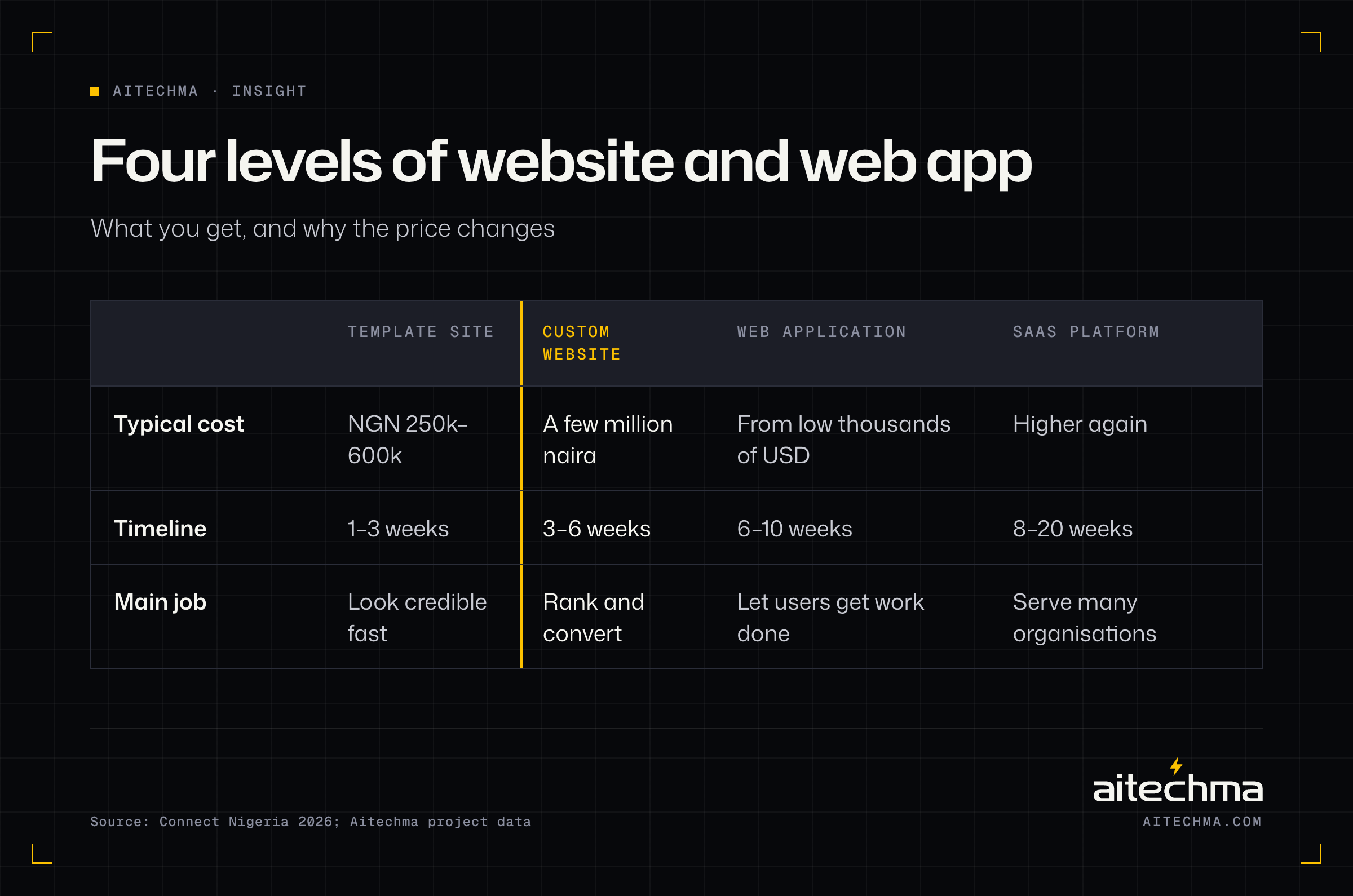
Short answer: in Nigeria going into 2027, a basic template website commonly costs NGN 250,000 to 600,000 [1], a custom business website with a content editor, SEO set-up and lead capture usually costs a few million naira, and a web application (a customer portal, dashboard, marketplace or SaaS product) typically starts in the low thousands of US dollars and rises with users, roles, integrations and data. The single biggest driver is not design. It is how much the software has to do.
This guide explains where those numbers come from, what you get at each level, the costs most buyers forget, and how to brief and choose a team so you pay for your website or web app once instead of twice.
Website or web application: know which one you are buying
Most confusion about price starts here. People ask for "a website" when they need a web application, or ask for "an app" when a fast website would do.
A website mainly shows information. Visitors read about your business, browse services, see prices, contact you and perhaps book a call or pay a deposit. The content changes occasionally and is usually edited by your team through a content management system.
A web application does work. Users sign in, create and change data, and see different things depending on who they are. It enforces rules, talks to other systems and keeps records. Customer portals, internal dashboards, ERP and CRM tools, booking platforms, marketplaces, learning platforms and software-as-a-service products are all web applications.
The difference matters because the cost structures are completely different:
Website | Web application | |
|---|---|---|
Main job | Inform and convert visitors | Let users get work done |
Who logs in | Usually only your editors | Customers, staff, partners |
Core cost driver | Pages, design, content, SEO | Features, roles, data, integrations |
Typical build time | Two to six weeks | Six weeks to several months |
Ongoing cost | Hosting, updates, content | Hosting, support, new features, security |
If your project includes accounts, dashboards, approvals, payments that update records, or anything your staff currently does in a spreadsheet, you are buying a web application, and you should budget and brief accordingly. Our guide to web application development explains the common types in more detail.
The Nigerian price landscape going into 2027
Pricing in Nigeria is unusually spread out because the market includes everyone from students building sites over a weekend to established agencies serving banks and multinationals.
Recent local surveys put basic website design at roughly NGN 250,000 to 600,000 for a small business site [1], and other Lagos agencies publish comparable ranges for template-based work, with custom design and development priced well above that [2]. Those prices usually buy a theme-based site with a handful of pages, a contact form and basic hosting set-up. They rarely include original design, structured SEO, performance work, analytics, or integrations with your other tools.
Further up the market, custom business websites built for search and lead generation cost several times more, because they involve research, copywriting, original design, a proper content model and technical SEO. Web applications sit on a different scale again, and are often quoted in US dollars because senior engineering time is priced against an international market.
None of these levels is wrong. They are different products. The mistake is buying the cheapest level for a job that needs the next one up, then paying again when the site cannot rank, cannot be edited or cannot grow.
Naira or dollars? How quotes are priced
Buyers are sometimes surprised to receive a quote in US dollars from a Lagos company. There are understandable reasons: senior engineers are hired against an international market, many tools and cloud services are billed in dollars, and exchange-rate swings during a long project can turn a fair naira quote into a loss.
Whichever currency you are quoted in, protect yourself with three questions:
Which rate applies, and when? Agree whether payments convert at the rate on the invoice date or a fixed rate for the whole project.
Which costs are pass-through? Hosting, paid plugins, SMS and messaging fees are often billed in dollars by the provider. Ask for these to be listed separately from the build fee.
What happens if the scope changes? Changes priced in a different currency or rate from the original quote cause most billing disputes.
A clear answer to all three is a good sign that the team has done this before.
What you get at each price level
Level 1: template website
Typical cost: NGN 250,000 to 600,000 [1]. Timeline: One to three weeks.
You get a pre-made theme adapted with your logo, colours, photos and text, usually on WordPress or a hosted website builder. It can work well for a new business that needs to look credible quickly.
Watch for: slow page loads from heavy themes and plugins, generic design that looks like competitors, weak SEO structure, unclear ownership of the hosting and domain, and plugins that stop being updated.
Level 2: custom business website
Typical cost: a few million naira, depending on pages, content and integrations. Timeline: Three to six weeks.
You get a site designed around your buyers: research into what they search for, a page structure aimed at those searches, original design, copy that explains your offer clearly, and a content editor your team can use without a developer. Good teams add analytics, schema markup, fast hosting and conversion paths such as WhatsApp chat with a pre-filled message, booking calendars and payment links.
This is the right level for most established businesses whose website is expected to bring in customers. Our website design service works at this level.
Level 3: web application (first version)
Typical cost: from the low thousands of US dollars for a focused first version. Timeline: Six to ten weeks for a focused portal, dashboard or internal tool.
You get secure sign-in, user roles, the core workflow your users need, an admin area, integrations with one or two other systems, cloud hosting and monitoring. A good first version does one job very well and leaves room to grow.
Level 4: SaaS or multi-tenant platform
Typical cost: higher again, because the product must serve many customer organisations, each with its own users, data and billing. Timeline: Eight to twenty weeks for a first version, depending on scope.
You get organisations and teams, roles and permissions, subscription billing in naira and dollars, onboarding, usage analytics and integrations. See our SaaS development page for what goes into these builds.
The seven things that actually drive cost
When two quotes for "the same" project differ by a factor of five, it is almost always because the teams are pricing different assumptions about these seven things.
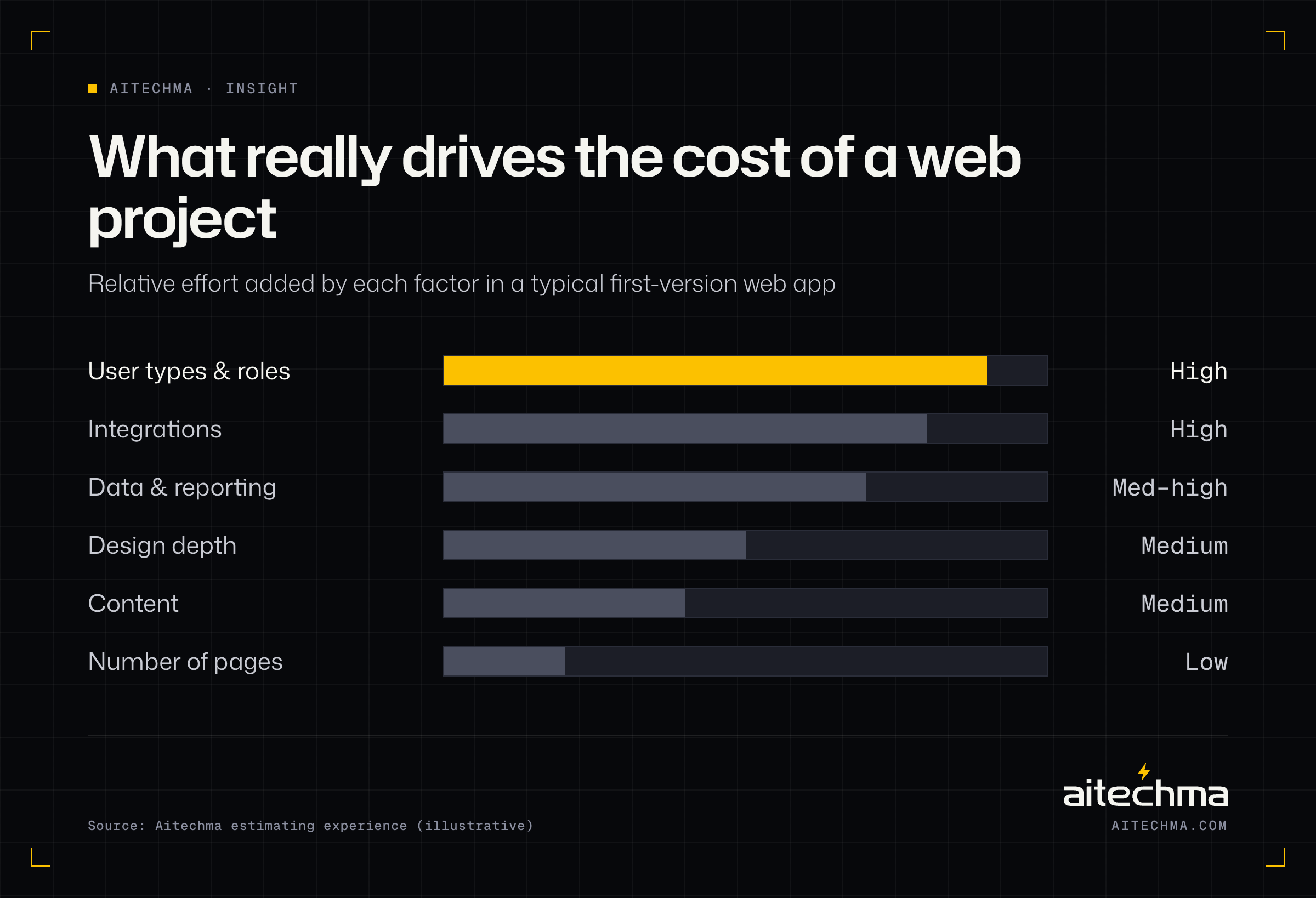
Number of user types. Every distinct kind of user (customer, staff, manager, partner, admin) needs its own screens, permissions and testing. Going from one user type to four can more than double the work.
Integrations. Payment gateways, bank transfers, identity checks, SMS and WhatsApp, accounting software and existing internal systems each add design, development, testing and error handling.
Data and reporting. Simple lists are cheap. Dashboards, exports, filters and reports that finance or management rely on take real effort to get right.
Design depth. A theme adapted with your colours costs far less than original design tested with real users, but the second usually converts better and ages better.
Content. Somebody has to write, structure and maintain the words and images. If the agency writes the content, budget for it.
Performance and reliability. Fast pages on mobile data, uptime monitoring, backups and security reviews are not free, and they matter more as the stakes rise.
Who you are paying for. Junior freelancers, mid-sized agencies and senior product teams charge differently because they carry different responsibility. Ask what you get for the price, not just what the price is.
Costs buyers forget
The quote you sign is rarely the total cost of owning a website or web app. These are the line items that surprise people most often.
Domain and hosting. Usually modest, but recurring, and often priced in dollars. Make sure the domain and hosting accounts are in your company's name.
Paid tools and plugins. Premium themes, form builders, booking tools, email services and analytics can add up to a noticeable monthly bill.
Maintenance and updates. Software ages. Libraries, plugins and frameworks need updates for security. Budget for a small monthly maintenance retainer or in-house time.
Content and SEO over time. A website that never changes rarely ranks. Plan for new pages, articles and updates.
Support after launch. Bugs found by real users, small changes and training for your team.
Data and messaging costs. SMS, WhatsApp Business messaging, email sending and payment processing fees grow with usage.
Rebuilding. The most expensive hidden cost is rebuilding a site or app that cannot grow. Paying a little more for a sound foundation usually costs less over three years.
Design that converts in Nigeria
Good design in Nigeria is not just about looking modern. It is about removing the reasons a visitor leaves without contacting you.
Design for mobile first. Most of your visitors are on phones, many on mobile data. Nigeria had about 157 million internet subscriptions by May 2026, and broadband penetration was around 56% [3], so a large share of your audience is connecting on networks that are not always fast. Keep pages light, images compressed and the main action visible without scrolling.
Make the next step obvious. For most Nigerian buyers that step is a WhatsApp chat or a call, not a long form. Nearly half of the MSMEs surveyed in one IFC study already market on WhatsApp [4], so customers expect to reach businesses there. Put a pre-filled WhatsApp link in the header, on every service page and at the end of every article.
Show prices or price ranges. Buyers in Nigeria are used to being told "call for a quote". Publishing a starting price filters out people who cannot afford you and builds trust with those who can.
Show proof close to the claim. Case studies, client logos and real numbers convince more than adjectives. Put them next to the service they prove, not on a separate page nobody visits.
Write for one reader at a time. "We provide innovative solutions" says nothing. "We build customer portals that let your clients track orders without calling your office" tells a buyer exactly why to keep reading.
Building a website that ranks on Google
Most businesses want their website to bring in customers from search. That depends on decisions made during the build, not after it.
Start with buyer searches. Research what your customers type when they are ready to buy: "web design company in Lagos", "how much does an app cost in Nigeria", "school management software Nigeria". Build one strong page for each important search, rather than one page that tries to rank for everything.
Avoid the job-seeker trap. Searches like "tech companies in Lagos" or "IT companies in Lagos" attract job seekers and students looking for placements, not buyers. If you sell services, target searches with buyer words in them: cost, hire, build, agency, services, near me.
Get the technical basics right. Fast loading, clean URLs, one H1 per page, descriptive titles and meta descriptions, schema markup for your organisation and FAQs, a sitemap, and one version of your domain (with or without www, never both indexed).
Make content easy to update. A content editor your team can use is what keeps a site ranking: new pages, case studies and articles every month.
Earn trust signals. A Google Business Profile with genuine reviews, listings on reputable directories, and links from partners and press.
Choosing a technology: WordPress, website builders or custom code
There is no single best option. Choose based on what the site must do and who will maintain it.
Website builders (hosted drag-and-drop tools) are quick and cheap to start, and fine for simple brochure sites. They become limiting when you need custom features, integrations or serious performance work.
WordPress powers a large share of the web and has a huge ecosystem of themes and plugins. It suits content-heavy sites when it is built carefully and maintained. The risks are bloated themes, too many plugins and missed security updates.
A modern framework with a headless CMS (for example, a React-based framework with a content platform such as Contentful) gives you fast pages, full design control and a clean editing experience. It costs more to build and needs developers for structural changes, but it ages well and scales into web application features.
Custom web application code is the right choice when the product has accounts, workflows, data and integrations. Here the question is not which website tool to use, but which engineering team can design, build and support the system properly.
How to brief an agency (and get comparable quotes)
A clear brief is the fastest way to get accurate quotes and avoid disputes. It does not need to be long. It needs to answer these questions:
What is the goal? Leads, bookings, sales, fewer support calls, or replacing a manual process.
Who uses it? List each type of user and what they need to do.
What must it connect to? Payment providers, WhatsApp, your CRM, accounting software, internal systems.
What content exists? Do you have copy, photos, product data and case studies, or does the agency need to create them?
What does success look like in three months? A number: leads per month, bookings, hours saved.
What is your budget range and deadline? Sharing a range saves weeks of back-and-forth.
What do you already have? An existing site, domain, hosting, brand guidelines or designs.
Send the same brief to every agency you consider. Quotes based on the same brief are comparable. Quotes based on a phone call are not.
Red flags when choosing a web developer
No portfolio of comparable work, or a portfolio of mockups rather than live sites and products.
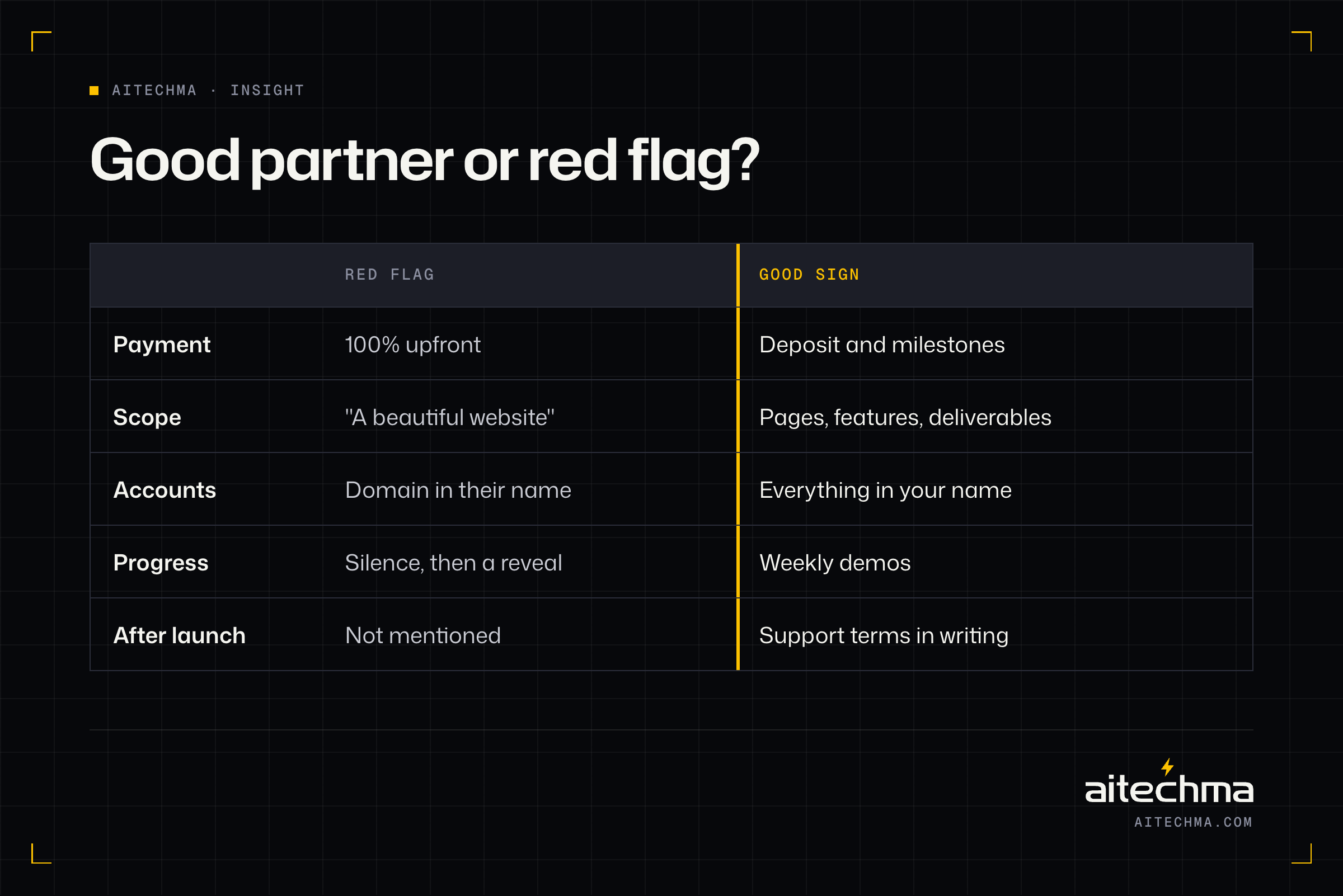
100% payment upfront. Reasonable teams ask for a deposit and milestone payments tied to work you can see.
Vague scope. "A beautiful, responsive website" is not a scope. Pages, features, integrations and deliverables are.
Domain and hosting in the developer's name. Insist that accounts are registered to your business, with your access.
No mention of what happens after launch. Who fixes bugs, applies updates and makes small changes?
No questions about your business. A team that quotes without asking who your customers are is guessing.
Unclear code and design ownership. You should own the code, designs and content you paid for, in writing.
Questions to ask before you sign
Can we see two live projects similar to ours and speak to one of those clients?
Who exactly will work on our project, and what is their experience?
How do you handle changes to scope, and how are they priced?
What is included after launch, and for how long?
How will we track progress? Will we see working software every week?
Who owns the domain, hosting, code and designs when the project ends?
How do you test for speed and mobile performance before launch?
What happens if a key team member leaves mid-project?
A realistic timeline
For a custom business website, a good team typically spends the first week on research, goals and page structure; the second on content and wireframes; weeks three and four on design and build; and the final week on testing, speed, SEO checks and launch. Template sites are faster; sites with lots of content or integrations take longer.
For a first-version web application, expect roughly a week or two of discovery and scoping, one to two weeks of design and prototyping, then four to six weeks of building in short cycles with weekly demos, followed by testing, data migration and launch. Our MVP development process follows this pattern.
The fastest projects are not the ones with the most developers. They are the ones where decisions are made quickly, content is ready on time and scope stays stable.
How to avoid paying twice
Most expensive website and web app stories in Nigeria are stories of paying twice: once for a cheap version that does not work, and again for the version that does. These habits prevent that.
Buy the right level first. If you need accounts, workflows or integrations, budget for a web application, not a template site with plugins bolted on.
Own your accounts. Domain, hosting, code repositories and analytics in your company's name from day one.
Insist on a content editor. If every text change needs a developer, the site will stop being updated.
Pay in milestones. Tie payments to working software you can see.
Ask for documentation. A short handover document on how the site is built, hosted and updated saves future teams weeks.
Plan the first three months after launch. Budget time for fixes, improvements and content.
Frequently overlooked: accessibility and performance
Two things separate professional builds from amateur ones and are almost never in cheap quotes.
Accessibility means people with visual, motor or cognitive impairments can use your site: readable contrast, text alternatives for images, keyboard navigation and clear structure. It also tends to improve SEO and usability for everyone.
Performance means pages load quickly on a mid-range Android phone on mobile data. Test your site on a real budget phone, not just a laptop on office Wi-Fi. Large uncompressed images, auto-playing video and heavy plugins are the usual culprits.
Ask any agency how they test both. A confident, specific answer is a good sign.
Web apps: the extra questions that matter
If you are building a web application, add these questions to your brief and conversations.
How will user data be protected? Authentication, permissions on every request, encryption and backups.
How will it scale? What happens when users grow from one hundred to ten thousand?
How will you test it? Automated tests on critical flows such as sign-up, payments and the core workflow.
How will we see what users do? Analytics and error monitoring from day one.
What happens to our data if we change provider? Exports, documentation and code ownership.
Are there regulatory requirements? Fintech, health and education products may carry rules about data location, consent and audit trails. If your product moves money, read our guide to fintech app development.
Budget planning template
Use this structure to plan your total first-year budget rather than just the build price:
Cost line | One-off | Monthly |
|---|---|---|
Discovery and design | Yes | |
Build | Yes | |
Content and copywriting | Yes | Optional |
Domain and hosting | Yes | |
Paid tools and services | Yes | |
Maintenance and security updates | Yes | |
SEO and new content | Yes | |
Support and small changes | Yes |
Most businesses find the monthly costs are what decide whether a website keeps working for them. Plan them before you start.
Do you need a website if you already sell on Instagram and WhatsApp?
Many Nigerian businesses run successfully on Instagram, TikTok and WhatsApp alone. So is a website worth paying for? Usually yes, for three reasons, but the website's job is different from the social accounts' job.
Search is a different audience. Social media reaches people who already follow you or happen to see your content. A website reaches people actively searching for what you sell, at the moment they are ready to buy. Those visitors often have bigger budgets and clearer intent.
You own it. Social platforms change their rules, reach and fees, and accounts can be restricted. A website on your own domain, with your own contact list, is an asset nobody can switch off.
It answers questions at scale. Prices, delivery areas, policies, case studies and FAQs on a website save your team from answering the same questions in DMs every day, and make you look more established to corporate buyers.
The best set-up for most businesses uses both. Social media builds attention, the website captures search demand and proves credibility, and WhatsApp closes the sale. Link them together: every page offers a WhatsApp chat, and every social profile links to the most relevant page, not just the homepage.
How to judge a website after launch
A launched website is not automatically a working one. Three months after launch, check these five things:
Is it being found? In Google Search Console, look at which searches show your pages and how often people click. Rising impressions for buyer searches mean the structure is working.
Are visitors taking the next step? Track WhatsApp clicks, form submissions, bookings and calls as goals in your analytics. A site with traffic but no actions has a conversion problem, not a traffic problem.
Is it fast on a phone? Open it on a budget Android phone on mobile data. If you wait, so do your customers.
Is the content current? Old prices, past events and missing services quietly cost you trust.
Who is it attracting? If most enquiries are job applications or irrelevant requests, your pages may be ranking for the wrong searches. Adjust titles and content towards buyer language.
Fixing what these checks reveal is usually cheaper and faster than a redesign.
Five example projects and what drives their price
Numbers make more sense with examples. These five composite projects are typical of what Nigerian businesses ask for. They are illustrative, not quotes, and real prices depend on the details.
1. A Lagos law firm's website. Eight pages, practice-area pages aimed at specific searches, partner profiles, a short articles section, a WhatsApp button and a consultation booking form. The cost is mainly in content and design: the firm has little written material, so copywriting is a big share of the budget. A custom business website is the right level; a template would look like every other firm's.
2. A logistics company's customer portal. Business customers sign in, book pickups, track deliveries, download invoices and see their monthly spend. Three user types (customer, dispatcher, finance), integration with the existing dispatch system and Paystack, and an admin dashboard. This is a first-version web application, and the integrations drive the cost more than the screens.
3. A school's management system. Admissions forms, fee payments, results publication, timetables and parent messages. Four user types (admin, teacher, parent, student), payments, bulk SMS or WhatsApp notifications and printable reports. A web application with a mobile-friendly parent view. Data migration from existing spreadsheets is a real cost line here.
4. A manufacturer's internal operations tool. Stock levels across two warehouses, purchase approvals, sales orders and a management dashboard replacing several spreadsheets. Few users but complex rules, and accurate reporting matters to the owners. Process mapping at the start saves money later, because the rules are rarely written down anywhere.
5. A B2B SaaS product for clinics. Clinics sign up, add staff, manage appointments and send reminders, paying a monthly subscription in naira. Multi-tenancy, roles, billing, onboarding and analytics. This is the highest level in this guide because the product has to work for many organisations at once, not just one.
Notice the pattern: the more users, rules, integrations and organisations, the higher the price. Page count matters much less than buyers expect.
Do you need an online store?
Many businesses ask for "a website where people can buy". Before choosing how to build it, answer three questions.
How many products, and how often do they change? A dozen products with stable prices suit a simple product catalogue with payment links or a hosted store builder. Hundreds of products with stock levels and variations need a proper commerce platform.
How do customers actually buy today? If most orders already come through WhatsApp or Instagram, a catalogue that hands customers to a WhatsApp chat with the item pre-filled, plus a payment link, may convert better than a full checkout. Do not force a buying process your customers do not use.
What happens after payment? Delivery, stock updates, invoices and returns are where online stores create work. If your team will still update a spreadsheet after every order, budget for integrations that remove that step.
A hosted store builder is usually the cheapest way to start selling. A custom build makes sense when your products, pricing rules, delivery logic or integrations do not fit what the hosted tools offer.
Hosting options compared
Hosting is often an afterthought, then a source of slow pages and outages. These are the common options and when each makes sense.
Option | Good for | Watch out for |
|---|---|---|
Shared hosting | Small, low-traffic sites | Slow pages, noisy neighbours, limited control |
Managed WordPress hosting | Content sites on WordPress | Cost rises with traffic and plugins |
Static or edge hosting | Fast marketing sites on modern frameworks | Needs a developer for structural changes |
Cloud platforms | Web applications and APIs | Needs proper set-up, monitoring and cost control |
Local data centres | Data that must stay in Nigeria | Fewer managed services, plan capacity early |
Whatever you choose, make sure the account belongs to your company, that backups run automatically and that someone is alerted when the site goes down.
Maintenance plans explained
A website or web app is not finished at launch. Something has to keep it secure, fast and current. There are three common approaches.
Pay as you go. You call the developer when something breaks. It is the cheapest option until something breaks at the wrong moment, and response times are not guaranteed.
Monthly maintenance retainer. A fixed monthly fee covers security updates, backups, uptime monitoring, small fixes and a set number of hours for changes. This suits most business websites.
Product retainer. For web applications, a monthly team commitment covers support, bug fixes and new features delivered in regular cycles. This suits products that are still growing.
Ask any agency which of these they offer, what response times they commit to, and what happens if you decide to move to another provider.
Working with an agency, week by week
Knowing what a good engagement looks like helps you spot a bad one early. For a typical custom business website, expect something like this:
Week 1: discovery. Goals, audience, competitors, keyword research and page structure. You should finish the week with a sitemap and a clear list of what content is needed.
Week 2: content and wireframes. Copy drafted for the main pages, and simple layouts showing what goes where. This is the cheapest point to change your mind.
Week 3: design. Visual designs for key pages on mobile and desktop. Review them on your own phone, not just in a presentation.
Week 4: build. Pages built, the content editor set up and integrations connected. You should see a working staging site you can click through.
Week 5: testing and launch. Speed tests on mobile, SEO checks, form and payment tests, redirects from any old site, analytics and Search Console set up, then launch.
For web applications, replace the middle weeks with short build cycles that each end in a demo of working software. If a team goes quiet for three weeks and then reappears with a finished product, you have lost the chance to correct course cheaply.
Glossary for non-technical buyers
CMS (content management system). The tool your team uses to edit pages and publish articles without writing code.
Headless CMS. A CMS that stores content separately from the website's design, so the same content can feed a website, an app and other channels.
Hosting. The servers that store your website and deliver it to visitors.
Domain. Your web address, such as yourbusiness.com. Register it in your company's name.
SSL certificate. What makes your site load over https with a padlock in the browser. It should be free and automatic with modern hosting.
Responsive design. Layouts that adapt to phones, tablets and desktops.
Technical SEO. The behind-the-scenes work that helps search engines read and rank your pages: speed, structure, schema markup and sitemaps.
Staging site. A private copy of your site where changes are tested before going live.
Web application. Software that runs in a browser and lets users sign in and get work done.
Multi-tenant. A product that serves many customer organisations from one system while keeping each one's data separate.
Getting a fast, honest estimate
If you want a quick range before talking to anyone, use our project estimator. It asks what you are building, which features you need and how fast you need it, then gives you a price range, a timeline and a brief you can send to any agency, including us.
How Aitechma can help
Aitechma is a software engineering company in Ikeja, Lagos. We design and build custom business websites that are built to rank and convert, and web applications such as portals, dashboards, ERP and CRM tools and SaaS products for businesses in Nigeria and abroad. We publish starting prices, work in milestones with weekly demos, and you own everything we build.
If you are planning a website or web app, see how we build web applications, look at our website design service, or get an instant estimate.
Frequently asked questions
A basic template website commonly costs NGN 250,000 to 600,000. A custom business website with original design, a content editor, SEO set-up and lead capture usually costs a few million naira. Web applications are priced separately because they involve accounts, workflows and integrations.
A website mainly shows information and converts visitors. A web application lets users sign in and get work done, such as tracking orders, approving requests or managing records. Web applications cost more because they include roles, data, rules and integrations.
Template sites can take one to three weeks. A custom business website usually takes three to six weeks. A focused first-version web application typically takes six to ten weeks.
WordPress suits content-heavy sites when it is built and maintained carefully. A modern framework with a headless CMS gives faster pages and full design control. Custom application code is right when the product has accounts, workflows and integrations.
Domain and hosting, paid tools and plugins, maintenance and security updates, new content and SEO, support after launch, and usage-based fees for SMS, WhatsApp, email and payments.
Your business. Register the domain, hosting, code repositories and analytics accounts in your company's name, and give your developer access rather than ownership.
Sources
- Connect Nigeria. How much does website design cost in Nigeria in 2027? (2026)
- Kolonell. Website design cost in Lagos: agency pricing 2026 (2026)
- Techeconomy. Nigeria internet subscriptions rise to 157.4 million as broadband penetration hits 56.1% in May (2026)
- IFC. Nigeria MSME Finance Market Bite (2022)
Need help with web applications?
Talk to the Aitechma team in Ikeja about your product, timeline and the fastest path to a working release.
See web applications