
How to Take Your African Product to the US Market: The 2027 Go-to-Market Guide for Nigerian Startups
A practical 2027 go-to-market guide for Nigerian and African startups: evaluate global potential, pick a first market, price in USD, win with SEO and AEO, and land a first foreign order.

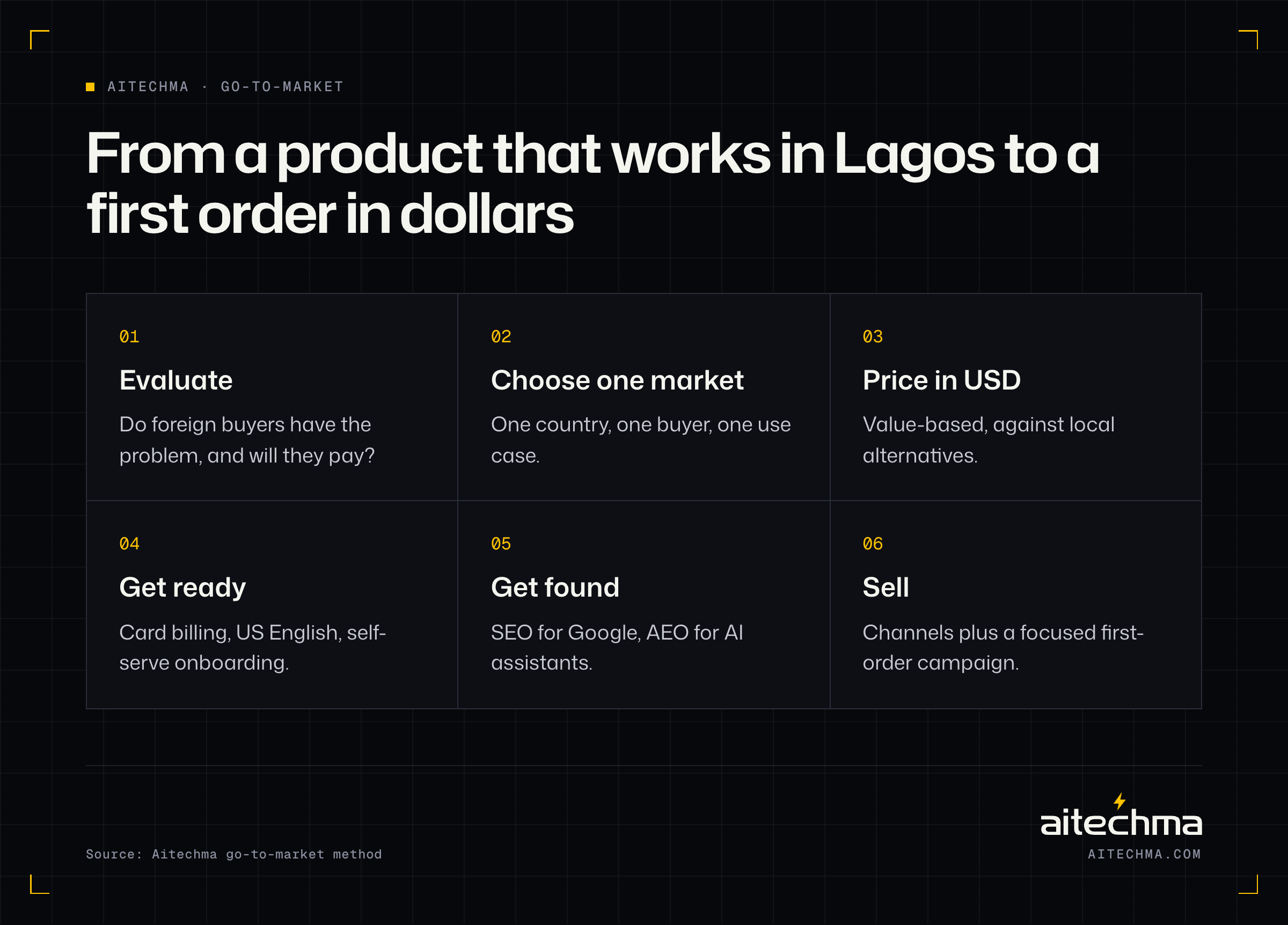
Short answer: to sell an African product in the US, UK or Europe, start by proving that foreign buyers have the problem you solve and already pay to solve it. Then pick one market and one type of buyer, set a US dollar price based on the value you deliver (not a converted naira price), and make the product easy to buy from abroad: card billing, US English, self-serve onboarding and the trust pages foreign buyers look for. Get found through search and AI assistants (SEO and AEO), open the two or three distribution channels where your buyers already gather, and run a focused campaign to win the first order. With that sequence, a first foreign order within three months and a steady, growing flow by month six are realistic targets for a ready product, though no one can promise them.
This 2027 guide is for founders, product leads and growth teams in Lagos, Abuja, Nairobi, Accra and across Africa who have built something that works at home and want to earn in dollars, pounds or euros. It covers the full go-to-market strategy: evaluating global potential, choosing the first market, pricing, product readiness, SEO and AEO for foreign buyers, distribution channels, the first-order campaign and a three-month and six-month plan. If you would rather have a team run it with you, see our US market entry and go-to-market service.
Why 2027 is the year to sell abroad
Three forces make international expansion more urgent for Nigerian startups than it was even two years ago.
Naira revenue keeps shrinking in dollar terms. Economists expect the naira to remain under pressure[8]. If your costs include cloud bills, software licences, devices and salaries benchmarked against remote offers, every naira you earn buys less of what you need. A share of revenue in a hard currency is the most direct hedge a software business has.
African products are already proving they can travel. NOTAP reported that Nigerian-built applications passed USD 1 million in sales across more than 50 locally developed apps, with over 60% of those sales coming from other African countries[6]. That is a small number, but it shows the pattern: products built here are being bought elsewhere, mostly next door for now. Coverage of made-in-Nigeria brands scaling globally tells the same story at a larger scale[7]. The next step for many of these products is the US, UK and Europe, where software budgets are far bigger.
Foreign buyers no longer need to meet you. A buyer in Ohio or Manchester used to discover vendors through sales reps, conferences and analyst reports, all of which favour companies with offices and travel budgets. Today, 61% of B2B buyers say they prefer a buying experience without a sales rep at all[4], and half of software buyers now start their research with an AI chatbot more often than with Google[1]. A Lagos team with a strong website, good content and a clear presence in AI answers can be found by the same buyers as a San Francisco team. That levels the field more than any previous shift in how software is bought.
The opportunity is real, but so is the waste. Many African startups spend months on a US entity, a US website and paid ads, then discover their product does not fit the market they picked. The rest of this guide is about avoiding that.
What a go-to-market strategy actually is
A go-to-market (GTM) strategy is the plan for how a specific product reaches a specific buyer in a specific market and turns into revenue. It answers five questions:
Who exactly is the buyer? Not "SMEs in America" but "operations managers at US home-care agencies with 20 to 200 caregivers".
What problem do they pay to solve, and what do they use today? Their current tool, spreadsheet or agency is your real competitor.
Why should they choose you? Your positioning: the one reason you are the better choice for this buyer.
What does it cost, and how do they pay? Pricing, packaging and the payment path.
How will they find you and buy? Channels, content, search, AI answers, partners and the sales motion.
A GTM strategy for Nigeria and a GTM strategy for the US share the same questions but rarely the same answers. The buyer, the competitors, the price and the channels all change when you cross a border. That is why "we'll just launch in the US" is not a strategy. It is a wish.
For startups that also need help with the product itself, GTM and product work overlap. Positioning shapes the roadmap, and buyer feedback from the first campaign often decides what gets built next. Our guide to product management for startups covers that side in more depth, and our fractional product managers can run it with you.
Step 1: Evaluate your product's global potential
Before you spend on a foreign market, find out honestly whether your product can win there. We run this as a short, fixed evaluation at the start of every engagement, because it is the cheapest point to discover a "not yet".
The five tests
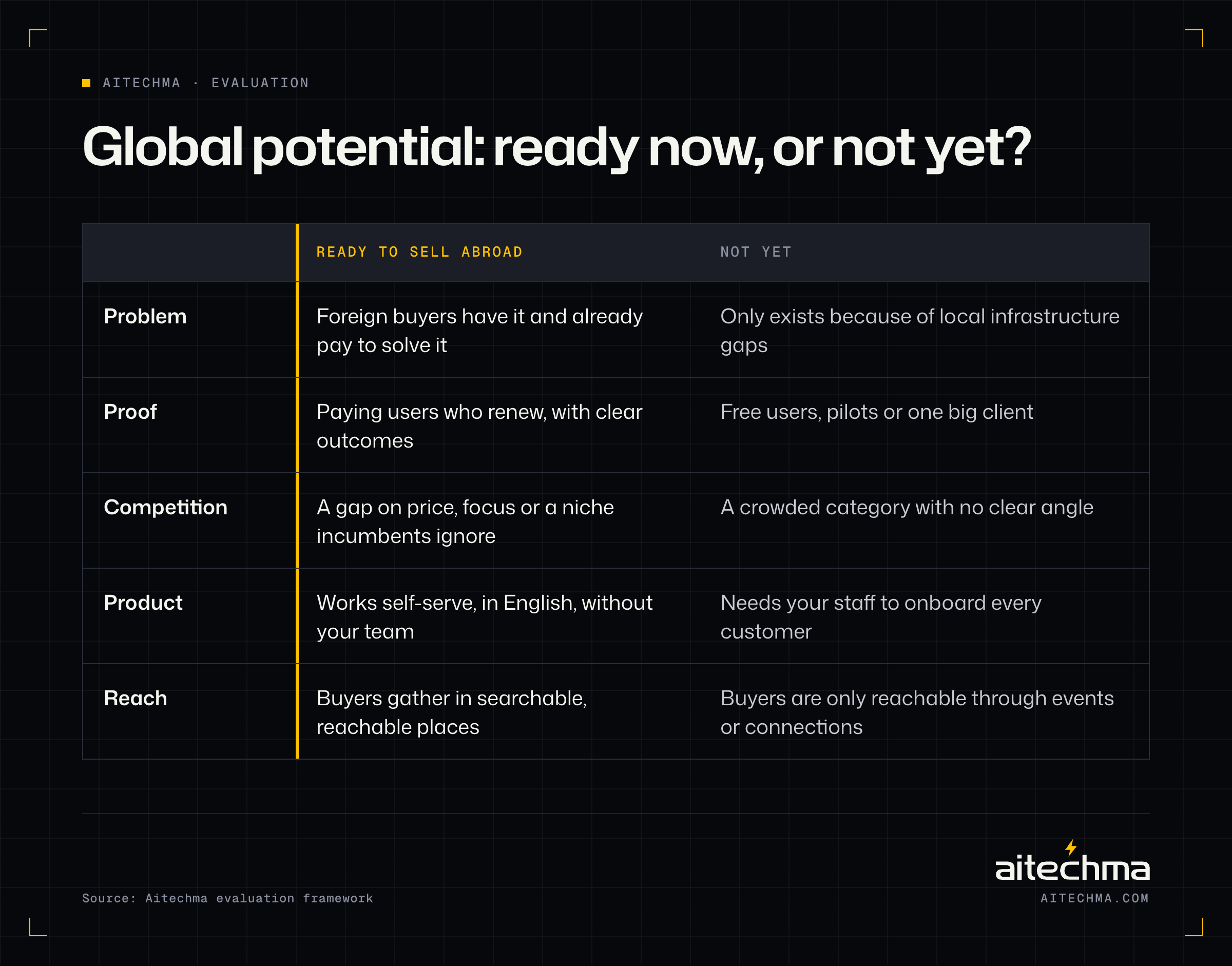
1. Do foreign buyers have the problem? Some problems exist mainly because of local infrastructure gaps: unreliable power, cash-heavy commerce, missing credit data. Products built around them are valuable at home but may have no equivalent buyer in the US. Other problems are universal: scheduling, invoicing, compliance tracking, customer support, data cleaning, hiring workflows. The more universal the problem, the stronger the case.
2. Do they already pay to solve it? The best sign of a market is money already being spent. If US buyers pay competitors, agencies or staff to solve the problem, you can win some of that budget. If nobody pays today, you are creating a category, which is slow and expensive from 8,000 kilometres away.
3. Is there a gap you can own? Look at the incumbents. Are they expensive, bloated, focused on enterprise, slow to support, or ignoring a niche? A gap on price, focus or service is the usual entry point for a smaller team.
4. Does your product work without your team? Many African B2B products succeed at home because the team onboards each customer personally, often over WhatsApp. Foreign buyers expect to sign up, learn and get value with little or no human help. If your product depends on your staff to work, that is the first gap to close.
5. Can you reach the buyers? Some buyers gather in searchable, reachable places: Google searches with clear intent, marketplaces, app stores, communities and review sites. Others are reachable only through industry events and personal connections. The first group suits a remote team. The second needs partners or a much longer timeline.
How to run the evaluation in two weeks
You do not need a research agency. You need focused desk research and a handful of conversations.
Search research. Use keyword tools set to the US or UK to see how many people search for the problem, your category and your competitors' names. Look at what ranks and what AI assistants say when you ask them for recommendations in your category.
Competitor teardown. List five to ten competitors. Record their prices, plans, positioning, reviews and the complaints that appear again and again on review sites. Complaints are your opportunity map.
Buyer conversations. Speak to five to ten people who match your target buyer abroad. Diaspora networks, LinkedIn and industry communities make this easier than it sounds. Ask how they solve the problem today, what it costs them and what frustrates them. Do not pitch.
Product gap review. List what a foreign buyer would need that your product lacks: card billing, integrations with US tools, US date and currency formats, compliance pages, support hours.
Channel check. Identify where these buyers already look: which marketplaces, app stores, communities, newsletters and partners.
The output should be a written verdict, not a deck: ready now, ready after specific fixes, or not a fit for foreign markets yet. If the answer is "not yet", knowing in week two is far cheaper than finding out in month six.
Step 2: Choose your first foreign market
The most common mistake is trying to sell "globally" from day one. A small team can only build content, partnerships, proof and pipeline for one market at a time. Pick one country, one buyer and one use case, and win there before you widen.
US, UK or EU?
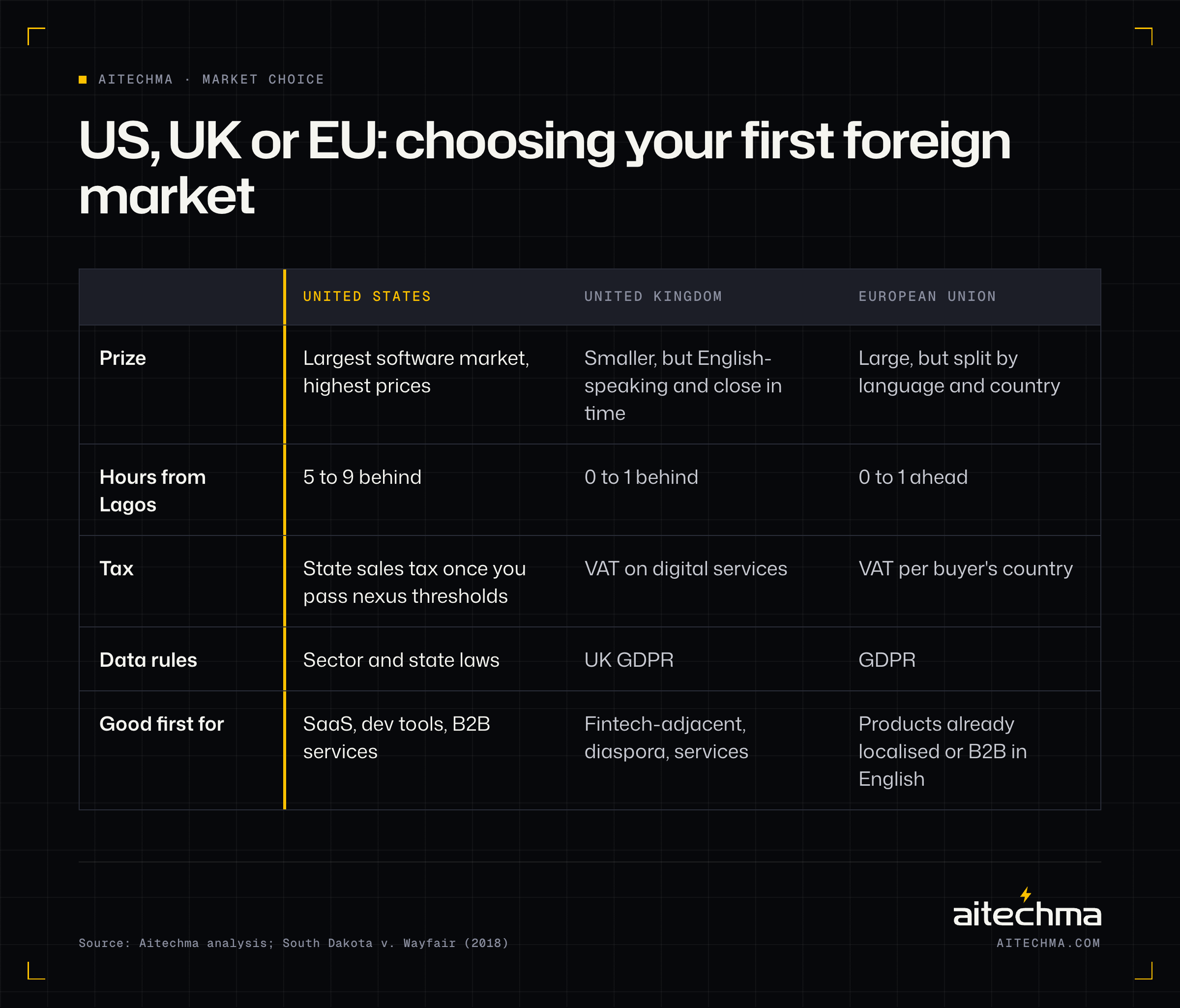
The United States is the largest software market and usually pays the highest prices. Buyers are used to self-serve SaaS, card billing and trying tools without talking to sales. The trade-offs: competition is intense, the time difference is five to nine hours behind Lagos, and once you sell enough into a state you may have sales tax obligations there[15]. The US is a strong first market for SaaS, developer tools, AI products and specialist B2B services.
The United Kingdom is smaller but English-speaking, culturally familiar to many Nigerian teams, and within an hour of Lagos time. It has a large Nigerian diaspora, a strong fintech sector and a services market that is used to working with offshore teams. It is often a sensible first step for fintech-adjacent products, services and products with a diaspora audience.
The European Union is large but fragmented by language, payment habits and country. Selling across the EU means VAT in each buyer's country and GDPR compliance from the start. It suits products that are already localised or B2B products whose buyers work comfortably in English, such as developer tools.
Other options deserve a look too. Canada behaves like a smaller US. The Gulf states are close in time and growing fast. And sometimes the best first foreign market is another African country, as the NOTAP data suggests[6], before you take on the US.
Pick a beachhead, not a country
Within your chosen market, narrow further. A beachhead is a group of buyers small enough to dominate and similar enough that one message, one price and one set of channels reach them all. Good beachheads share three traits:
A sharp, shared pain your product solves better than their current option.
A reachable gathering place: a search term, a marketplace category, a community or a partner who already serves them.
Word of mouth: buyers who talk to each other, so each win makes the next one easier.
"Small US accounting firms that serve Nigerian and Ghanaian diaspora clients" is a beachhead. "US small businesses" is not.
Do not forget the diaspora
Nigerians abroad sent home about USD 20.9 billion in 2024[9], a measure of how large, connected and economically active the diaspora is. For many products, diaspora buyers are a natural first customer group: they understand your context, trust your brand faster and talk to each other in communities you can reach. They are also often decision-makers inside foreign companies. Treat the diaspora as a channel and an early customer group, not as the whole market. Products that only ever sell to the diaspora stay small.
Step 3: Position your product and price it in US dollars
Positioning for a foreign buyer
Positioning is the reason a buyer should choose you over everything else they could do. For a foreign market, write it in one sentence using this frame:
For [specific buyer] who [specific problem], [product] is a [category] that [key benefit]. Unlike [main alternative], we [key difference].
Then test it. Show it to the people you interviewed in Step 1 and ask what they think the product does. If they cannot repeat it back accurately, rewrite it.
Three positioning traps catch African startups abroad:
Leading with geography. "Built in Africa" is a great story for press and the diaspora, but foreign buyers mostly buy outcomes. Lead with the result; tell the origin story on the About page.
Leading with cheap. Being cheaper can open doors, but positioning on price alone attracts the buyers most likely to leave and makes buyers worry about quality. Lead with a focused benefit and let the fair price be a supporting reason.
Copying the incumbent's message. If your homepage reads like a smaller version of the market leader's, buyers have no reason to switch. Find the specific angle the leader ignores.
How to set a USD price
Do not convert your naira price at today's rate. Your naira price reflects Nigerian purchasing power and Nigerian alternatives. A US buyer compares you with US alternatives and with the cost of the problem.
Use this sequence:
Find the value metric. Decide what a customer pays more for as they get more value: users, locations, transactions, records or usage. Pricing research has long found that the right value metric matters more than the exact price point.
Anchor on alternatives. List what buyers pay today: competitors' plans, an agency's fee, or the staff time the problem consumes. Your price should sit sensibly against those, not against your costs.
Build three plans. A starter plan for small teams, a main plan for your target buyer and a higher plan for larger accounts. Most buyers choose the middle.
Offer annual billing. A discount of around two months for annual payment brings cash forward, which matters when every dollar converts into a weakening currency.
Decide on a trial. Self-serve products usually need a free trial or free plan, because buyers who prefer not to speak to sales[4] want to try first.
Review after twenty conversations. If nobody pushes back on price, you are probably too cheap.
A practical example: a Lagos team selling scheduling software to Nigerian clinics at the naira equivalent of a few dollars per clinic per month might find US clinic buyers comparing it with tools that cost USD 30 to 100 per provider per month. Pricing at a fraction of that, but well above the naira equivalent, can still be the best deal in the market while transforming the company's dollar revenue.
The proof foreign buyers need
Buyers abroad will ask, often silently: is this company real, is it safe, and will it still exist next year? Answer before they ask:
Case studies with named results, ideally including any foreign customers you already have.
Reviews on the review sites your buyers check.
A clear security and data protection page.
Real people and a real address on the About page, and a fast, human reply to every enquiry.
Integrations with tools the buyer already uses, which signal that you belong in their stack.
Step 4: Get the product ready for foreign buyers
This is where many international launches quietly fail: the marketing works, but the product makes buying hard. Fix these before you spend on reach.
Getting paid
You need a way for a foreign buyer to pay by card, in dollars, with a receipt their finance team accepts. The main routes are:
A Nigerian gateway with international cards. Gateways such as Paystack and Flutterwave can accept international cards, and some support USD settlement for eligible businesses. Check current terms, settlement currency and fees with your provider.
A merchant of record. Services like Paddle act as the legal seller of your software, calculate and remit sales tax and VAT, and pay you out[13]. You pay a higher fee per transaction, but you avoid registering for tax in many jurisdictions. For a small team selling software worldwide, that trade is often worth it.
A US entity. Forming a US company, for example through Stripe Atlas, gives you a US entity, a tax ID and access to US payment and banking partners[14]. It helps with enterprise buyers and investors, but it adds cost, filings and tax obligations. Get advice from an accountant who works with cross-border startups before you form one.
Whichever route you choose, the checkout must show prices in the buyer's currency, accept major cards, send proper invoices and handle failed payments and renewals automatically. Our SaaS development team builds this billing layer regularly.
US English and local formats
Foreign buyers notice small details, and those details shape trust.
Use US spelling and vocabulary for US buyers (or UK spelling for UK buyers): "organization", "color", "check", "zip code".
Show dates as MM/DD/YYYY for the US, and support local time zones throughout the product.
Format currency as USD 1,250.00 or $1,250.00, and phone numbers and addresses in local formats.
Rewrite copy that relies on Nigerian context, such as references to BVN, naira or local banks, for the foreign version.
Write clearly and directly. Foreign buyers skim; short sentences and plain words convert better.
Self-serve onboarding
If a buyer cannot reach value without a call, most will not reach it at all. Map the path from sign-up to the first moment the product is useful (the "aha" moment), and remove every step that is not essential.
A sign-up that takes under two minutes, with Google or Microsoft sign-in.
Sample data or templates so the product is never empty.
A short checklist that guides the first session.
Help articles and short videos for every core task.
Emails that bring back users who stall.
Support that answers within hours during the buyer's working day, which may mean shifting some support hours to cover US mornings.
Trust, legal and compliance pages
Foreign buyers, especially businesses, look for these pages before they buy:
Privacy policy that covers the buyer's jurisdiction (GDPR and UK GDPR for Europe and the UK, plus relevant US state laws).
Terms of service and, for B2B, a data processing agreement.
Security page describing hosting, encryption, access control, backups and incident response.
Status page showing uptime.
Accessibility basics, which many US organisations now expect.
Larger US buyers may send a security questionnaire or ask about SOC 2. You do not need a SOC 2 report for your first small customers, but you should be able to answer the questionnaire honestly and know your path to one. A fractional CTO can own this work if you do not have a senior technical lead.
Integrations
Buyers adopt tools that connect to what they already use. Check which integrations your US competitors advertise most: common ones include Google Workspace, Microsoft 365, Slack, HubSpot, Salesforce, QuickBooks, Zapier and Shopify. One or two well-chosen integrations can matter more than ten new features.
Step 5: Get found with SEO and AEO
Foreign buyers cannot meet you at a Lagos event. They search Google, read review sites and, increasingly, ask ChatGPT, Gemini, Claude or Perplexity which tools to use. Being visible in both search results and AI answers is the cheapest way for a small team to reach buyers in another country, and it keeps working after the campaign ends.
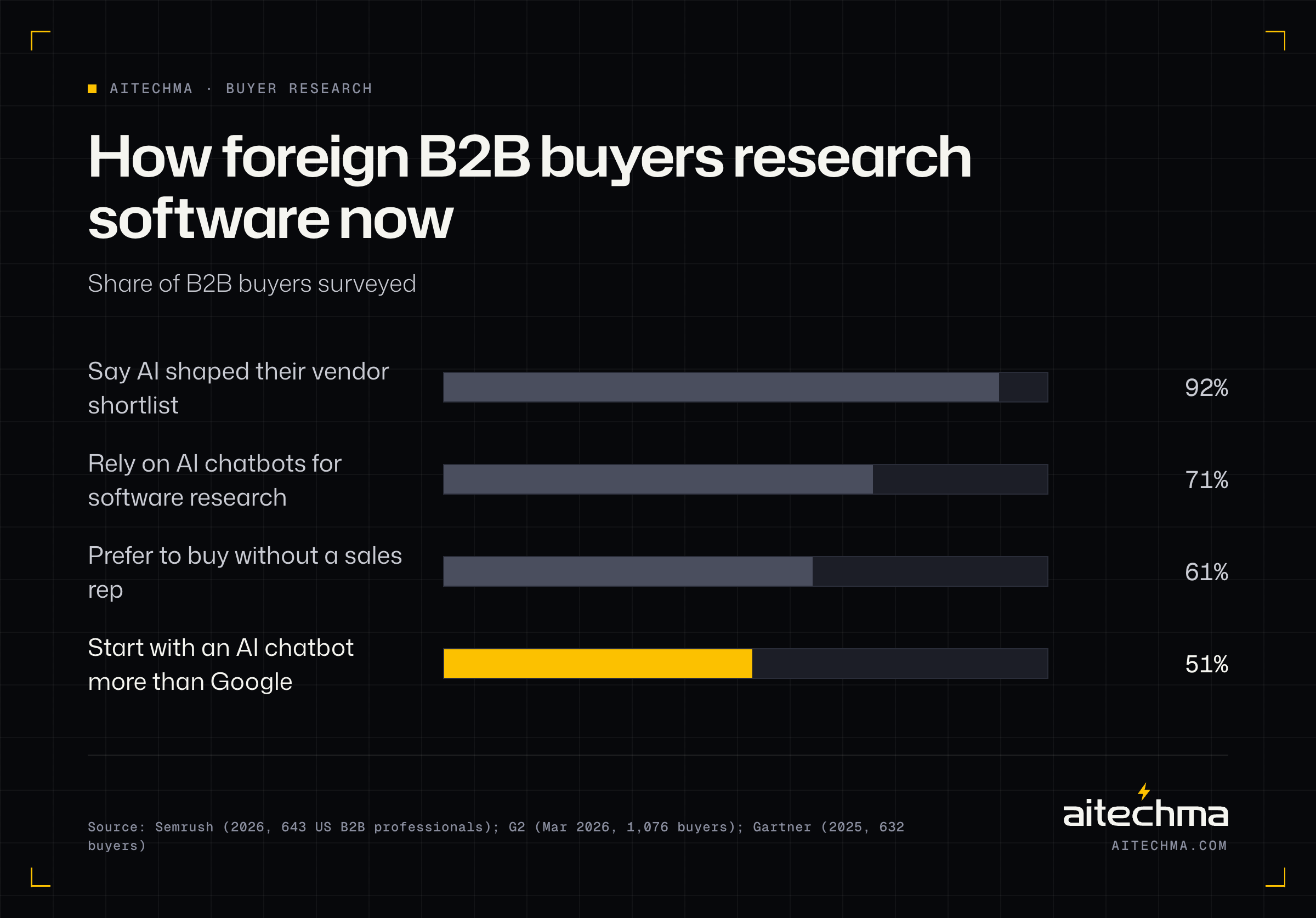
The numbers explain why. In G2's March 2026 survey of more than 1,000 buyers, 51% said they now start software research with an AI chatbot more often than with Google, up from 29% a year earlier[1]. In G2's 2025 research, AI chatbots were already the top source influencing vendor shortlists[2]. A 2026 Semrush study of 643 US B2B professionals found that 92% said AI had shaped their vendor shortlist[3]. If your product is missing from those answers, many foreign buyers will never see it.
SEO: ranking where foreign buyers search
Search engine optimisation (SEO) gets your pages ranking in Google and Bing for the searches your buyers make. For a foreign market, it starts with the buyer's language, not yours.
Research keywords in the target market. Set your tools to the US or UK. Look for searches that show buying intent: "[category] software for [industry]", "[competitor] alternatives", "[competitor] vs [competitor]", "how to [job your product does]" and "[problem] template".
Build pages for each kind of intent:
Use-case pages for each industry or job you serve, written in that buyer's words.
Comparison and alternative pages that honestly compare you with the tools buyers already know.
Integration pages for each tool you connect to.
Pricing page that is clear, public and complete.
Guides and templates that answer the questions buyers ask before they are ready to buy.
Write for people first. Google's guidance is clear that it rewards helpful, reliable content written for people, with first-hand experience and expertise behind it[16]. Thin, mass-produced articles may get indexed but rarely rank or convert. Every page should answer a real question better than the pages already ranking.
Get the technical basics right. Fast pages, clean URLs, mobile-friendly layouts, an XML sitemap, sensible internal links and hosting that serves foreign visitors quickly. If you serve both Nigerian and US buyers, use separate pages or sections with hreflang tags rather than mixing both audiences on one page.
Earn links and mentions. Links from respected sites in your target market (industry publications, partner directories, podcasts, guest articles and review sites) remain one of the strongest ranking signals.
AEO: being the answer AI assistants give
Answer engine optimisation (AEO), also called generative engine optimisation, is the work of getting your product described accurately and recommended in AI-generated answers. It matters more each year, because AI summaries are taking clicks that once went to websites. An Ahrefs study found that when Google showed an AI Overview, the click-through rate for the top-ranking page fell by about a third[5]. If the answer is on the results page, you need to be in the answer.
What helps AI assistants describe and recommend you:
Clear, factual pages. State plainly what your product is, who it is for, what it costs, what it integrates with and how it compares with alternatives. AI systems repeat clear statements; they struggle with vague marketing copy.
Question-and-answer content. Write FAQ sections and guides that answer the exact questions buyers ask, in the first sentence of each answer.
Structured data. Use schema markup for your organisation, product, software application, FAQs and articles, so search engines and AI systems can read the facts reliably[17].
Third-party presence. AI answers draw heavily on review sites, comparison articles, community discussions and directories. Profiles and reviews on the sites your buyers trust matter as much as your own website.
Consistency. Use the same product name, category and description everywhere. Conflicting descriptions confuse people and machines alike.
Fresh facts. Keep pricing, features and integrations current. Outdated facts get repeated for months.
Brand fame matters less than many founders fear. In the Semrush study, only 7% of respondents said brand recognition decides whether they notice a vendor named in an AI answer[3]. A small, well-described product can appear alongside the leaders.
Measuring SEO and AEO
Track rankings and organic sign-ups from the target country in Google Search Console and your analytics. For AEO, keep a fixed list of 20 to 30 buyer questions, ask them in the main AI assistants every month, and record whether you are mentioned, how you are described and which sources are cited. Sign-up forms should also ask "How did you hear about us?", with an option for AI assistants.
Choosing an SEO company in Lagos (or anywhere)
Many startups hire an SEO agency for this. If you do, whether you choose us or another SEO company in Lagos or elsewhere in Nigeria, ask these questions:
Can you show results for clients selling to US, UK or EU buyers, not just Nigerian traffic?
How do you approach AEO and AI visibility, and how do you measure it?
Who writes the content, and do they understand our product and buyer?
Will the work connect to sign-ups and revenue, or only to rankings and traffic?
Who owns the content, accounts and data when the contract ends?
Avoid any agency that promises a specific ranking position, sells links in bulk or reports only on traffic. Rankings that do not bring foreign buyers are a cost, not an asset.
Step 6: Open the right distribution channels
SEO and AEO build long-term demand, but a startup also needs channels that put the product in front of buyers now. Choose two or three channels where your beachhead already looks, rather than trying all of them.
Marketplaces
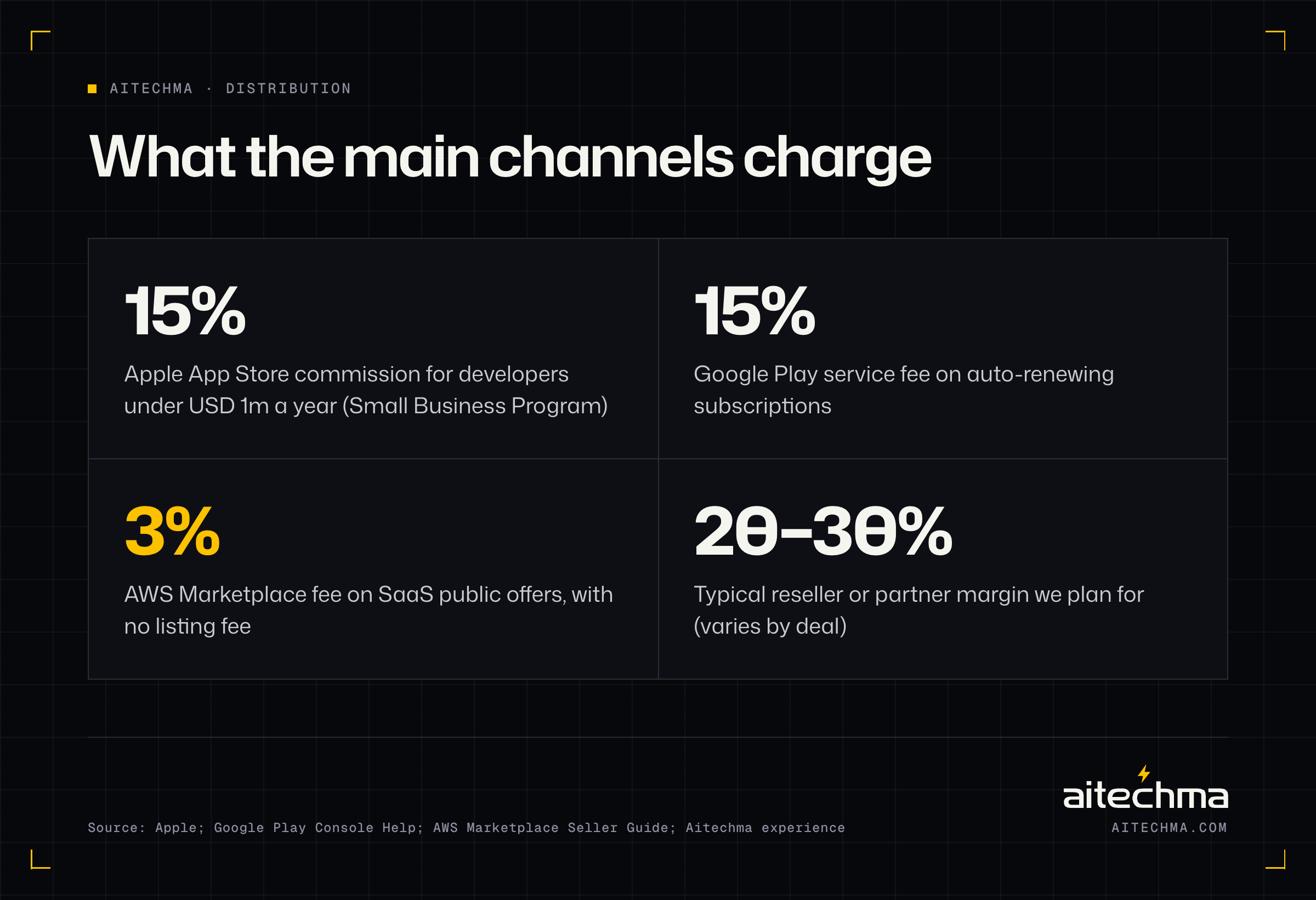
Cloud and software marketplaces let buyers purchase through accounts they already have, often from pre-approved budgets. AWS Marketplace charges no listing fee and takes 3% on SaaS public offers[10]. Microsoft, Google Cloud, Salesforce, Shopify, HubSpot and Atlassian all run marketplaces where the right product can be found by buyers already using those platforms. Marketplaces work best when your product integrates with the platform and your buyers already live there.
App stores
For consumer and mobile products, app stores are the main channel. Apple's App Store Small Business Program reduces the commission to 15% for developers earning under USD 1 million a year[11], and Google Play charges a 15% service fee on auto-renewing subscriptions[12]. App store optimisation (titles, keywords, screenshots, ratings and localised listings for each country) works like SEO inside the store.
Review sites and directories
G2, Capterra, Product Hunt, TrustRadius and industry-specific directories are where many buyers check shortlists, and they feed AI answers too. Claim your profiles, complete every field and ask happy customers to leave reviews. A dozen honest reviews can change how both buyers and AI systems describe you.
Resellers and agencies
Agencies, consultants and resellers already serve your target buyers and can bundle your product into their services. They usually expect a margin; we typically plan for 20% to 30% of revenue, depending on the deal. Resellers are especially useful for products that need setup or training, where a local partner can deliver it in the buyer's time zone.
Integration and technology partners
Companies whose products sit next to yours can refer customers, co-market and list you in their integration directories. Start with one partner whose customers match your beachhead, build a solid integration and make a joint case study.
Diaspora networks
Diaspora professional associations, alumni networks, community groups and founders abroad can open doors to first customers, partners and advisers. Approach them with something useful to offer, such as an introduction, a discount or content, not just a request.
Communities and content
Online communities where your buyers discuss their work (Slack and Discord groups, subreddits, LinkedIn groups and newsletters) can produce early customers if you contribute genuinely before you promote.
Which channels to choose
Channel | Best for | Cost | Time to first sale |
|---|---|---|---|
SEO and AEO | Most B2B and SaaS products | Content and time | 3 to 9 months to compound |
Cloud marketplaces | B2B software tied to a platform | 3% on AWS SaaS public offers[10] | 1 to 3 months after listing |
App stores | Consumer and mobile apps | Weeks, with good store optimisation | |
Review sites | B2B software in established categories | Free profiles; paid tiers optional | Weeks, once reviews arrive |
Resellers and agencies | Products needing setup or training | Revenue share | 1 to 3 months per partner |
Integration partners | Products that extend a popular tool | Engineering time | 2 to 4 months |
Diaspora networks | Products with a natural diaspora audience | Time and goodwill | Weeks |
Outbound campaign | High-value B2B deals | Tools, data and time | 4 to 12 weeks |
Step 7: Run the first-order campaign
Search and channels build a steady flow, but they take time to compound. To win the first foreign customers within three months, run a focused campaign alongside them.
Build a target list
Start with 100 to 200 organisations that fit your beachhead exactly. For each, identify the person who feels the problem and the person who signs. Use LinkedIn, industry directories, conference speaker lists and competitor review pages, where unhappy reviewers often name their company.
Write outreach that earns a reply
Gartner found that 73% of B2B buyers actively avoid suppliers who send irrelevant outreach[4]. Generic, high-volume messages will hurt your reputation in a market where you have none yet. Instead:
Reference something specific: their job posting, a review they wrote, a process they described publicly.
Name the problem in their words, using phrases from your buyer interviews.
Offer something useful before asking for time: a short audit, a benchmark, a template or a recorded walk-through.
Make the ask small: a 15-minute call or a reply, not a demo request.
Follow up three or four times over three weeks, adding something new each time.
Make it easy to say yes
Book calls in the buyer's time zone. Shift part of your team's day to cover US mornings, which fall in the Lagos afternoon.
Run demos around their problem, not your feature list.
Offer a paid pilot with a clear success measure and a short timeline. A paid pilot, even a small one, proves commitment and creates the reference you need.
Have the paperwork ready: order form, invoice, data processing agreement and security answers.
Handle the trust question directly
Some buyers will hesitate to buy from a young company based in Africa. Do not hide where you are. Address the concern with evidence: customer references, your security page, your support hours, how data is hosted and what happens to their data if they leave. Offer monthly billing at first so the risk feels small. Many buyers are reassured more by a fast, clear answer than by any credential.
Learn from every conversation
Record why prospects say yes, no or "not now". After twenty conversations, you will know whether your positioning, price and product fit the market, and what to change. Feed this back into your messaging, pricing page and roadmap every week.
The 3-month and 6-month plan
Here is the plan we use as a starting point. It assumes a product that passed the evaluation and a team that can act on feedback quickly. A first foreign order by month three and a steady, growing flow by month six are targets we plan and report against, not guarantees: they depend on the product, the price and how fast the team moves.

Weeks 1 to 2: Evaluate
Desk research, competitor teardown and five to ten buyer conversations.
Product gap review and channel check.
A written verdict and a six-month plan, or a clear "not yet" with what to fix.
Weeks 3 to 4: Position and price
One-sentence positioning, tested with buyers.
USD pricing, plans and trial decision.
A proof plan: case studies, reviews and the trust pages to write.
Weeks 5 to 8: Get ready and get found
Card billing, invoices and the payment route chosen in Step 4.
US English copy, local formats and self-serve onboarding fixes.
A market-specific website section with use-case, comparison and pricing pages.
SEO and AEO foundations: keyword plan, first content, schema markup, review site profiles.
First channel opened, such as a marketplace listing, app store listing or partner conversation.
Weeks 7 to 12: First-order campaign
Target list built and outreach running.
Demos and paid pilots offered.
Weekly review of replies, objections and conversions.
Target: a first foreign order.
Months 4 to 5: Compound
Publish content every week and build links and mentions.
Open the second channel and support the first partners.
Turn first customers into case studies and reviews.
Fix the product gaps that early customers report.
Month 6: Review and hand over
Compare results with the plan: sign-ups, pipeline, revenue, cost per customer and AI visibility.
Double down on the channels that work and stop the ones that do not.
Hand over a written playbook so your team can run it without outside help.
Target: a steady, growing flow of foreign orders.
The metrics that matter
Track a small set of numbers every week and review them together every month.
Metric | What it tells you |
|---|---|
Qualified conversations booked | Whether your message reaches the right buyers |
Trial or pilot starts | Whether buyers believe the product might solve their problem |
Activation rate | Whether the product delivers value without your team |
First orders and revenue in USD | Whether the market pays |
Sales cycle length | How long it takes to turn interest into revenue |
Cost to acquire a customer | Whether the channel is sustainable |
Organic sign-ups from the target country | Whether SEO is working |
Mentions in AI answers | Whether AEO is working |
Retention after 90 days | Whether foreign customers stay |
Avoid vanity metrics. Website traffic from the wrong country, social followers and press mentions feel good but rarely pay salaries.
What it costs and how to budget
Costs vary widely with the product and the market, but every international launch has the same budget lines. Plan for:
Evaluation and strategy. A fixed piece of work at the start, whether done in-house or with a partner.
Product changes. Billing, onboarding, localisation, integrations and trust pages. This is often the largest single cost, and it depends on how ready the product already is. Our project estimator gives a quick range for the engineering work.
Content and SEO. Writing, design and link building, usually monthly.
Tools. Keyword research, analytics, CRM, outreach and data tools, typically priced in dollars.
Channel costs. Marketplace fees, app store commissions and partner margins, all taken from revenue rather than paid up front.
Legal and tax. Terms, privacy policy, entity formation if needed and accounting advice.
Team time. Someone must own the plan. Without an owner, international expansion becomes a side project that never ships.
Paid advertising is deliberately missing from the list above. Ads can help later, once you know your buyer, message and conversion rates. Before then, they mostly buy expensive lessons.
If you are a labelled startup under the Nigeria Startup Act 2022, check the incentives available to you. The Act provides for export incentives and support for labelled startups that export qualifying products and services[18]. Ask your adviser whether your software sales abroad qualify.
Legal, tax and money: what to settle early
This section is not legal or tax advice. Use it to prepare the right questions for your lawyer and accountant.
Who is the seller? Your Nigerian company, a US entity or a merchant of record. Each has different tax and contract consequences.
Sales tax and VAT. Since the US Supreme Court's 2018 Wayfair decision, US states can require sellers without a physical presence to collect sales tax once their sales in that state pass a threshold[15]. Many states tax SaaS. In the UK and EU, VAT applies to digital services sold to consumers and, depending on the setup, to businesses. A merchant of record handles much of this for you[13].
Getting money home. Plan how foreign revenue reaches your Nigerian accounts, how much you keep in a domiciliary account, and what reporting applies.
Contracts. Which country's law governs your terms, and where disputes are settled.
Data protection. GDPR, UK GDPR and US state privacy laws, plus your obligations under the Nigeria Data Protection Act if Nigerian staff process foreign customer data.
Intellectual property. Make sure your company, not individual developers or contractors, owns the code and brand, and consider registering your trademark in the target market.
Eight mistakes that slow African startups abroad
Launching everywhere at once. A global launch with no focus produces scattered results and no learning. Pick one market and one buyer.
Converting naira prices. Foreign buyers judge your price against foreign alternatives. Converted naira prices leave money on the table and can signal low quality.
Forming a US company first. An entity does not create demand. Validate demand first unless a specific buyer, investor or payment route requires the entity now.
Copying the home playbook. WhatsApp onboarding, cash-heavy assumptions and personal sales relationships rarely translate.
Spending on ads before the message works. Paid traffic magnifies whatever the funnel already does, including its weaknesses.
Ignoring AI answers. If AI assistants describe your category without you, half of software buyers may never see you[1].
Treating the diaspora as the whole market. Diaspora customers are a great start but a limited end.
No owner. International expansion fails most often because nobody's job depends on it.
A worked example: a Lagos HR tool goes to the US
The example below is illustrative, combining patterns we see across products rather than describing a single client.
A Lagos team built an HR and shift-scheduling tool for Nigerian hospitals and clinics. It worked well at home, with steady renewals, but naira revenue was losing value every quarter.
Evaluation. Desk research showed that US home-care agencies struggle with the same problem: scheduling caregivers across many client homes, tracking hours and avoiding missed visits. They paid for software, but buyer reviews of the main tools repeatedly complained about price and complexity for small agencies. Five interviews with agency managers, two found through diaspora nurses' networks, confirmed the pain. The verdict: ready after specific fixes.
Market and positioning. The team chose US home-care agencies with 20 to 200 caregivers as the beachhead. The positioning: "Simple caregiver scheduling for small home-care agencies, set up in a day, at a price small agencies can afford."
Pricing. Instead of converting the naira price, the team priced per active caregiver per month in USD, with three plans and a 14-day free trial, below the main competitors but many times higher than the Nigerian price in dollar terms.
Product readiness. Card billing through a merchant of record, US date and time formats, a self-serve set-up wizard with sample data, a QuickBooks integration for payroll exports and a clear privacy and security page.
Get found. Use-case pages for home-care scheduling, comparison pages for the two main competitors, a free caregiver schedule template, review site profiles and an FAQ written to answer the exact questions agency owners ask AI assistants.
Channels and campaign. A list of 150 agencies in three states, personalised outreach referencing each agency's job postings for schedulers, and a partnership conversation with a home-care training consultancy. Demos ran in the Lagos afternoon to match US mornings.
Outcome pattern. In plans like this, the first paid pilot typically arrives from the outreach campaign in the third month, while organic sign-ups from the template and comparison pages start to build in months four and five. By month six, the team knows its cost per customer, its best channel and which features US agencies need next.
Questions to answer before you start
Use these to frame your first planning session, whether you run it in-house or with a partner:
Which foreign buyer has our problem most acutely, and what do they use today?
What would they pay, and what is our value metric?
What must change in the product before a foreign buyer can sign up, pay and succeed alone?
Where do these buyers search, ask, read and gather?
What do AI assistants say today when someone asks for a tool like ours?
Who on our team owns international revenue, and how much time can they give it?
What is our "not yet" signal, and when will we check for it?
Glossary
Go-to-market (GTM) strategy: the plan for how a product reaches a specific buyer in a specific market and turns into revenue.
Beachhead market: a narrow group of similar buyers you aim to win first, before expanding.
Ideal customer profile (ICP): a description of the organisation most likely to buy and succeed with your product.
Positioning: the reason a specific buyer should choose you over the alternatives.
Value metric: the unit a customer pays for that grows with the value they receive.
SEO (search engine optimisation): work that helps your pages rank in search engines.
AEO (answer engine optimisation): work that helps AI assistants describe and recommend your product accurately.
Merchant of record: a company that legally sells your product on your behalf, handling payments, tax and invoicing.
Economic nexus: a US state's rule that a remote seller must collect sales tax once sales into the state pass a threshold.
Paid pilot: a short, paid trial with agreed success measures, used to win first customers and references.
How Aitechma can help
Aitechma is a software engineering and go-to-market company in Ikeja, Lagos. Our US market entry service takes African products to buyers in the US, UK and Europe: we evaluate global potential, position and price the product in dollars, get it found through SEO and AEO, open the right distribution channels and run the first-order campaign, targeting a first foreign order within three months and a steady, growing flow by month six.
Because we are also an engineering team, we can make the product changes foreign buyers expect, from card billing to onboarding and integrations, through our SaaS development team, with a fractional CTO or fractional product manager where you need senior leadership.
Book a global potential evaluation, or get a quick estimate for the product work.
Frequently asked questions
It is the plan for how a specific product reaches a specific foreign buyer and turns into revenue: who the buyer is, what problem they pay to solve, why they should choose you, how much it costs and how they pay, and which channels bring them to you. The answers usually differ from your Nigerian go-to-market, so they need to be worked out for each market.
The US is the largest software market and pays the highest prices, so it is often the best first market for SaaS, developer tools and B2B services. The UK is smaller but English-speaking, close to Lagos time and home to a large diaspora. The EU is large but split by language and VAT rules. Choose based on where your specific buyer is easiest to reach and win.
Not always. Many startups sell to US buyers through a Nigerian company using a payment gateway that accepts international cards, or through a merchant of record that handles payments and sales tax. A US entity helps with some enterprise buyers, investors and payment partners, but it adds cost and filings. Validate demand first and take advice from an accountant before forming one.
Price against what foreign buyers pay today for competitors, agencies or staff time, and against the value your product delivers. Choose a value metric such as users or locations, offer three plans, consider annual billing and review the price after about twenty sales conversations. Do not convert your naira price.
Answer engine optimisation (AEO) is the work of getting your product described accurately and recommended by AI assistants such as ChatGPT, Gemini and Perplexity. G2 found in March 2026 that half of B2B software buyers start their research with an AI chatbot more often than with Google, so being in those answers is now one of the cheapest ways for a startup to reach foreign buyers.
For a product that passes an honest evaluation and a team that acts on feedback quickly, a first foreign order within about three months and a steady, growing flow by month six are realistic targets. They are targets, not guarantees, because results depend on the product, the price and how quickly the team moves.
Sources
- G2. In the answer economy, don't win the click: win the answer (2026)
- G2. How AI is redefining the buyer journey in 2025 and how sellers can adapt (2025)
- Semrush. How AI tools shape the B2B buying process: a survey of 600+ US business professionals (Jul 2026)
- Gartner. Gartner sales survey finds 61% of B2B buyers prefer a rep-free buying experience (25 Jun 2025)
- Ahrefs. AI Overviews reduce clicks by 34.5% (17 Apr 2025)
- Nairametrics. Nigerian-built applications hit over $1 million in sales: NOTAP (29 Jan 2026)
- Nairametrics. From Lagos to the world: 10 made-in-Nigeria tech brands scaling globally (24 Jun 2026)
- Nairametrics. Naira likely to remain under pressure in 2026: Yemi Kale (7 Jan 2026)
- Nairametrics. Diaspora remittances to Nigeria hit $20.93b in 2024 (26 Jul 2025)
- Amazon Web Services. Understanding listing fees for AWS Marketplace sellers (accessed Nov 2026)
- Apple. App Store Small Business Program (accessed Nov 2026)
- Google. Service fees (Play Console Help) (accessed Nov 2026)
- Paddle. What is a merchant of record? (accessed Nov 2026)
- Stripe. Stripe Atlas documentation (accessed Nov 2026)
- Thomson Reuters. Supreme Court abandons physical presence standard: an in-depth look at South Dakota v. Wayfair (2018)
- Google Search Central. Creating helpful, reliable, people-first content (accessed Nov 2026)
- Google Search Central. Introduction to structured data markup in Google Search (accessed Nov 2026)
- Forvis Mazars Nigeria. The Nigeria Start-up Act 2022: key provisions and incentives (2022)
Need help with us market entry?
Talk to the Aitechma team in Ikeja about your product, timeline and the fastest path to a working release.
See us market entry