
Hiring an AI Implementation Specialist in Lagos: The 2027 Guide for Nigerian Businesses
What an AI implementation expert does, what it costs in Nigeria in 2027, how to pick the first use case, stay NDPA-compliant and get AI past the pilot stage.
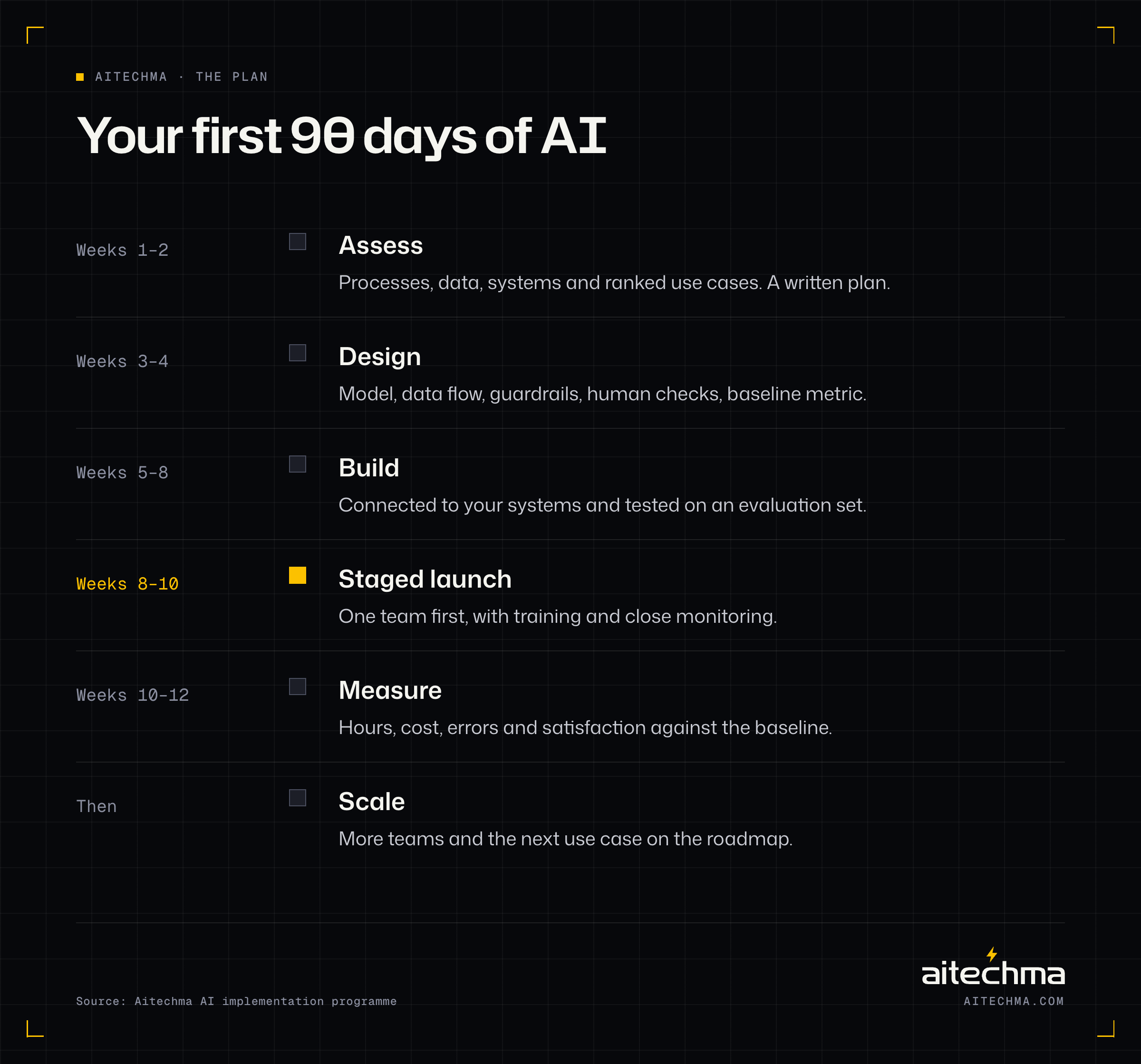
Short answer: an AI implementation specialist is the person or team that turns AI from an experiment into something your business relies on every day. They find the processes where AI saves real time or money, choose the right model and tools, connect them to your data and systems, add guardrails and human checks, train your staff and measure the result. In Lagos and across Nigeria, the businesses getting value from AI in 2027 are not the ones with the most chatbot licences. They are the ones that picked one costly, repetitive process, implemented AI properly inside it, proved the saving and then scaled. A good AI implementation expert gets a first use case into production in about 8 to 12 weeks, and from roughly USD 3,500 for a focused project, though the right budget depends on your data and systems.
This 2027 guide is for founders, managing directors, operations leads and IT heads in Lagos, Abuja, Port Harcourt and the rest of Nigeria who want AI to do measurable work, not just impress in a demo. It covers what an AI implementation specialist actually does, why most AI pilots fail, how to choose a first use case, build versus buy, data and compliance under the Nigeria Data Protection Act, costs, a 90-day plan, and how to choose the right partner. If you would rather have a team run it with you, see our AI implementation consulting service.
Why 2027 is the year AI has to start paying
Three things have changed for Nigerian businesses in the last two years.
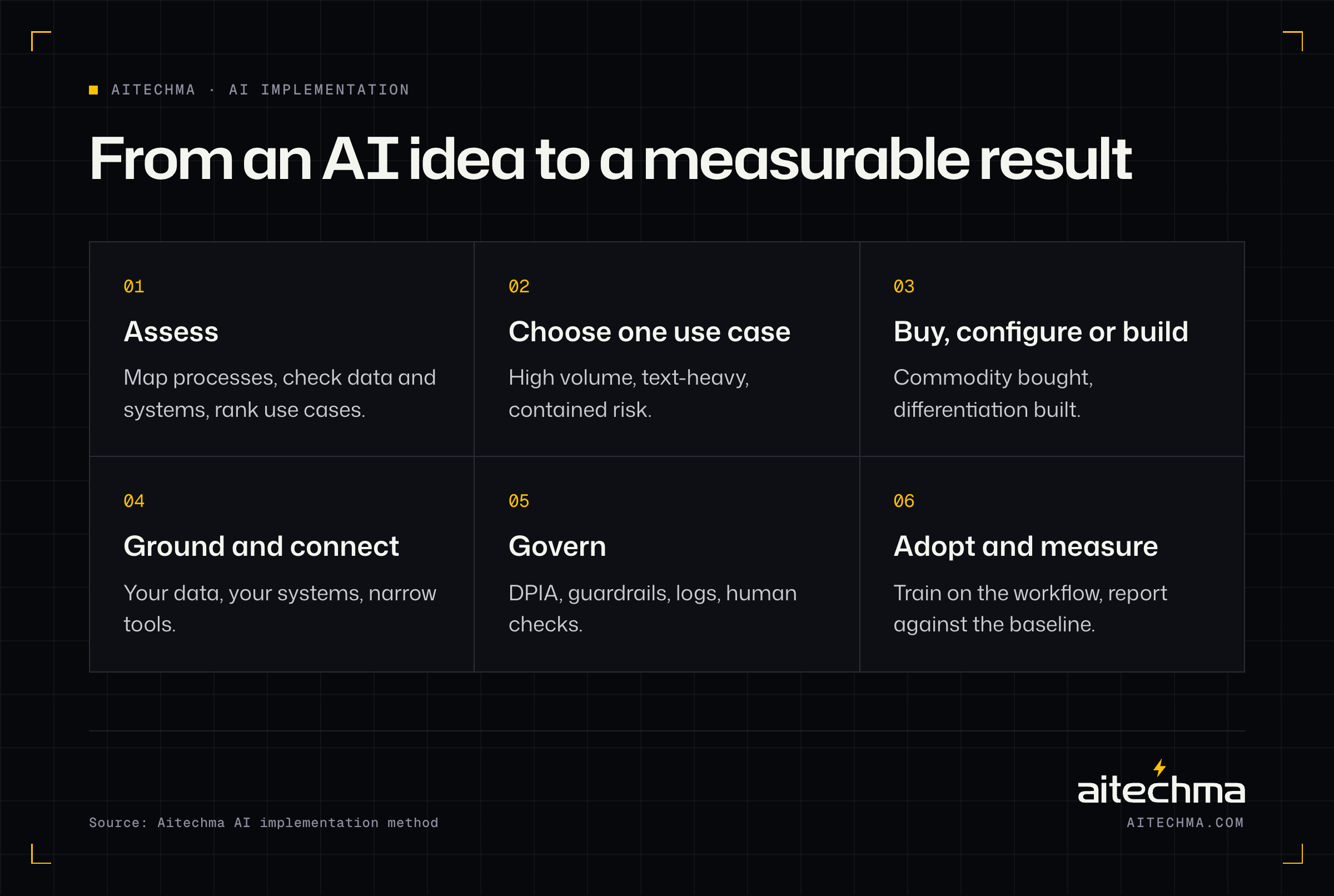
AI use is now normal, not novel. The World Bank's World Development Report 2026 put AI use among formal Nigerian firms at about 40% in 2025, up from under 5% in 2022, roughly level with firms in the United States[4]. Nigerians are also among the world's heaviest personal users of AI for work and learning[5]. Your staff are almost certainly using ChatGPT, Gemini or Claude already, whether or not there is a company policy.
Use is not the same as value. Globally, McKinsey's survey found that 88% of organisations use AI regularly in at least one business function, yet only about 39% could point to any impact on earnings, and most of those said it was under 5% of EBIT[2]. Its 2026 edition found that number essentially flat, with only about 6% of companies qualifying as "AI high performers"[3]. MIT's NANDA initiative went further: in its 2025 study, about 95% of the generative AI pilots it examined delivered no measurable impact on profit and loss[1].
The rules have arrived. Nigeria published its National Artificial Intelligence Strategy in 2025[8], and the Nigeria Data Protection Commission's General Application and Implementation Directive (GAID), in force since September 2025, sets out expectations for organisations deploying AI on personal data, including impact assessments, staged deployment and ongoing monitoring[9][10]. AI that touches customer data is now a compliance question as well as a technology one.
Put together, this means the easy phase is over. Trying AI is cheap and everyone has done it. Getting a return from AI, safely and legally, is the hard part, and it is exactly what an AI implementation specialist is for.
What an AI implementation specialist actually does
The title is used loosely, so it helps to be precise. An AI implementation specialist (or AI implementation expert, or AI implementation consultant; the terms overlap) is not primarily a researcher who trains new models. Nor is it someone who only gives strategy advice. The role sits between the two: it takes existing AI models and tools and makes them work inside a specific business.
In practice, the work covers seven areas:
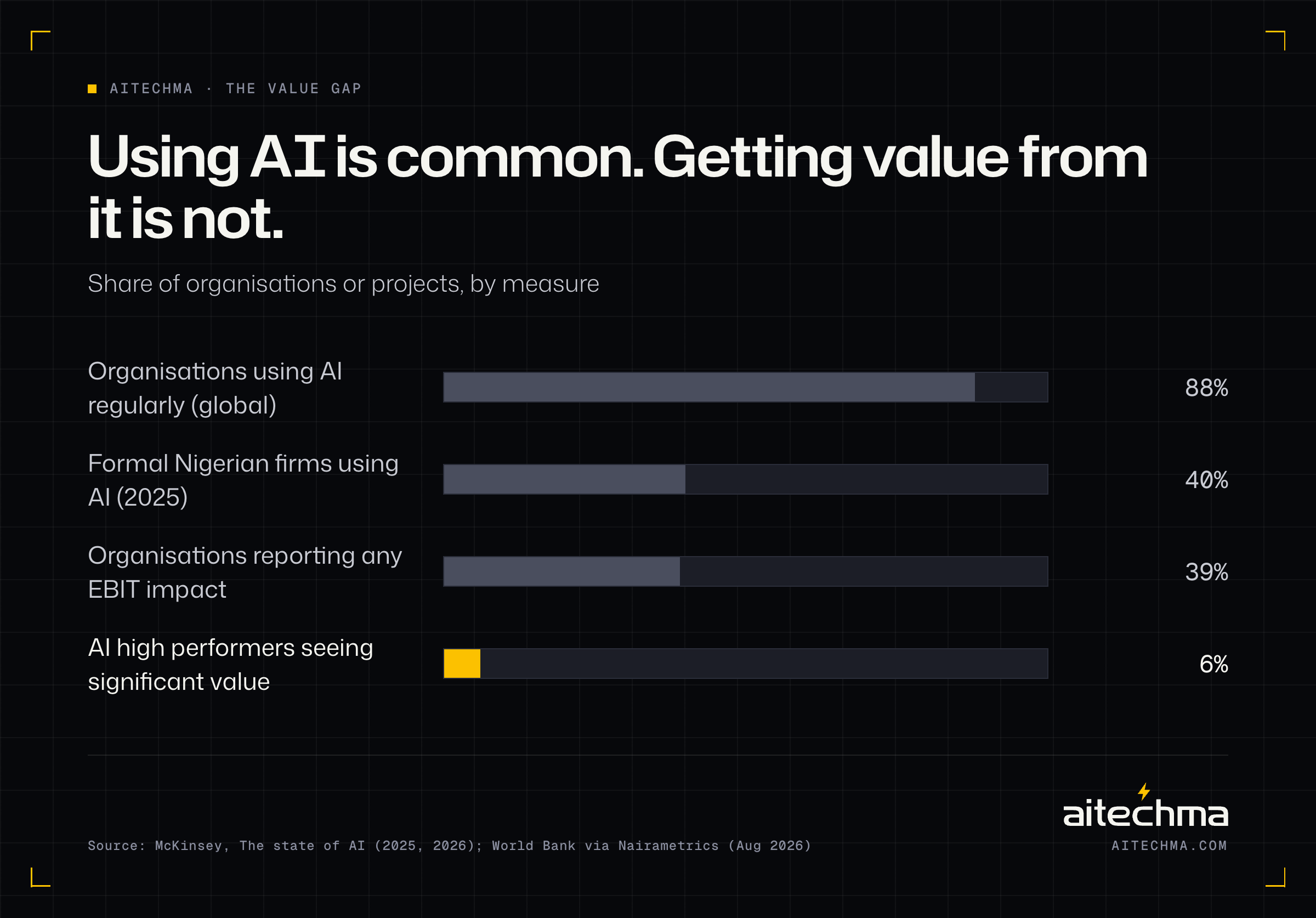
Discovery and use case selection. Mapping how work actually flows through the business, finding where time, errors and cost pile up, and ranking which of those AI can realistically improve.
Data readiness. Checking what data exists, where it lives, how clean it is, who is allowed to see it and whether it can legally be processed by an AI service.
Solution design. Choosing between off-the-shelf tools, configured platforms and custom builds; picking models; deciding how the AI gets its knowledge (retrieval from your documents, database queries, tool calls) and where people stay in the loop.
Integration and engineering. Connecting the AI to the systems your team already uses: your CRM, ERP, core banking or accounting software, email, WhatsApp, help desk and internal databases.
Guardrails and governance. Limiting what the AI can see and do, logging actions, testing it against real cases, handling failure safely and documenting it for regulators and auditors.
Adoption and training. Teaching staff to use the new workflow, redesigning roles where needed and creating internal champions.
Measurement and improvement. Setting a baseline before launch, tracking hours saved, cost, errors and customer satisfaction afterwards, and improving the system as it meets real-world cases.
A specialist who only covers the first two areas is a strategy consultant. One who only covers the third and fourth is a developer. Real implementation needs all seven, which is why it is usually delivered by a small team rather than one person.
AI implementation specialist vs data scientist vs AI engineer
Role | Main focus | When you need it |
|---|---|---|
AI implementation specialist | Making AI work inside business processes, end to end | You want measurable results from existing AI tools |
AI or ML engineer | Building and running AI systems in software | You are building AI features into a product |
Data scientist | Analysing data and building predictive models | You need forecasting, scoring or analytics |
Data engineer | Moving, cleaning and storing data reliably | Your data is scattered or unreliable |
AI strategy consultant | Vision, roadmap and investment cases | You need board-level direction before acting |
Most Nigerian businesses starting with AI in 2027 need the first role most, with access to the second and fourth when a use case demands it. Very few need to train their own model.
Why most AI projects stall
Before choosing a partner or a use case, it helps to understand why so many AI projects never get past the pilot. The research is unusually consistent on this.
Gartner predicted in 2024 that at least 30% of generative AI projects would be abandoned after proof of concept by the end of 2025, citing poor data quality, inadequate risk controls, escalating costs and unclear business value[7]. In 2025 it went further for AI agents, predicting that over 40% of agentic AI projects will be cancelled by the end of 2027 for the same reasons, and warning that many vendors are "agent washing", relabelling ordinary chatbots and automation as agents[6].
MIT's researchers found that the problem was rarely the quality of the AI models. It was how organisations used them: generic tools that did not learn from the business's own workflows, projects bolted onto processes nobody redesigned, and budgets skewed towards visible sales and marketing pilots when the biggest returns were in back-office work. They also found that buying from specialised vendors and working with partners succeeded far more often than purely internal builds[1].
In our own work in Lagos, the same patterns show up with a local flavour:
The demo trap. A vendor shows a polished chatbot on clean sample data. Connected to real customer messages in Pidgin, Yoruba-English mixes and voice notes, it falls apart.
No owner. IT thinks the business owns it; the business thinks IT owns it. The pilot ends when the champion changes jobs.
No baseline. Nobody measured how long the task took before, so nobody can prove the AI helped, and the budget is not renewed.
Data locked away. The information the AI needs is in PDFs on someone's laptop, in WhatsApp chats, or inside a core system with no API.
Compliance as an afterthought. Legal or the data protection officer hears about the project a week before launch and, reasonably, stops it.
Cost surprises. Usage-based model costs were never estimated, and the first month's bill kills the business case.
Every one of these is an implementation failure, not a technology failure. Each is avoidable with the right process, which is what the rest of this guide sets out.
Step 1: Assess your AI readiness
An honest readiness assessment is the cheapest insurance against a failed project. It answers four questions in about two weeks.
1. Where does the work actually go?
Start with process, not technology. Interview the people doing the work and map three to five core processes as they really run, not as the policy manual says. For each step, note who does it, how long it takes, how often it happens, how often it goes wrong and what it costs when it does.
You are looking for work that is:
High volume: done hundreds or thousands of times a month.
Repetitive but not identical: too varied for simple rules, which is where AI beats traditional automation.
Text, document or conversation heavy: reading, writing, classifying, summarising, extracting or answering.
Costly when slow or wrong: delayed loan decisions, missed sales leads, reconciliation errors, unhappy customers.
2. What data do you have?
For each candidate process, check what information the AI would need and where it lives. Typical sources in Nigerian businesses include core systems (banking, ERP, accounting, CRM), shared drives full of policies and contracts, email, WhatsApp Business conversations, call recordings and spreadsheets.
Rate each source on access (is there an API or export?), quality (is it current and consistent?) and sensitivity (does it contain personal data, financial data or trade secrets?). If the data an idea depends on is poor or inaccessible, either fix that first or pick a different use case.
3. What systems will it connect to?
AI is only useful when it fits into tools people already use. List the systems a use case touches and whether each one can be integrated. Modern SaaS tools usually have APIs. Older on-premise systems may need a database connection, a file export or, as a last resort, screen automation. This step often decides which use case goes first.
4. Are people and policies ready?
Check whether there is a business owner willing to own the outcome, staff who will use the new workflow, and a policy on staff use of AI tools. If staff are already pasting customer data into public chatbots (they often are), that is a risk to fix in week one, regardless of any project.
The output of the assessment should be a short written report: the processes reviewed, a ranked list of use cases, the data and integration gaps, the risks and a recommended first project with a target metric. If a partner cannot produce that before quoting a build, be cautious.
Step 2: Choose your first use case
The first use case matters more than any other because it sets the organisation's belief about whether AI works. Choose it for a high chance of measurable success, not for the most exciting demo.
Score candidates on value and effort
Score each candidate from 1 to 5 on:
Value: hours saved, cost avoided, revenue gained or risk reduced, in naira.
Feasibility: data available, systems reachable, task within current AI capability.
Risk: what happens if the AI gets it wrong, and how easily a person can catch it.
Adoption: whether the team doing the work wants help with it.
Start in the quadrant with high value, high feasibility and contained risk. Leave high-risk, customer-facing autonomy for later, once you have the governance and confidence to support it.
First use cases that work well in Nigeria
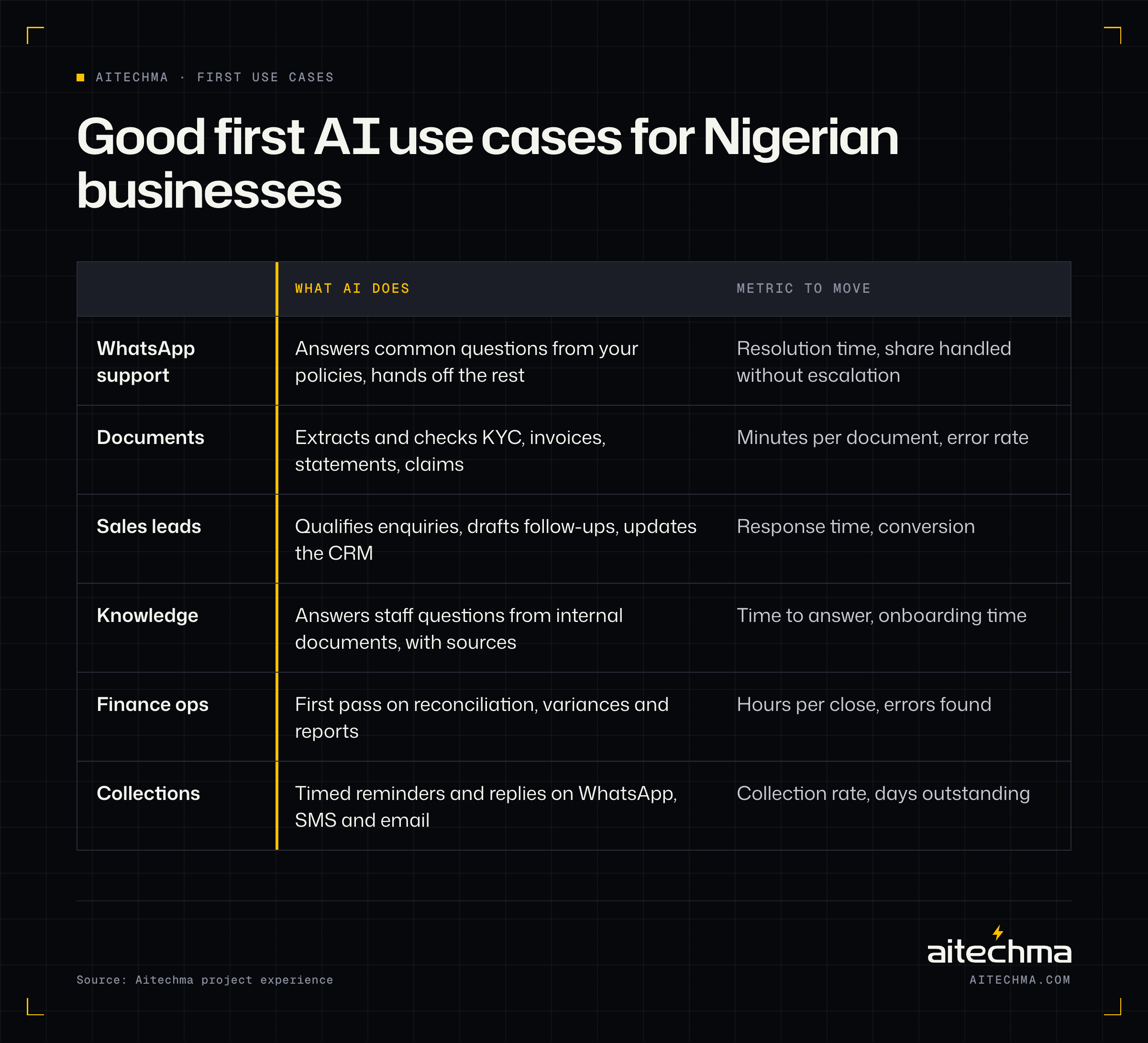
These are the use cases we see delivering measurable results fastest for Nigerian businesses in 2027:
Customer support assistant on WhatsApp and web. Most Nigerian customers prefer WhatsApp. An AI assistant grounded in your own policies and product information can answer the common questions instantly, look up order or account status, and hand complex or sensitive conversations to a person with the context already summarised. The metric is resolution time and the share of conversations handled without escalation. Our WhatsApp automation and AI agent development services cover the build.
Document processing. Loan applications, KYC documents, invoices, waybills, purchase orders, medical claims and contracts are all read and re-keyed by hand in many Lagos businesses. AI can extract the fields, check them against rules and flag exceptions for a person. The metric is processing time per document and error rate.
Sales lead qualification and follow-up. AI can read inbound enquiries, ask qualifying questions, score leads, draft follow-ups and update the CRM, so salespeople spend their time on qualified buyers. The metric is response time and conversion.
Internal knowledge assistant. Staff waste hours finding the right policy, procedure or product detail. An assistant that answers from your own documents, with citations, cuts that time and makes new staff productive faster. The metric is time to answer and onboarding time.
Reconciliation and reporting. Matching payments to invoices, explaining variances and drafting management reports are tedious and error-prone. AI with human review can do the first pass. The metric is hours per close and errors found.
Collections and reminders. Personalised, well-timed reminders over WhatsApp, SMS and email, with AI handling the common replies ("I've paid", "Can I pay next week?") and routing disputes to staff. The metric is collection rate and days outstanding.
Notice what is missing: fully autonomous agents that make decisions with no human check, and grand "AI transformation" programmes. Both have a place later. Neither is a good first project.
Step 3: Decide whether to buy, configure or build
Once you know the use case, decide how to deliver it. There are three broad options.
Option | What it means | Good for | Watch out for |
|---|---|---|---|
Buy | Use an off-the-shelf AI product as it is | Common tasks: meeting notes, writing help, generic support | Limited fit to your process; data leaves your control |
Configure | Set up a platform with your data, prompts and integrations | Most first use cases | Platform pricing and lock-in |
Build | Custom software around AI models via API | Core processes, unusual workflows, strict data rules | Needs engineering and ongoing ownership |
MIT's finding that partnerships and specialised vendors succeed more often than purely internal builds[1] is worth taking seriously, but "buy" and "build" are not opposites. Most successful implementations we see combine them: a commercial model from Anthropic, OpenAI or Google, configured tools where they fit, and a thin layer of custom software to connect it all to the business's own systems and rules.
Three principles help:
Buy commodity, build differentiation. Do not build your own meeting-notes tool. Do build the loan-review assistant that encodes your credit policy.
Stay model-agnostic. Models improve and prices drop every few months. Design so you can switch providers without rebuilding. Open standards such as the Model Context Protocol (MCP) make it easier to connect AI to your tools once and reuse those connections; see our MCP development service.
Own the important parts. Your prompts, workflow logic, evaluation tests and data pipelines should belong to you, documented, whoever builds them.
Step 4: Get your data and integrations ready
Most of the engineering effort in an AI project is not the AI. It is getting the right information to it, safely, and getting its output into the right system.
Grounding: stop the AI from making things up
Generic AI models know a lot about the world and nothing about your business. To answer accurately about your products, policies or customers, the AI needs to be given the right information at the moment it answers. The common technique is retrieval-augmented generation (RAG): your documents are indexed, the most relevant passages are retrieved for each question, and the model answers from them, with citations.
Good grounding needs clean, current source documents, a clear owner who updates them, and tests that check the AI says "I don't know" rather than inventing an answer. Many Nigerian businesses discover during this step that their policies contradict each other or are years out of date. Fixing that is valuable in its own right.
Integrations
For AI to act, not just answer, it needs controlled access to your systems through tools: look up an account, create a ticket, update a CRM record, schedule a delivery. Each tool should do one narrow thing, require the minimum permissions, and log every call. For sensitive actions, such as refunds, credit decisions or changes to customer records, the AI drafts and a person approves.
Older systems without APIs are common in Nigerian banks, insurers, hospitals and manufacturers. Options include read-only database replicas, scheduled exports, a small integration service in front of the legacy system or, rarely, robotic process automation. A good AI implementation expert will tell you honestly which of these is realistic for your systems and what each costs.
Local language and channel realities
Nigerian customers write in English, Pidgin, Yoruba, Igbo, Hausa and every mix in between, often in voice notes. Test candidate models on real, anonymised samples of your own customer messages before committing. Leading commercial models handle Nigerian English and Pidgin reasonably well in our experience; quality in Yoruba, Igbo and Hausa varies more by model and task. Plan for human handover where understanding is uncertain.
Connectivity and power also matter. Design for retries, offline queues and graceful failure, and make sure staff can keep working if the AI service is unavailable.
Step 5: Build in compliance and governance from day one
AI governance sounds like a large-company concern, but in Nigeria it now applies to any business processing personal data with AI. Getting it right early is far cheaper than retrofitting it.
The Nigeria Data Protection Act and GAID
The Nigeria Data Protection Act 2023 sets the core rules: a lawful basis for processing, purpose limitation, data minimisation, security, data subject rights and conditions for transferring personal data outside Nigeria[11]. The NDPC's GAID, which replaced the old NDPR framework, adds detail for emerging technologies including AI. Commentators highlight expectations of data protection impact assessments (DPIAs) before deploying AI on personal data, staged deployment and continuous monitoring, alongside rules on cross-border transfers and data protection officers[9][10].
In practice, for an AI implementation that touches personal data, plan to:
Run a DPIA before launch, describing the data, purpose, risks and controls.
Minimise data sent to AI models. Strip or mask identifiers the task does not need.
Check cross-border transfers. Most AI models run on servers outside Nigeria. Confirm the legal basis for the transfer and the provider's contractual protections.
Use enterprise terms that commit the provider not to train on your data and to delete it within a set period.
Tell people when they are talking to an AI and give them a route to a human.
Log and monitor what the AI sees and does, and review a sample of interactions regularly.
This is general guidance, not legal advice. Take advice from your data protection officer or counsel for your specific case.
Sector rules
Banks, payment companies, lenders and other CBN-regulated firms face additional requirements on data residency, outsourcing and model risk. If you are in fintech, read our CBN data localisation playbook before choosing where AI workloads and data will run; our fintech data localisation service covers the architecture. Insurers, healthcare providers and telecoms have their own regulators and expectations.
National direction
Nigeria's National AI Strategy sets out the government's goals for AI development, adoption and governance over 2025 to 2029[8], and observers expect more specific AI regulation to follow[13]. You do not need to wait for it, but building with transparency, human oversight and documentation now means you will not have to rebuild when it arrives.
An internal AI policy
Every business using AI should have a short policy covering which tools staff may use for work, what data may never be pasted into them, how AI output must be checked, and who to ask. Surveys suggest Nigerian organisations already spend heavily on privacy protection[12]; a one-page AI policy is one of the cheapest controls you can add.
Step 6: Pilot properly, then launch in stages
A good pilot is designed to produce a clear decision, not to run forever.
Set the baseline first
Before the AI is switched on, measure the current process: average handling time, volume, error rate, cost per case, customer satisfaction or whatever the use case should move. Without a baseline, you cannot prove value, and projects without proven value lose their budget.
Build an evaluation set
Collect 100 to 300 real, anonymised examples of the task with the correct outcome. Run every version of the AI against this set before it reaches users, and again after every change to prompts, models or data. This is the single practice that most separates professional AI implementation from hobby projects, and it is how you catch regressions before customers do.
Launch to one team, with people in the loop
Start with one team, branch or customer segment. Keep a person reviewing AI output at first, then reduce review as accuracy is proven, case type by case type. Gartner's advice on agentic AI is the same: pursue autonomy only where it delivers clear value and risk is controlled[6].
Decide with data
At the end of the pilot, compare against the baseline and decide: scale, adjust or stop. Stopping a use case that does not pay is a success of the process, not a failure. It frees budget for one that will.
Step 7: Drive adoption and measure the return
The most common reason a working AI system fails is that people do not use it, or use it badly.
Train for the workflow, not the tool
Generic "introduction to AI" sessions have their place, but adoption comes from training on the new workflow: here is how a loan file now arrives, what the AI has already checked, what you must verify, and how to flag a mistake. Short, hands-on sessions with the actual system work far better than slides. Our AI automation training is built around this.
Name champions
Pick one or two respected people on each team to become the go-to users. Give them a direct line to the implementation team and a role in deciding improvements. They will find problems and opportunities faster than any dashboard.
Measure what the business cares about
Track a small number of metrics tied to money:
Metric | Example |
|---|---|
Time saved | Hours per week no longer spent on the task |
Cost per case | Cost per document processed or ticket resolved |
Speed | Customer response time, loan decision time |
Quality | Error rate, rework, compliance exceptions |
Revenue | Lead conversion, collections, upsell |
Satisfaction | Customer and staff ratings |
Running cost | Model, hosting and maintenance per month |
Report them monthly to the business owner. Convert time saved into naira honestly: saved hours only become savings if they are redeployed to valuable work or reduce overtime, outsourcing or hiring.
What AI implementation costs in Nigeria in 2027
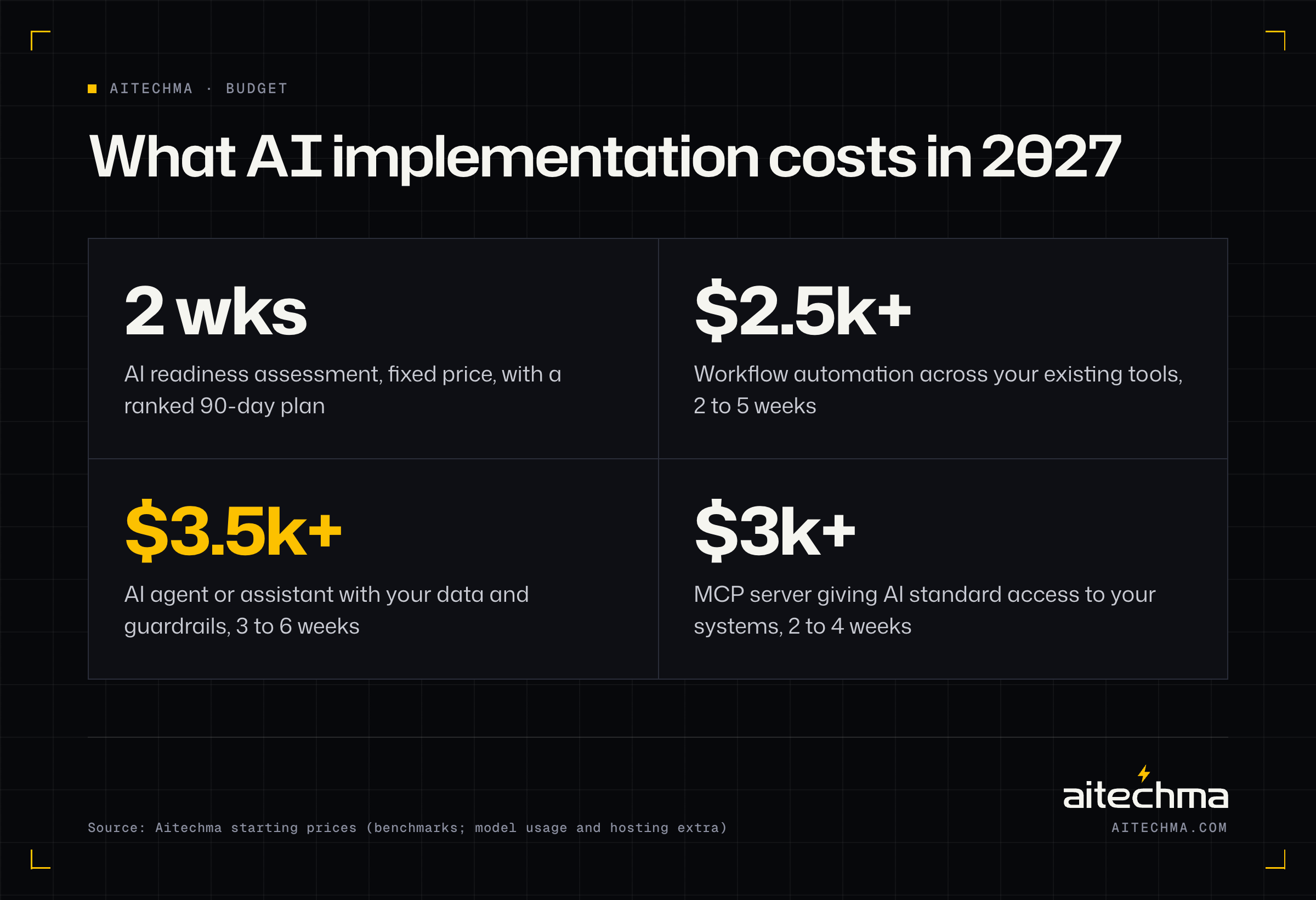
Costs vary widely with scope, data and systems, but the structure is predictable. The figures below are the starting points we quote at Aitechma; they are benchmarks to plan against, not fixed prices.
Engagement | Typical scope | Starting point | Timeline |
|---|---|---|---|
AI readiness assessment | Process mapping, data check, ranked use cases, 90-day plan | Fixed price, quoted after a first call | 2 weeks |
Workflow automation | AI-assisted process across existing tools, with human review | From about USD 2,500 | 2 to 5 weeks |
AI agent or assistant | One job, your knowledge base, 2 to 3 integrations, guardrails, evaluation set | From about USD 3,500 | 3 to 6 weeks |
MCP server for internal tools | Standard AI access to your product or systems | From about USD 3,000 | 2 to 4 weeks |
Ongoing AI programme | Roadmap, multiple use cases, governance, training | Monthly retainer | 6 to 12 months |
On top of build costs, budget for:
Model usage. Charged by the AI provider per amount of text processed. For many business use cases it is modest, but high-volume customer channels can add up. A good partner estimates the monthly figure before you commit, and designs to keep it low by using smaller models for simple steps.
Hosting and tools. Vector databases, servers, monitoring and any platform licences.
Maintenance. Updating content, adding cases to the evaluation set, adapting to model updates and improving accuracy. Plan for a few days a month per live use case.
Your team's time. A business owner and subject experts need to be available for discovery, testing and training.
Paying in naira for foreign AI services adds currency risk. Where possible, pick a model and architecture where running costs are small relative to the value created, and review them quarterly. For a rough figure on a specific project, our project estimator gives a range in minutes.
In-house team, freelancer or AI implementation partner?
Nigerian businesses have three realistic ways to get AI implementation expertise.
Option | Strengths | Weaknesses | Best when |
|---|---|---|---|
Hire in-house | Deep knowledge of your business, long-term ownership | Hard to hire, one person rarely covers all seven areas, slow to start | AI is core to your product and you will run many use cases |
Freelance specialist | Low cost, flexible | Single point of failure, often strong in only one area, limited support | A small, well-defined task |
Implementation partner | Full team from day one, proven process, faster results | Higher day rate, needs a good handover | Getting first use cases live and building internal capability |
Many companies combine them: a partner delivers the first two or three use cases and trains internal staff, who then take over day-to-day ownership while the partner stays on call. If you are building an internal team, our guide to hiring software engineers in Nigeria covers sourcing and vetting, and our fractional CTO service can provide senior technical leadership while you hire.
How to choose an AI implementation expert in Lagos
The AI consulting market in Lagos has grown fast, and quality varies. These questions separate experienced implementers from rebranded agencies and trainers.
"Show me something you built that is in production now." Ask for a live system with real users, not a demo or a slide. Ask what it does, how many people use it and what it changed.
"How will we measure success?" Expect a specific metric, a baseline and a target, agreed before the build.
"What happens when the AI is wrong?" Look for evaluation sets, guardrails, human review and logging, not "the model is very accurate".
"How do you handle our data and the NDPA?" They should talk about DPIAs, minimisation, cross-border transfer and provider terms without prompting.
"Which model will you use, and can we switch?" Good partners are model-agnostic and explain the trade-offs.
"Who will actually do the work?" Meet the engineers, not only the sales lead.
"What will it cost to run each month?" They should estimate model and hosting costs before you sign.
"What do we own at the end?" Prompts, code, workflows, evaluation sets, documentation and accounts should all be yours.
"What would you not use AI for here?" An honest expert will tell you where simple software, a process change or nothing at all is the better answer.
Red flags include guaranteed accuracy figures, a refusal to show working systems, pressure to start with a large "transformation" programme, vague answers on data, and proposals that are mostly licences for a single vendor's platform.
A worked example: a Lagos lender automates loan document checks
To make this concrete, here is a composite example based on the kind of work we see in Lagos fintech. The figures are illustrative.
The situation. A digital lender in Lagos receives around 3,000 loan applications a month. Each needs a bank statement analysed, an ID checked and employment details verified. A team of six analysts spends most of its time reading PDFs and re-keying figures. Decisions take two to three days, and applicants drop off.
Assessment (2 weeks). Process mapping shows that about 60% of analyst time goes on reading and extracting statement data, and that most delays come from queues, not judgement. Statement PDFs vary by bank but are machine-readable. The core lending system has an API. Data includes personal and financial information, so a DPIA and CBN considerations are in scope.
Use case. AI extracts income, regular obligations and red flags from bank statements, pre-fills the credit file and writes a short summary for the analyst, who makes the decision. No automated credit decisions.
Build (6 weeks). Document extraction tuned on a few hundred anonymised statements from the main Nigerian banks, a rules layer for the lender's credit policy, integration with the lending system, and an analyst review screen. Personal identifiers are masked before any data reaches the model, and the model provider's enterprise terms prohibit training on the data. An evaluation set of 250 statements is used to test every change.
Launch (4 weeks). One analyst pair uses it first, reviewing every field. After two weeks of matching accuracy on the evaluation set, review moves to exceptions only for well-performing banks.
Result. In this example, analyst time per application falls from about 40 minutes to about 12, decision time from two to three days to the same day, and the team handles growth without new hires. The lender's next use case, AI-assisted collections on WhatsApp, reuses the same integrations and governance.
The lesson is not the specific numbers. It is the sequence: a costly, high-volume process, clear data, contained risk, a human in the loop, a baseline and a measured result.
Ten mistakes to avoid
Starting with a tool instead of a problem. "We need a chatbot" is not a use case.
Choosing the flashiest use case first. Fully autonomous customer-facing agents are a poor first project.
Skipping the baseline. No baseline means no proof, which means no budget.
Ignoring data quality. AI amplifies messy or outdated information.
Leaving compliance to the end. Bring in your DPO in week one.
No evaluation set. Without tests, every change is a gamble.
Underestimating running costs. Estimate model usage before you build.
Locking into one vendor. Keep the ability to switch models and platforms.
Training on the tool, not the workflow. Adoption depends on the new way of working.
No owner. Every live AI system needs a named business owner and a technical owner.
Questions to answer before you start
Use this checklist in your first internal discussion or with any partner:
Which process costs us the most time, money or customer goodwill today?
How will we know, in numbers, that AI improved it?
What data does it need, where is that data, and can we legally use it this way?
Which systems must it connect to, and do they have APIs?
What happens if the AI makes a mistake, and who catches it?
Who in the business owns the outcome?
What is our budget for the build and for monthly running costs?
What is our policy on staff using public AI tools today?
What would make us stop this project?
If you can answer most of these, you are ready for a first use case. If not, a readiness assessment will answer them for you.
Glossary
AI agent: an AI system that can take actions through tools (look up data, update records, send messages), not only answer questions.
AI implementation specialist: a professional or team that takes AI from idea to reliable daily use inside a business, covering use cases, data, integration, governance, training and measurement.
DPIA: data protection impact assessment, a structured review of the privacy risks of processing personal data and the controls in place.
Evaluation set: a collection of real examples with known correct outcomes, used to test an AI system before and after every change.
GAID: the General Application and Implementation Directive issued by the Nigeria Data Protection Commission under the Nigeria Data Protection Act 2023.
Grounding / RAG: giving the AI relevant information from your own documents or data at the moment it answers, so it responds from facts rather than guesses.
Human in the loop: a design where a person reviews or approves AI output before it takes effect.
MCP (Model Context Protocol): an open standard for connecting AI models to tools and data sources in a consistent way.
NDPA: the Nigeria Data Protection Act 2023, Nigeria's primary data protection law.
How Aitechma can help
Aitechma is an AI implementation partner based in Ikeja, Lagos. Our AI implementation specialists work with Nigerian businesses and international companies to find where AI pays, build it into real systems with guardrails and human checks, train teams and measure the results. We start with a readiness assessment and a written plan, deliver a first use case in production within about 90 days, and design every system for the NDPA, the NDPC's GAID and, where relevant, CBN rules. Our engineers build AI agents, WhatsApp automation, document processing and integrations with the systems you already run, using whichever model fits the job, and everything we build belongs to you.
If you want to know where AI can make a measurable difference in your business, see our AI implementation consulting service or book a call. We will tell you honestly where AI can pay, where it cannot yet, and what the first step should be.
Frequently asked questions
An AI implementation specialist turns AI from an experiment into something a business relies on. They find the processes where AI saves time or money, choose models and tools, connect them to the company's data and systems, add guardrails and human checks, train staff and measure the result. The role sits between strategy consulting and software engineering.
At Aitechma, a readiness assessment is fixed-price and quoted after a first call, workflow automation starts from about USD 2,500 and a focused AI agent or assistant from about USD 3,500, with timelines of 2 to 6 weeks for the build. Model usage, hosting and maintenance are extra, and a good partner estimates them before you commit.
Research from MIT, Gartner and McKinsey points to the same causes: no clear business value or baseline, poor data, weak risk controls, rising costs and generic tools that are not fitted to the business's real workflows. These are implementation problems rather than limits of the AI models, which is why process, data and governance work matters more than the choice of model.
Pick a high-volume, repetitive, text- or document-heavy process where mistakes are easy for a person to catch: customer support on WhatsApp, document processing such as KYC or invoices, lead qualification, an internal knowledge assistant, reconciliation or collections. Avoid fully autonomous, customer-facing decisions as a first project.
Yes, if it complies with the Nigeria Data Protection Act 2023 and the NDPC's General Application and Implementation Directive. In practice that means a lawful basis, a data protection impact assessment, data minimisation, checks on transferring data to AI providers abroad, enterprise terms that prevent training on your data, transparency with customers and ongoing monitoring. Take legal advice for your specific case.
If AI is core to your product and you will run many use cases, build an in-house team over time. To get the first use cases live quickly and safely, a partner with a full team and a proven process is usually faster. Many companies combine the two: a partner delivers the first projects and trains internal staff who then take over.
A readiness assessment takes about two weeks. A first use case usually goes from design to a measured result in 8 to 12 weeks: design, build, a staged launch to one team and a comparison with the baseline. Scaling to more teams and use cases follows once the first one has proven its value.
Sources
- Fortune. MIT report: 95% of generative AI pilots at companies are failing (18 Aug 2025)
- McKinsey. The state of AI in 2025: agents, innovation, and transformation (2025)
- McKinsey. The state of AI in 2026: on the road to ROI (2026)
- Nairametrics. World Bank: AI adoption among Nigerian firms jumps to 40%, matching US levels (4 Aug 2026)
- Nairametrics. Nigeria leads global AI adoption for learning and work: report (21 Jan 2026)
- Gartner. Gartner predicts over 40% of agentic AI projects will be canceled by end of 2027 (25 Jun 2025)
- Gartner. Gartner predicts 30% of generative AI projects will be abandoned after proof of concept by end of 2025 (29 Jul 2024)
- NCAIR / NITDA. National Artificial Intelligence Strategy (Sep 2025)
- DLA Piper. Nigeria: NDPC issues GAID, key compliance insights (Jun 2025)
- Mondaq. GAID 2025 unpacked (series II): data protection officers, mandatory consents and emerging technologies (2025)
- DLA Piper. Data protection laws of the world: Nigeria (accessed Nov 2026)
- Nairametrics. Nigerian firms invest over 30% of IT budgets in privacy protection: report (8 Sep 2025)
- IAPP. Nigeria moves toward comprehensive AI regulation (accessed Nov 2026)
Need help with ai implementation?
Talk to the Aitechma team in Ikeja about your product, timeline and the fastest path to a working release.
See ai implementation